Watch What You Post on Social Media [Infographic] | Jobvite #recruiting #socialmedia


Heads up, Job Seekers: Data from our Social Recruiting Survey makes it clear that recruiters are inspecting your profiles, posts, and tweets. Are you broadcasting something that turns employers off?

Take a look at our new infographic below to learn what types of posts recruiters consider to be red flags. You’ll also see where they’re most likely to look you up, and what profile details matter most. via Jobvite Infographic: Watch What You Post on Social Media.

The 5 Biases Pushing Women Out of STEM | HBR


Emotional Intelligence Predicts Job Success: Do You Have It? | Fast Company


Daniel Goleman, the psychologist who coined the term emotional intelligence, talked to the Huffington Post about the many characteristics of emotional intelligence. Lets go over a few here, so that we can know what to train in. READ MORE: Emotional Intelligence Predicts Job Success: Do You Have It? | Fast Company | Business + Innovation.

You may also like:

So you wanna be a data scientist? A guide to 2015’s hottest profession | Mashable


Are you good at math? Like, really good at math? Do you also know Python and, oh yeah, have deep knowledge of a particular industry?

On the off chance that you possess this agglomeration of skills, you might have what it takes to be a data scientist. If so, these are good times. LinkedIn just voted “statistical analysis and data mining” the top skill that got people hired in 2014.

Glassdoor reports that the average salary for a data scientist is $118,709 versus $64,537 for a programmer. A McKinsey study predicts that by 2018, the U.S. could face a shortage of 140,000 to 190,000 “people with deep analytic skills” as well as 1.5 million “managers and analysts with the know-how to use the analysis of big data to make effective decisions.” READ MORE: So you wanna be a data scientist? A guide to 2015s hottest profession | Mashable

My Brief and Curious Life As a Mechanical Turk | Gizmodo


As accomplished as modern-day computers are, there are some very basic things even the smartest machines have yet to master: tough judgment calls, advanced image recognition, making goofy faces, conducting psychological surveys. These are an assortment of tasks we humans can still claim as our own. Or at least, that we can outsource to other, less fortunate humans. Like me.

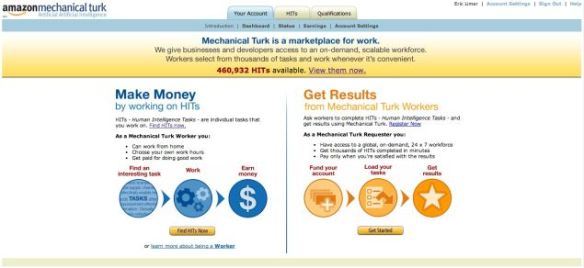
In Amazons words, Mechanical Turk is “a marketplace for work that requires human intelligence.” But in reality its even simpler than that description implies: Its a job board where the pay is low and the jobs are dumb. If you have a functional cerebral cortex, an internet connection, and a few minutes to spare, you can pick up a handful of odd jobs—the oddest of jobs—and make a few bucks, pennies, and nickels at a time. But whats it like to be that “human intelligence?” As I found out last year, its weird, fascinating, perplexing, and a little depressing, all at once.

READ MORE:  My Brief and Curious Life As a Mechanical Turk | Gizmodo

How to Make Yourself Work When You Just Don’t Want To | Harvard Business Review


There’s that project you’ve left on the backburner – the one with the deadline that’s growing uncomfortably near.  And there’s the client whose phone call you really should return – the one that does nothing but complain and eat up your valuable time.  Wait, weren’t you going to try to go to the gym more often this year?

Can you imagine how much less guilt, stress, and frustration you would feel if you could somehow just make yourself do the things you don’t want to do when you are actually supposed to do them?  Not to mention how much happier and more effective you would be?

The good news and its very good news is that you can get better about not putting things off, if you use the right strategy.  Figuring out which strategy to use depends on why you are procrastinating in the first place…

READ MORE: How to Make Yourself Work When You Just Don’t Want To | HBR

Discoverables: Web Service for Skill Discovery | Spark+Mettle


Discoverables. A website that helps young people identify, develop and showcase their key strengths and soft skills to potential employers or investors, progressive organisations and freelancers, instead of posting job descriptions, can discover raw talent through us.

Read More: Discoverables | Spark+Mettle

Women in Data Science Are Invisible. We Can Change That | WIRED


READ: Women in Data Science Are Invisible. We Can Change That | WIRED

Study: Children With Mentors Find Happier, More Fulfilling Careers | Fast Company


While most of the evidence has been largely anecdotal, the idea that a mentor can help guide you along a better path in life is hard to argue against. Now, a large study from North Carolina State University seems to support the claim that, yes, having a mentor at a young age can lead to better, more-fulfilling employment later on.

READ MORE: Study: Children With Mentors Find Happier, More Fulfilling Careers | Fast Company | Business + Innovation.

What I Learned From My Internship at Twitter | Information Space


This past April, between the demands of a packed schedule and midterm season, I secured my dream internship: a chance to work at Twitter in their San Francisco headquarters.

READ MORE: What I Learned From My Internship at Twitter | Information Space