How to Opt Out of Data Tracking on Your Most-Used Sites | Mashable


Google’s latest updates to its terms of service have left many privacy advocates crying foul. One new feature called “shared endorsements” allows your name and photograph to be used in targeted advertisements on Google property sites.

Google’s support page for shared endorsements claims the feature will allow for more friend-based recommendation of music and restaurants, working much like Facebook’s Sponsored Stories.

Shared endorsements are not unique. Many sites, apps and browsers are using your information in ways you might not entirely comply with if you’d take the time to read their privacy policies. Often, opting out is only a click away, though it may be difficult to find out where exactly to click.

We’ve compiled this list of ways various Internet companies are tracking and using your data — plus, given you the tools to opt out, if you wish.

Reviews how to opt out for:

  • Targeted Advertisements
  • Search History
  • Disable Third-Party Cookie Tracking

Read: How to Opt Out of Data Tracking on Your Most-Used Sites | Mashable

Related:
30 Library Stories You May Have Missed in October | Ellyssa Kroski | OEDB.org


October was chock-full of library-related articles and blog posts which were both educational and entertaining.  My two favorite resources for the month would have to be the article illustrating 37 Ways To Proudly Wear Your Love Of Books,  as well as the informative and thought-provoking article by Brian Mathews,  Seven things to think about as wearable computing emerges.  Here are all 30 of the library stories you may have missed out on last month.

Read: 30 Library Stories You May Have Missed in October | Ellyssa Kroski | OEDB.org.

How The Informational Interview Helps You Get The Job | Fast Company


People get jobs through connections. If you don’t have any, make them. And then ask yourself these five questions to prep.

Read: How The Informational Interview Helps You Get The Job | Fast Company | Business + Innovation.

A guide for the informational interview.

This Tech-Enabled Thermometer Tracks More Than Just A Fever | Co.Design


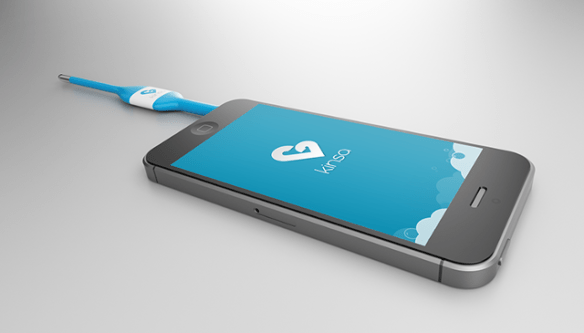
Kinsa wants to change how we glean information about our health, starting with the world’s most common medical device.

Quotable: “There’s a bigger picture: Like the Scanadu Scout, Kinsa is part of a larger tapestry of data companies, fitness wearables, and health gadgets that want to empower us to start owning our own data. Sensors give us on-demand insights into our health, whereas a doctor’s office means tests and a wait time for a phone call.”

Read: This Tech-Enabled Thermometer Tracks More Than Just A Fever | Co.Design | business + design.


This Tech-Enabled Thermometer Tracks More Than Just A Fever | Co.Design | business + design


Keep Your Precious Data Safe by Storing Passwords in Your Subconscious | Gizmodo


Do you ever fear that, one day, data-hungry bandits will tie you to a chair and make you surrender your Facebook password? It’s not an unreasonable fear, actually. Christopher Nolan made a gripping documentary about this very scenario. But, thanks to a new method developed by scientists from Stanford and Northwestern, you may never have to worry about remembering a password ever again.

The technique depends on so-called “procedural memories,” the things stored in your brain that you access unconsciously. For example, you ride a bike or play a guitar without thinking about it. These memories are actually stored deep in the part of your brain that handles motor control and habit-forming, as opposed to explicit memories which are stored in the frontal cortex, among other places. However, you can train yourself to access procedural memories when you need them.

Read More: Keep Your Precious Data Safe by Storing Passwords in Your Subconscious | Gizmodo.

How to Erase Yourself From the Internet | Gizmodo


If your growing weariness of being constantly tethered to the Internet has become overwhelming, it might be time to scrub yourself from the social media sphere altogether. Here’s how you can become a ghost on the Internet, by tracking down and eliminating your digital past.

Read: How to Erase Yourself From the Internet | Gizmodo.

Provides instructions for how to remove/deactivate accounts for Facebook, Twitter, LinkedIn, and Google+. Recommends other tools including Account Killer, Just Delete Me and Knowem.

Recent Pew Research Links


Broadband Adoption: The Next Mile | Statement of Aaron Smith (Senior Researcher, Pew Research) | Pew Internet

The New Library Patron from Pew Research Center’s Internet & American Life Project
Lee Rainie, Director of the Pew Research Center’s Internet & American Life Project, will discuss the Project’s new research about library patrons and non-patrons: who they are, what their information needs are, what kind of technology they use, and how libraries can meet the varying needs of their patrons.

Photo and Video Sharing Grow Online | Pew Internet
A new study by the Pew Research Center’s Internet Project shows that 54% of internet users have posted original photos or videos to websites and 47% share photos or videos they found elsewhere online. Also: AFP: Smart phones boost photo, video sharing: study and from TIME: One Stat that Explains Why Instagram Is Adding Ads.

Tablet and E-reader Ownership Update | Pew Internet
The number of Americans ages 16 and older who own tablet computers has grown to 35%, and the share who have e-reading devices like Kindles and Nooks has grown to 24%. Overall, the number of people who have a tablet or an e-book reader among those 16 and older now stands at 43%.

1 in 7 Americans is offline. Why? It’s complicated | Kathryn Zickuhr, Pew Research | CNBC

Pew Data on News Consumption: Millennials Lead the Shift to Web Use | ContentBlogger

Mobile Health in Context: How Information is Woven Into Our Lives from Pew Research Center’s Internet & American Life Project

Climb Your Family Tree With These Online Genealogy Tools | Gizmodo


The questions of who we are and where we came from can often be answered, not by looking inward, but by looking backward. While nature and nurture certainly play the primary roles in our development as individuals, it’s only through the study of one’s ancestry that we develop a more complete view of ourselves as how we fit into the larger scope of human history. Luckily, tracing one’s roots is easier than ever thanks to the Internet.

The following web services are discussed:

  • Family Search
  • US Gen Web
  • Ancestry
  • World Vital Records
  • DistantCousin

via Climb Your Family Tree With These Online Genealogy Tools | Gizmodo.

Digital Kids: how children are using devices, apps and media in 2013 | theguardian.com


A day-long liveblog covering the latest research, trends and views on childrens changing media habits…blending research links, videos, infographics and snapshots of previous Guardian coverage on children’s changing media habits, as well as some first-hand views from kids.

Includes clinks to media literacy reports, charts, survey results, etc.

Sample of the topics/questions:

  • Can Minecraft create the next generation of quantum scientists?
  • Question: where to start teaching my kids to code?
  • What do tablets do to children’s developing minds?

Read: Digital Kids: how children are using devices, apps and media in 2013 | Technology | theguardian.com.

Library Catalog Cards For Classic Books | HuffPost Books


For many of us, a trip to the library these days involves an efficient search on the branch’s site, a hold placed on a hot new release, and a quick pop-in to collect our spoils.

It’s great that so many libraries have gone digital — and some have even gone bookless— because to remain open, remaining relevant is key. Still, it’s hard not to pine for the more quixotic days of dusty shelves and hand-written library catalog cards.

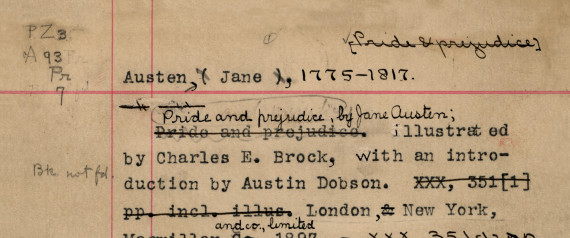
For those of us who romanticize a more tactile library experience, Chronicle Books has created stationary from images of The Library of Congress’s original cards for a number of classic authors. The text of each card interestingly matches the mood often evoked when imagining the author’s era.

See all: Library Catalog Cards For Classic Books (IMAGES) | HuffPost Books

30 Notecards from the Library of Congress | Chronicle Books

Jane Austen