A Search Engine For The Internet Of Things | Fast Company | Business + Innovation


“A little-known search engine which indexes information on computers attached to the internet is increasingly leaving itself open to be used by hackers as fears about cyber attacks an American infrastructure and banking systems heighten.” via A Search Engine For The Internet Of Things | Fast Company | Business + Innovation.

Shodan

You may also like:

The cloud is fundamental to the Internet of Things | TechRepublic | The Modern MLIS

Collection of Links: Resources for Learning to Code


Update (August 30, 2015): Coding resources available on the Internet are listed here.

I began learning to code more than a decade ago during my undergraduate days at university sitting in a darkened room in front of a SunSystem computer running Unix. I programmed in C++ and Java for endless hours. I never complained about my biology and math labs and tutorials again after taking a computer science class! I did not realize at the time how useful I would find this skill in future years. During my Masters, which I completed in 2012, I learned to program in HTML/XHTML and CSS from the ground up, although I had prior knowledge from building my own websites. Now my next goals are to learn to code PHP and APIs. I not only want to learn these languages to bolster my resume but to learn more about the fundamentals of Internet and mobile architecture. How they are connected. I think learning to code is a great way to learn how to solve problems.

I find it surprising how popular coding is becoming, especially in libraries. Although now with the morphing of hackerspaces and makerspaces in libraries maybe its not so surprising. Librarians are known for being pioneers in education, learning and collaborative efforts after all. We can now even learn a programming language by attending a conference session – the 2013 ALA Conference in June will be presenting a LITA Pre-conference Introductory Python Workshop2012 was known as Code Year. With this push for awareness and education of coding there are now numerous resources one can use to learn abut coding and how to code. Here are a few of them:

Literacy

Learning to Code

APIs/Apps

Collection of Links: SEO and Libraries


Libraries can leverage SEO as another avenue to investigate in confirming their importance to communities and increasing visibility of their services. Here are some useful links.

Book publishers blast Amazon’s plan to control domain names | Internet & Media – CNET News


“Two industry groups argue that the retailer’s plan to control several generic top-level domains, including .book, .author, and .read, would be anti-competitive.”

via Book publishers blast Amazon’s plan to control domain names | Internet & Media – CNET News.

Mashable | Free Database of the Entire Web May Spawn the Next Google


Common Crawl, and subsequent spin off projects, is an organization I believe librarians should be following closely. It would be great for library and information service professionals to be involved with some of these projects. I could also see the government and educational institutions providing funding for research proposals analyzing some of the data.

“A nonprofit called Common Crawl is now using its own web crawler and making a giant copy of the web that it makes accessible to anyone. The organization offers up more than 5 billion web pages, available for free so that researchers and entrepreneurs can try things otherwise possible only for those with access to resources on the scale of Google’s.”

via Mashable | Free Database of the Entire Web May Spawn the Next Google.

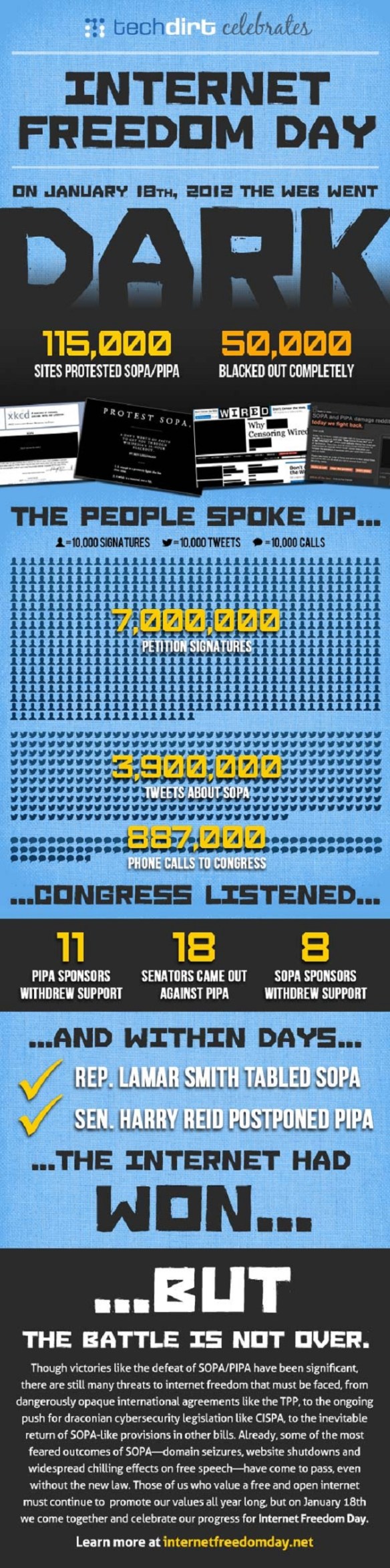
One Year After SOPA Blackout, Activists Celebrate ‘Internet Freedom Day’ | News & Opinion | PCMag.com


Today marks the one-year anniversary of the Internet blackout in protest of SOPA and PIPA, and in celebration, Internet activists have dubbed it “Internet Freedom Day.” via One Year After SOPA Blackout, Activists Celebrate ‘Internet Freedom Day’ | News & Opinion | PCMag.com.

You may also like:

What is Internet Freedom Day? | Mashable
Celebrating Internet Freedom Day: When the Internet Met Copyright | Michael Geist
A year after the Blackout: Where do we stand post-SOPA? | Information Space

Gizmodo | Scientists Confirm That Blocking Pirate Sites Does Absolutely Nothing


“A team of scientists have finally bothered to do a study, crunch the numbers, and come to the same conclusion as everyone else – blocking pirate sites does nothing to stop piracy.”

via Scientists Confirm That Blocking Pirate Sites Does Absolutely Nothing | Gizmodo.

Information Space | RockMelt: A Social Web Browser


“…a browser designed with the social media lover in mind: RockMelt.”

via Information Space | RockMelt: A Social Web Browser.

Pew Research | Senior Citizens and Digital Technology


Pew Internet & American Life Project Senior Citizens and Digital Technology  Presentation