A Beautifully Simple Comic Book for the Blind | Wired Design | Wired.com


Braille has come a long way since its invention in the 19th century, but it’s still tough to apply it to the highly-visual storytelling we see in comics. This realization led Phillipp Meyer, a Copenhagen-based interaction designer, to create the first comic for the blind.

Simple, recognizable shapes paired with a contextual title and a simple narrative flow was enough for readers to glean a basic understanding of a story. From there, the reader’s imagination is in charge.

For the full story see: A Beautifully Simple Comic Book for the Blind | Wired Design | Wired.com.
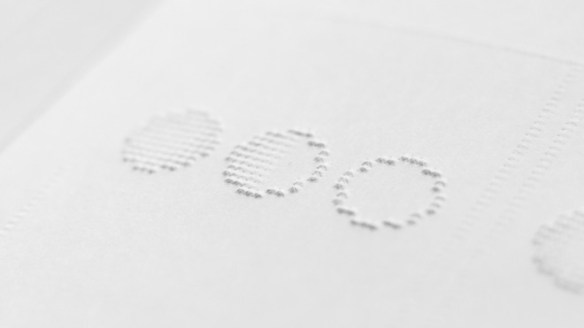
Braille Comic

10 Fun Ways to Feed Your Mind this Summer | Ellyssa Kroski – OEDB.org


10 Fun Ways to Feed Your Mind this Summer | Ellyssa Kroski – OEDB.org.

These include:

  1. Learn a new language
  2. Register for a MOOC
  3. Watch Videos from Recent Conferences
  4. Create an Awesome Summer Reading List
  5. Play an Educational Game
  6. Learn how to play an instrument
  7. Listen to Some Smart Podcasts
  8. Download Free Audiobooks
  9. Install Educational Apps on Your Tablet
  10. Read Free eBooks

See the article for the full discussion.

The Case for Preserving the Pleasure of Deep Reading | MindShift


Recent research in cognitive science, psychology and neuroscience has demonstrated that deep reading—slow, immersive, rich in sensory detail and emotional and moral complexity—is a distinctive experience, different in kind from the mere decoding of words. 

For the full article see: The Case for Preserving the Pleasure of Deep Reading | MindShift.

Recent Pew Research Links


Teens, Social Media, and Privacy by Mary Madden, Amanda Lenhart, Sandra Cortesi, Urs Gasser, Maeve Duggan, Aaron Smith | Pew Internet & American Life Project

Parents, Children, Libraries, and Reading by Carolyn Miller, Kathryn Zickuhr, Lee Rainie and Kristen Purcell | Pew Internet & American Life Project

Related:

Greatest Hits from Pew Internet’s Library Research from Pew Research Center’s Internet & American Life Project

Tech trends and library services in the digital age from Pew Research Center’s Internet & American Life Project and also Pew: Tech trends and library services in the digital age | Stephen’s Lighthouse

Pew – Public’s Knowledge of Science and Technology | Stephen’s Lighthouse

Brandon Zarzyczny: My Dad And His 10,496 Book Reviews | Huffington Post Books


“He originally bought most of the books he read, and the attic is still filled with boxes of old books, however for the past 15-20 years he’s mostly loaned the books from the library. My Dad loved our local library, the James V Brown Library, where all of the librarians knew his name, and he would leave there with a bag full of books about once a week. For the past year or two, he’d also tried reading ebooks on a Tablet I bought for him for Christmas, and while he loved downloading all of the free indie Kindle books he could get his hands on, he still preferred a good hardcover book.” See full article here: Brandon Zarzyczny: My Dad And His 10,496 Book Reviews | Huffington Post Books.

What a great story! I too keep track of the books I have read within both a database called Bookpedia (print) and Calibre (digital) on my Mac (now I’m thinking I should combine them into one). Not with as much detailed information as Mr. Craig Zarzyczny though! I also used to post reviews to GoodReads, LibraryThing and ChaptersIndigo Community. Reviewing was taking the enjoyment out of reading, so I slowed down around 2 years ago.

The Age | Don’t pop a pill, read a book


I have to say reading…and even re-reading some of my favourite novels (many thanks Georgette Heyer)…got me through one of the most difficult periods in my life. I think this is a great program for a library to pilot. I do not hold the opinion that books replace medication though – for some people, in some situations, its necessary. As always, talk to your doctor first!

“Using books as therapy or bibliotherapy as it is known, is not a new idea. Sigmund Freud used literature during psychoanalysis sessions with his patients and books were used to help soldiers recovering from physical and emotional trauma following the First and Second World Wars. Now reading as therapy is set to enjoy a resurgence. In May, a new pilot program, Books on Prescription, will launch in libraries across the Central West area of New South Wales.”

via Don’t pop a pill, read a book | The Age.

Collection of Links: For the Typeface and Font Lovers…


Google Type – Random Google images become characters for a typeface.

Next Gen OCR Project Reaches Back into Early English History and Databases via The Digital Shift

This Font Made Of DNA Isn’t Just For Kicks via Co.Design | FastCompany

8 Typefaces Designed to Serve a Greater Purpose. Fonts to help dyslexia, proofreading and saving the planet…

Oyster Raises $3M From Founders Fund To Finally Create An Unlimited Subscription Service For Books | TechCrunch


Oyster Raises $3M From Founders Fund To Finally Create An Unlimited Subscription Service For [e]Books | TechCrunch.

The Data-Driven, 21st-Century ‘Choose Your Own Adventure’ – Betsy Morais – The Atlantic


“Flexibility is the guiding principle at Coliloquy: narrative structure, process, and format are all up for adjustment with every new title, and every last reader. A choose-your-own-adventure model* for the data-tracking age, its books are designed with multiple “pathways” that lead stories down divergent plotlines. The choices that readers make are logged, anonymously, for analysis by Coliloquy’s team and the authors themselves.”

via The Data-Driven, 21st-Century ‘Choose Your Own Adventure’ – Betsy Morais – The Atlantic.

BBC News – The man who turned his home into a public library


BBC News – The man who turned his home into a public library.