
What motivates us at work? 7 fascinating studies that give insights – Stephen’s Lighthouse
Tag Archives: research
Research Publications at Facebook
Helping a billion people share requires innovation. At Facebook, we solve technical problems no one else has seen because no one else has built a social network of this size. Working at the intersection of research and engineering to make the world more open and connected is one of the best things about being at Facebook right now.
via Research Publications at Facebook.
Here is just a sample of some of research article titles:
- Self-censorship on Facebook
- Gender, Topic, and Audience Response: An Analysis of User-Generated Content on Facebook
- The Role of Social Networks in Information Diffusion
You may also like:
Check Out Facebook’s Nerdy Library Of Its Research Papers | TechCrunch
The Big Library Read Experiment | Sourcebooks.com
A unique pilot program to research book discovery and generate data on libraries supporting authors.
Sourcebooks and OverDrive are partnering on a pilot program that will allow library patrons worldwide the opportunity to read New York Times bestselling author Michael Malone’s acclaimed novel “The Four Corners of the Sky” in ebook format. The Big Library Read is a no cost program in which libraries worldwide promote from their lending catalog a single ebook to their patrons. In addition to creating a global “library book club,” it’s designed to generate data about the positive exposure and sales influence library ebook catalogs provide to authors and publishers. See the full article at Library eBooks: The Role of Libraries in the Book Discovery Process | Sourcebooks.com.
You may also like:
OverDrive and Sourcebooks to Launch Ambitious Ebook Data Experiment | The Digital Shift
What is Text Mining? | Information Space
Text-mining programs go further, categorizing information, making links between otherwise unconnected documents and providing visual maps via What is Text Mining? | Information Space.
Text mining, or the indexing of content, is important because it allows us to make sense and extract meaning out of large amounts of data. Text-mining is an activity also related to data curation, the semantic web, big data and bioinformatics. Its becoming more popular as a way to conduct research and information retrieval within databases.
Here is an informative presentation called The Library as Dataset: Text Mining at Million-Book Scale from Yale University, which discusses a text mining method, digital humanities and libraries.
Here is an article with an information science perspective called Text Mining and Information Retrieval, Canadian Journal of Information and Library Science, 2011, 35(3), pp. 223-227, if you have access to scholarly databases.
Digital Data Finds an Ancient Abode in DNA | Information Space
In 2012, scientists achieved an engineering feat which combined billions of years of development by nature and the next generation of bio-engineering, opening the gate to a new frontier of bleeding edge data storage technology.
This new data storage solution is encoding DNA to store digital data that can hold millions of gigabytes of data for thousands of years without any power. Researchers, since then, have sought means to code DNA like a data storage device and the results of these works have been nothing short of ground-breaking. After all, DNA is nature’s storage device, replicating and propagating genetic code over thousands of generations.
via Digital Data Finds an Ancient Abode in DNA | Information Space
Are Ambitious People Happier? | Fast Company | Business + Innovation
From what the researchers found, ambition had clear causes and effects on lives as they grew into maturity via Are Ambitious People Happier? | Fast Company | Business + Innovation.
You may also like:
Relationships Are More Important Than Ambition | The Atlantic
The conflict between career ambition and relationships lies at the heart of many of our current cultural debates…Ambition drives people forward; relationships and community, by imposing limits, hold people back. Which is more important?
Digital Public Library Of America (DPLA) Launches To Public | Mashable
“After two and a half years of planning, the Digital Public Library of America (DPLA), the U.S.’s first public online-only library, opened its doors today — or at least was made publicly available on the Internet.
The DPLA is a free, open-source resource that makes a number of digital collections and archives across the country available in one place. It launched as a series of partnerships with the Smithsonian, the National Archives, New York Public Library, the University of Virginia, Harvard, Digital Library of Georgia, Minnesota Digital Library, Mountain West Digital Library and others. All of the text, photos, videos and audio contained in the DPLA can be searched, or browsed by place or time on the DPLA website” via Digital Public Library Of America (DPLA) Launches To Public | Mashable.
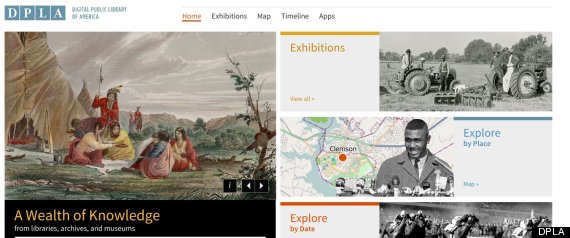
Vision of the DPLA Website:
The vision of a national digital library has been circulating among librarians, scholars, educators, and private industry representatives since the early 1990s. Efforts led by a range of organizations, including the Library of Congress, HathiTrust, and the Internet Archive, have successfully built resources that provide books, images, historic records, and audiovisual materials to anyone with Internet access. Many universities, public libraries, and other public-spirited organizations have digitized materials, but these digital collections often exist in silos. The DPLA brings these different viewpoints, experiences, and collections together in a single platform and portal, providing open and coherent access to our society’s digitized cultural heritage.
You may also like:
What is the DPLA? by John Palfrey | The Digital Shift
Quotable: “There are two key points about what the DPLA “is,” at least as of April 2013. First, the DPLA will be what we, the people, decide to make of it, as a shared, public-spirited resource. Second, the DPLA is the community of people who have devoted themselves (ourselves, in fact) to pursuing an ambitious, public-spirited vision of what the future might hold. On day one, we will present a radically open platform that will make a lot of exciting material available more broadly, as well as a lot of code and services with which technologists can do interesting things.”
How the Crowd Is Solving an 800-Year-Old Mystery – Karim R. Lakhani and Kevin J. Boudreau – Harvard Business Review
“Consider the case of Dr. Albert Yu-Min Lin, Research Scientist at University of California San Diego and a National Geographic Society Emerging Explorer. He turned the field of archaeology on its head by engaging more than 28,000 individuals around the world to help him solve one of the most enigmatic problems in history — locating the tomb of Genghis Khan.”
Researcher’s Corner: Reference Competencies from the Academic Employers’ Perspective | Hiring Librarians
Quotable: “One of the best ways for aspiring reference librarians to succeed in the job market is to have a clear understanding of job expectations, to develop the necessary skills and proficiencies, and be able to demonstrate and discuss those abilities on their resume and in job interviews. In this column, I share the results of a survey of academic reference librarians indicating what skills and knowledge they believe is important in the field right now.”
 infophile