Mind-Boggling Spherical Gear Made from 3D-Printed Moving Parts | Gizmodo


New York-based Proxy Design Studio has given Gizmodo a first glimpse of its incredible, 3D-printed spherical gear called the Mechaneu, equal parts tactile toy and mechanical sculpture, a mind-bogglingly precise intermeshing of wheels within wheels.

Read: Mind-Boggling Spherical Gear Made from 3D-Printed Moving Parts | Gizmodo

Finally, a Digital Library of Bizarre Human Bones From the Middle Ages | Gizmodo


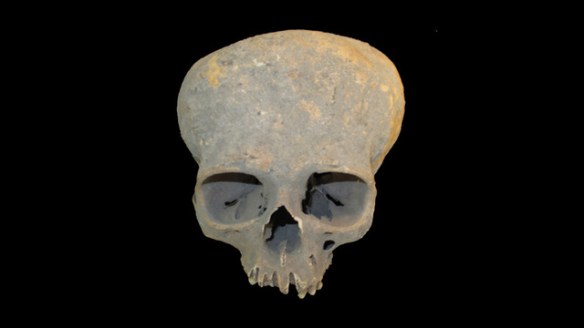
skull from Chichester

A spinal column with fused vertebrae. The bones of a woman with advanced syphilis. Skeletons deformed by rickets and leprosy. A fascinating online library of deformed bones from the Middle Ages goes live today—and while I didn’t even realize such a thing existed, now I can’t imagine living without it. God bless technology.

The Digit[ised] Diseases website is run by the Royal College of Surgeons in London. It brings together 3D scans of over 1,600 bone specimens taken from patients with debilitating and disfiguring conditions like rickets and leprosy, and makes them free for the public to browse. Bored on a Monday morning? Gawk at this deformed spinal column or marvel at this alien-like skull with an enlarged cranium. In the scientists’ own words, “it does not resemble any known hominid species.” Cool!

Read:  Finally, a Digital Library of Bizarre Human Bones From the Middle Ages | Gizmodo

Readworthy: Education & Technology, Librarianship


Education & Technology

Librarianship

Lithium-Ion Batteries, Straight from a 3-D Printer | MIT Technology Review


By making the basic building blocks of batteries out of ink, Harvard materials scientist Jennifer Lewis is laying the groundwork for lithium-ion batteries and other high-performing electronics that can be produced with 3-D printers. Although the technology is still at an early stage, the ability to print batteries and other electronics could make it possible to manufacture new kinds of devices.

Read: Lithium-Ion Batteries, Straight from a 3-D Printer | MIT Technology Review.

Canada’s parks and historic sites now on Google Street View | CBC News


Google/Parks Canada

The Google Maps team visited Banff National Park and about 70 other Parks Canada sites this past spring and summer, collecting imagery using its Street View cars and on foot using its Trekker backpack technology. (Google/Parks Canada)

Hikes through spectacular national parks such as Banff and tours of historic sites such as the Viking settlement at L’anse au Meadows in Newfoundland are now available on Google Street View.

Google and Parks Canada announced today that more than 70 Parks Canada locations across the country can now be explored online.

“From planning a summer vacation to augmenting classroom lesson plans, the partnership between Parks Canada and Google will better connect Canadians to the amazing places and geography that defines this country,” wrote Parks Canada’s Michael White on the Google Canada blog.

Read: Canada’s parks and historic sites now on Google Street View | Technology & Science | CBC News.

A Girl Who Codes | Fast Company


A Girl Who Codes | Fast Company | Business + Innovation

Computing has always been a boys’ club. How 18-year-old nikita rau–and other young women like her–are finally changing that.

Read: A Girl Who Codes | Fast Company | Business + Innovation.

What Neuroscience Says About The Link Between Creativity And Madness | Co.Design


The idea that very creative people are also a little crazy has been around since humanity’s earliest days. In ancient Greece, Plato noted the eccentricities of poets and playwrights, and Aristotle saw that some creative types were also depressives. In modern times, that connection has persisted, from Robert Schumann hearing voices guide his music to Sylvia Plath sticking her head in an oven to Van Gogh cutting off his ear to Michael Jackson … being Michael Jackson.

Today the link between creativity and mental illness is firmly embedded in the public conscience. Unlike some supposed cultural wisdoms, however, there’s a good bit of scientific evidence behind this one. Behavioral and brain researchers have found a number of strong if indirect ties between an original mind and a troubled one (many summarized in a recent post by psychologist Scott Barry Kaufman at his Scientific American blog).

Read: What Neuroscience Says About The Link Between Creativity And Madness | Co.Design | business + design.

Facebook Launches Open Academy To Give Kids College Credit For Open Source Contributions | TechCrunch


A perfect GPA isn’t cool. You know what’s cool? Advancing an open source project. To help computer science students prepare for jobs (and boost its own recruiting efforts) Facebook today publicly launched Open Academy. The partnership with premier CS universities sets up a special class where students get college credit for contributing to open source projects.

Read: Facebook Launches Open Academy To Give Kids College Credit For Open Source Contributions | TechCrunch.

Data Science: More Than Mining [Infographic] | Visual.ly

Image


Data Science: More Than Mining

Circle of Life: The Beautiful New Way to Visualize Biological Data | Wired Science


Krzywinski developed Circos, an open source visualization tool that arranges tabular data in circular form. It was a simple idea, but transformative: It’s since been used for thousands of visualizations, and its distinctive aesthetic is synonymous with the informational richness of our moment.

Read: Circle of Life: The Beautiful New Way to Visualize Biological Data | Wired Science

For more on Martin Krzywinski’s science art take a look at his website.

Circle of Life: The Beautiful New Way to Visualize Biological Data - Wired Science