Russian President Vladimir Putin is not f*cking around.
The president signed a new law on Monday that will prohibit cursing in music, books, movies and at entertainment events throughout the country as of July 1. Existing books, CDs and hard copies of movies that contain curse words provide a warning label about the obscene language. Anyone who breaks the law is subject to a fine.
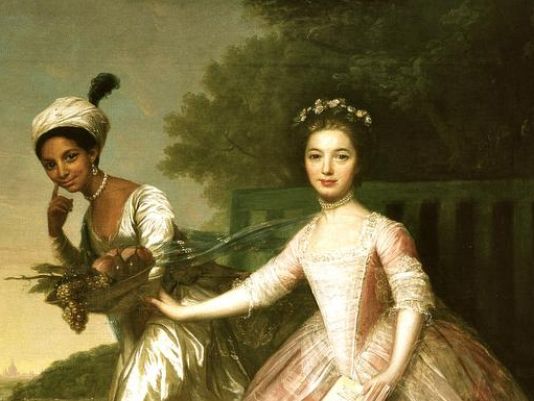
Wandering the grand halls of Scone Palace in Scotland you might stumble on a pretty portrait of two beautiful women in 18th-century clothes, seemingly affectionate sisters. Not so unusual — except one of the “sisters” is black.
Who is that, you might well wonder, as did Misan Sagay, then a young British college student of Nigerian descent, long accustomed to being the only black face in most British rooms. She stopped short upon spotting the painting while touring the palace near her university.
“I was stunned. And taken aback,” says Sagay, now in her 40s and a screenwriter (Their Eyes Were Watching God). The castle brochure named only the white woman in the portrait, Lady Elizabeth Murray. When she returned a few years later, Sagay says, there was more information on the label, naming the black woman as Dido, “the housekeeper’s daughter.”
“So the silent black woman had a name,” says Sagay. “But I looked at the portrait and the way they were touching, and thought, ‘I don’t buy this. There is more to this than meets the eye.’ ”
Indeed there was. Sagay dove into drafty palace archives to learn more, and years later the result is Belle, written on spec by Sagay, directed by Amma Asante, a British woman of Ghananian descent, and starring Gugu Mbatha-Raw,a British woman of South African descent.
Humans are clever: what sets us apart from the rest of the creatures on the planet is our ability to think about the world around us—and shape it. But in making all the technological advances that seems so smart, are we making the world better, or just different?
This video takes a pretty lofty view of that poser. Considering ideas like super intelligence, super longevity and super well being, it asks some pretty fundamental questions about whether those kinds of technological accomplishments are actually a good thing or not. What do you think? via Can Technology Ever Make Us Truly Happy? | Gizmodo
Many investors say they invest in people, not ideas. Everyone has great ideas, but not everyone has the right mix of intelligence, resourcefulness and determination to execute the idea.
Enter Pave, an impact-investing site that need not be compared to Kickstarter or Indiegogo. Pave is a platform where individuals can back young people’s careers (the average funding goal is $27,000). The idea isn’t new — patrons and angel investors have been around for a while — but the technological tactics are new, and the platform helps to level the playing for people with big ideas and passion to match. The site launched in December 2012 and has 4,500 prospects and 1,700 backers to date.
Pave prides itself on people, not projects, and the setup enables investors to back someonebased on aligned interests, such as business, education and environment. It’s not a traditional loan, and it’s not a donation — the point isn’t for the prospect to pay the investor back quickly. The financial backing is a way for established individuals to help young, ambitious people build sustainable careers and projects over the next 10 years — and the prospects can spend money how they see fit. Backers earn financial returns for supporting successful prospects, and they often evolve into mentors for the prospect, though that’s not written into the funding agreement.
The questions of who we are and where we came from can often be answered, not by looking inward, but by looking backward. While nature and nurture certainly play the primary roles in our development as individuals, it’s only through the study of one’s ancestry that we develop a more complete view of ourselves as how we fit into the larger scope of human history. Luckily, tracing one’s roots is easier than ever thanks to the Internet.
One year ago, Abha Dawesar was living in blacked-out Manhattan post-Sandy, scrounging for power to connect. As a novelist, she was struck by this metaphor: Have our lives now become fixated on the drive to digitally connect, while we miss out on what’s real?
As visuals go, it’s not the most mind-blowing advertisement you’ve ever seen–but the image of two consecutive blank pages of the New York Times, purchased to promote Fox’s upcoming film The Book Thief, is striking nonetheless.
As Web companies and government agencies analyze ever more information about our lives, it’s tempting to respond by passing new privacy laws or creating mechanisms that pay us for our data. Instead, we need a civic solution, because democracy is at risk.
Snip: “When all citizens demand their rights but are unaware of their responsibilities, the political questions that have defined democratic life over centuries—How should we live together? What is in the public interest, and how do I balance my own interest with it?—are subsumed into legal, economic, or administrative domains. “The political” and “the public” no longer register as domains at all; laws, markets, and technologies displace debate and contestation as preferred, less messy solutions.
But a democracy without engaged citizens doesn’t sound much like a democracy—and might not survive as one.”



 infophile