High-Tech Glove Could Help the Deaf-Blind Send Text Messages | Mashable


In German-speaking countries, deaf-blind people use a “tactile alphabet” called Lorm to communicate with one another, which involves a series of motions on the hand.

The problem with Lorm, though, is that few people understand it. This means that people who are both deaf and blind are often limited to communicating with others who understand Lorm.

But a new technology aims to help them communicate more easily with people who don’t understand Lorm. Researchers in Berlin are developing the Mobile Lorm Glove, with which deaf-blind people can transmit Lorm to text on a computer or mobile device.

READ MORE: High-tech glove could help the deaf-blind send text messages | Mashable

Further Thoughts On Tech Roles + Librarianship | LITA Blog


Given the overwhelming response to Bryan’s post, “What is a Librarian?” and Michael’s follow up post, “Librarians: We Open Access,” a few more of the LITA bloggers thought we’d weigh in on our roles and how they fit within the profession. READ MORE: Further Thoughts On Tech Roles + Librarianship | LITA Blog.

30 Useful Apps For Students You Probably Don’t Know About | InformED


The number of college students taking at least one online course has nearly doubled over the past five years according to a report by market research agency Refuel.

Online students are often faced with the challenge of juggling their academic responsibilities alongside families or full-time jobs, which is certainly no easy task.

Technology can help students better manage their learning by providing everything from study aids and research tools to time-management apps, so it’s somewhat surprising to learn that few students are actually using such tools for learning purposes.

The majority of students use online and mobile apps primarily for entertainment according to the Refuel report, with over 70% using them for games, 67% using them for music, and 64% using them for social networking.

If you want to encourage your students to start taking advantage of the many technology tools available to them, here are a few examples of the types of productivity and learning apps that can support them in their studies.

SEE THE LIST OF TOOLS: 30 Useful Apps For Students You Probably Don’t Know About | InformED

Projection Mapping Brings an Ancient Greek Statue to Life | WIRED


PURISTS WILL SCOFF, but we could be nearing a future where new technologies make art museums come to life. Not hyperbolically, in the sense that virtual reality displays and touchscreen tablets let you interact with art in new ways (we’re already seeing that in spades, thanks to smart renovations at places like the Cleveland Museum of Art and the new Cooper Hewitt.)

This is more literal. In this near-future, works of art might actually register facial expressions. They might blink, or look right at you. READ MORE: Projection Mapping Brings an Ancient Greek Statue to Life | WIRED.

3D printing produces a perfect replica of a sixth-century sword | CNET


A damaged sixth-century sword in a museum in Norway has been perfectly reproduced as new through 3D printing.

READ MORE: 3D printing produces a perfect replica of a sixth-century sword | CNET.

10 Breakthrough Technologies 2015 | MIT Technology Review


Introduction: Not all breakthroughs are created equal. Some arrive more or less as usable things; others mainly set the stage for innovations that emerge later, and we have to estimate when that will be. But we’d bet that every one of the milestones on this list will be worth following in the coming years. -The Editors

  • Magic Leap
  • Nano-Architecture
  • Car-to-Car Communication
  • Project Loon
  • Liquid Biopsy
  • Megascale Desalination
  • Apple Pay
  • Brain Organoids
  • Supercharged Photosynthesis
  • Internet of DNA

READ MORE: 10 Breakthrough Technologies 2015 | MIT Technology Review.

How do I start playing video games? A beginner’s guide | The Guardian + Top 20 best video games for beginners | The Guardian


Recently, several non-techy friends have sidled up to me and asked, in hushed conspiratorial tones: “Keith, should I be playing video games?”

It’s an interesting question for two reasons. First, I write about video games for a living; that’s my job. So what did they think I was going to say? “No, they’re a massive waste of time”? Secondly, a few years ago, people my age were feeling guilty about playing video games, now there are people feeling guilty that they’re not. This is progress.

So for all the potential gamers out there who are thinking about taking up a joypad but don’t know where to start, or which games to try, or what a joypad looks like, here is a quick guide

READ MORE: How do I start playing video games? A beginner’s guide | Technology | The Guardian.

So you’ve bought a shiny new games console, or a ridiculously powerful PC, or the latest smartphone iteration, and now you want to play games on it. What happens next?

Well, if you’ve been doing the whole gaming thing for years, you’ll know which review sites to go to, what developers and publishers produce the best stuff and what everyone is looking forward to playing. But if you’re just starting out, it can all be a bit … overwhelming. Every year around 1,000 new titles are released on consoles and PC, and there are more than 300,000 games available on the Apple App Store. So how are you supposed to work out what to play?

Following our Beginner’s Guide to Gaming, here are 20 titles which will get you started. We’ve included smartphone, console and PC titles, and instead of focusing on titles aimed specifically at non-gamers, we’ve tried to select excellent recent titles that will introduce you to more complex gaming experiences and represent where the medium is right now.

READ MORE: Top 20 best video games for beginners | Technology | The Guardian.

A Typology of Web 2.0 Learning Technologies [Article] | EDUCAUSE.edu


This article presents the outcomes of a typological analysis of Web 2.0 learning technologies. A comprehensive review incorporating over two thousand links led to identification of 212 Web 2.0 technologies that were suitable for learning and teaching purposes. The typological analysis then resulted in 37 types of Web 2.0 technologies that were arranged into 14 clusters. The types of Web 2.0 learning technologies, their descriptions, pedagogical uses and example tools for each category are described, arranged according to the clusters. Results of this study imply that educators typically have a narrow conception of Web 2.0 technologies, and that there is a wide array of Web 2.0 tools as yet to be fully harnessed by learning designers and educational researchers.

READ MORE: A Typology of Web 2.0 Learning Technologies | EDUCAUSE.edu

Listen to Free, High-Quality AudioBooks of Classic Literature on Spotify: Austen, Dickens, Tolstoy & More | Open Culture


Where music goes, technologically speaking, audio books soon follow. We’ve had audio books on vinyl LP, on cassette tape, on CD, and on MP3, just like we’ve had music. Now that so many of us pull up our daily jams on Spotify, it shouldn’t come as a surprise that we can do a fair bit of our “reading” there as well. We’ve found a few lists that gather up the best audio book available on Spotify, including 21 classics and a collection of Shakespeare plays and sonnets at Gnarl’d, ten evergreen literary picks from Lifehacker, and a Spotify forum thread dedicated to subject.

Below, you’ll find Spotify links to more than 60 classic works of literature that, even if you struggled on getting them read in your English classes, you can now revisit in a perhaps much more lifestyle-compatible medium. To listen to any of these, you will of course need Spotify’s software and account. MORE: Listen to 60+ Free, High-Quality AudioBooks of Classic Literature on Spotify: Austen, Dickens, Tolstoy & More | Open Culture.

For more great audio, don’t forget to visit our collection, 630 Free Audio Books: Download Great Books for Free | Open Culture.


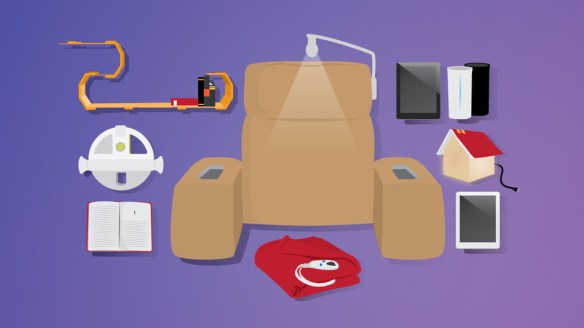
10 Gadgets for the Bookworm in Your Life | Mashable


Everyone knows one of them. They always have their nose stuck in a book, they don’t go anywhere without one and they are perennially asking you if you’ve read the book version of that movie that just came out. Bookworms. Book lovers. Bibliophiles.

Although book reading has historically been an analog and solitary activity, 2015 brings with it a new appreciation for digital gadgets, and the book industry isn’t exempt from the wave of tech innovation. READ MORE: 10 gadgets for the bookworm in your life | Mashable