Recent Pew Research Links


Broadband Adoption: The Next Mile | Statement of Aaron Smith (Senior Researcher, Pew Research) | Pew Internet

The New Library Patron from Pew Research Center’s Internet & American Life Project
Lee Rainie, Director of the Pew Research Center’s Internet & American Life Project, will discuss the Project’s new research about library patrons and non-patrons: who they are, what their information needs are, what kind of technology they use, and how libraries can meet the varying needs of their patrons.

Photo and Video Sharing Grow Online | Pew Internet
A new study by the Pew Research Center’s Internet Project shows that 54% of internet users have posted original photos or videos to websites and 47% share photos or videos they found elsewhere online. Also: AFP: Smart phones boost photo, video sharing: study and from TIME: One Stat that Explains Why Instagram Is Adding Ads.

Tablet and E-reader Ownership Update | Pew Internet
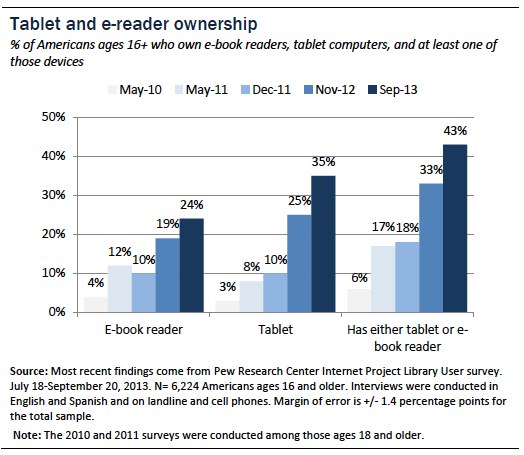
The number of Americans ages 16 and older who own tablet computers has grown to 35%, and the share who have e-reading devices like Kindles and Nooks has grown to 24%. Overall, the number of people who have a tablet or an e-book reader among those 16 and older now stands at 43%.

1 in 7 Americans is offline. Why? It’s complicated | Kathryn Zickuhr, Pew Research | CNBC

Pew Data on News Consumption: Millennials Lead the Shift to Web Use | ContentBlogger

Mobile Health in Context: How Information is Woven Into Our Lives from Pew Research Center’s Internet & American Life Project
Adobe Data Breach Affects 38 Million — Not 3 Million, as Reported | Mashable


Full Post

In early October, Adobe announced that 2.9 million customers were hit in a major data breach. As it turns out, the breach went much further, affecting 38 million users, according to a report from Naked Security.

The attackers gained access to users’ customer IDs, names, encrypted passwords, encrypted debit and credit card numbers and other personal data.

“So far, our investigation has confirmed that the attackers obtained access to Adobe IDs and (what were at the time valid), encrypted passwords for approximately 38 million active users,” said Adobe spokesperson Heather Edell.

Adobe initially believed the hackers accessed source code from Adobe Reader, Acrobat and ColdFusion. New data shows that a portion of source code for its Photoshop software was stolen, too.

Adobe set up a help page for affected users, notified them and reset their passwords. The company advises users to change their passwords entirely not only for Adobe products, but also for other sites where they used the same password.

Adobe Data Breach Affects 38 Million — Not 3 Million, as Reported | Mashable.

Facebook Is Testing Software That Tracks Your Cursor’s Every Move | Gizmodo


Facebook’s analytics chief Ken Rudin recently opened up to The Journal about how the social network plans to track user behavior. Long story short, Facebook plans to track it very closely. At the moment, the company is testing software that would record everything from when a user’s Newsfeed is visible on the screen to how long a user hovers over a certain part of the page.

That’s right. Facebook wants to know exactly where you’re moving your mouse. At all times.

Read: Facebook Is Testing Software That Tracks Your Cursor’s Every Move | Gizmodo.

Evgeny Morozov on Why Our Privacy Problem is a Democracy Problem in Disguise | MIT Technology Review


As Web companies and government agencies analyze ever more information about our lives, it’s tempting to respond by passing new privacy laws or creating mechanisms that pay us for our data. Instead, we need a civic solution, because democracy is at risk.

Snip: “When all citizens demand their rights but are unaware of their responsibilities, the political questions that have defined democratic life over centuries—How should we live together? What is in the public interest, and how do I balance my own interest with it?—are subsumed into legal, economic, or administrative domains. “The political” and “the public” no longer register as domains at all; laws, markets, and technologies displace debate and contestation as preferred, less messy solutions.

But a democracy without engaged citizens doesn’t sound much like a democracy—and might not survive as one.”

A lengthy but thought provoking read on the right to privacy and democracy. Read: Evgeny Morozov on Why Our Privacy Problem is a Democracy Problem in Disguise | MIT Technology Review.


How Amazon and Goodreads could lose their best readers | Salon.com

Aside


The original post is lengthy but worth the read, as it includes some discussion about censorship and creative user protest on the GoodReads platform.

With 20 million members (a number some have noted is close to the population of Australia) and a reputation as a place where readers meet to trade information and share their excitement about books, the social networking site Goodreads has always appeared to be one of the more idyllic corners of the Internet. The site sold to Amazon for an estimated $190 million this spring, and Goodreads recommendations and data have been integrated into the new Kindle Paperwhite devices, introducing a whole new group of readers to the bookish community.

But if, at a casual glance, the two companies — Goodreads and Amazon — seem to be made for each other, look again. A small but growing faction of longtime, deeply involved Goodreads members are up in arms about recent changes to the site’s enforcement of its policies on what members are permitted to say when reviewing books, and many of them blame the crackdown on the Amazon deal. They’ve staged a protest of sorts, albeit one that’s happening mostly out of the public eye. Their charge is censorship and their accusation is, in the words of one rebel, that Goodreads and Amazon want “to kill the vibrant, creative community that was once here, and replace it with a canned community of automaton book cheerleaders.”

Read the rest of the story: How Amazon and Goodreads could lose their best readers | Salon.com

Tablet and E-reader Ownership Update | Pew Research Center


The number of Americans ages 16 and older who own tablet computers has grown to 35%, and the share who have e-reading devices like Kindles and Nooks has grown to 24%. Overall, the number of people who have a tablet or an e-book reader among those 16 and older now stands at 43%.

Up from 25% last year, more than half of those in households earning $75,000 or more now have tablets. Up from 19% last year, 38% of those in upper-income households now have e-readers.

Tablet and E-reader Ownership Update | Pew Research Center's Internet & American Life Project

Read the full report or download the pdf.

via Tablet and E-reader Ownership Update | Pew Research Center’s Internet & American Life Project.

To Predict The Future Of Technology, Figure Out How People Will Use It Illegally | Co.Exist


I find that it’s often useful to imagine the unintended, seedy, improper, or illicit uses of new tools and systems…Thinking along those lines can help to uncover the more subtle connections between a new technology and incumbent systems, spot hidden security flaws, or even reveal markets for a product that the developer had ignored.

Read: To Predict The Future Of Technology, Figure Out How People Will Use It Illegally | Co.Exist | ideas + impact.

Oyster Brings ‘Netflix for E-Books’ App to iPad, Opens to Public | Mashable


A little more than a month after launching an iPhone app in invitation-only beta, Oyster is making its e-book subscription service available to all users and expanding to iPad.

Oyster charges $9.95 a month for access to more than 100,000 books from big and small publishers, but it now offers users one free month with the hope of getting more people to try the app experience. The startup declined to provide data on the number of users or books read during the beta period, but noted that 1 million pages were read in the first 10 days the app was available and another million pages were read in the following six days.

Read: Oyster Brings ‘Netflix for E-Books’ App to iPad, Opens to Public | Mashable.

You may also like: Test Driving Oyster, a “Netflix for Ebooks” | The Digital Shift

E-patients and their hunt for health information | Pew Research Center


Lee Rainie, Director of the Pew Internet Project, described the Project’s research on how patients and caregivers seek health information in the digital age and how people fit librarians into their general information needs as well as their specific health needs.


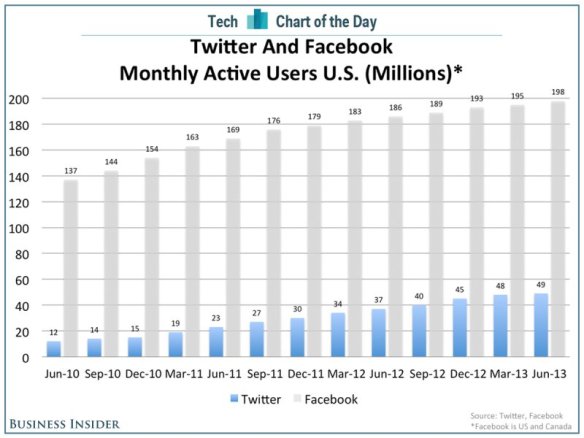
Twitter Has A Surprisingly Small Number Of US Users | Stephen’s Lighthouse


Twitter Has A Surprisingly Small Number Of US Users | Stephen’s Lighthouse

Read more: http://www.businessinsider.com/twitter-has-a-surprisingly-small-number-of-us-users-2013-10#ixzz2gypwp2LD