
Computing has always been a boys’ club. How 18-year-old nikita rau–and other young women like her–are finally changing that.
Read: A Girl Who Codes | Fast Company | Business + Innovation.

Computing has always been a boys’ club. How 18-year-old nikita rau–and other young women like her–are finally changing that.
Read: A Girl Who Codes | Fast Company | Business + Innovation.
Digital music might not have the same allure as sitting down to listen to a record on your turntable, but what it lacks in atmosphere, it makes up for in convenience — especially when you aren’t home with your collection.
It’s been five years since Spotify publicly launched and shifted the music industry’s focus toward streaming as a way to combat illegal downloading. While the streaming business model is far from perfect, even the most casual music fan should test out streaming while it’s still growing.
If you’re just dipping your toe into the stream, follow our beginner’s guide and soon you’ll be listening to Spotify’s massive library without the worry of losing precious hard drive space.
Macro topics:
Full Post
It’s probably no news to most people who work that poor leaders produce disgruntled, unengaged employees. Our research also shows convincingly that great leaders do the opposite — that is, that they produce highly committed, engaged, and productive employees.
And the difference is cavernous — in a study of 160,576 employees working for 30,661 leaders at hundreds of companies around the world, we found average commitment scores in the bottom quarter for those unfortunate enough to work for the worst leaders (those leaders who had been rated in the bottom 10th percentile by their bosses, colleagues, and direct reports on 360 assessments of their leadership abilities). By contrast, average commitment scores for those fortunate enough to work for the best leaders (those rated in the 90th percentile) soared to the top 20th percentile. More simply put, the people working for the really bad leaders were more unhappy than three quarters of the group; the ones working for the really excellent leaders were more committed than eight out of ten of their counterparts.
What exactly fosters this engagement? During our time in the training and development industry we’ve observed two common — and very different — approaches. On the one hand are leaders we call “drivers”; on the other, those we call “enhancers.”
Drivers are very good at establishing high standards of excellence, getting people to stretch for goals that go beyond what they originally thought possible, keeping people focused on the highest priority goals and objectives, doing everything possible to achieve those goals, and continually improving.
Enhancers, by contrast, are very good at staying in touch with the issues and concerns of others, acting as role models, giving honest feedback in a helpful way, developing people, and maintaining trust.
Which approach works best? When we asked people in an informal survey which was most likely to increase engagement, the vast majority opted for the enhancer approach. In fact, most leaders we’ve coached have told us that they believe the way to increase employee commitment was to be the “nice guy or gal.”
But the numbers tell a more complicated story. In our survey, we asked the employees not only about their level of engagement but also explicitly, on a scale of one to five, to what degree they felt their leaders fit our profiles for enhances and drivers. We judged those leaders “effective” as enhancers or drivers who scored in the 75th percentile (that is, higher than three out of four of their peers) on those questions.
Putting the two sets of data together, what we found was this: Only 8.9% of employees working for leaders they judged effective at driving but not at enhancing also rated themselves in the 10% in terms of engagement. That wasn’t very surprising to many people who assume that most employees don’t respond well to pushy or demanding leaders. But those working for those they judged as effective enhancers were even less engaged (well, slightly less). Only 6.7% of those scored in the top 10% in their levels of engagement.

Essentially, our analysis suggests, that neither approach is sufficient in itself. Rather, both are needed to make real headway in increasing employee engagement. In fact, fully 68% of the employees working for leaders they rated as both effective enhancers and drivers scored in the top 10% on overall satisfaction and engagement with the organization.
Clearly, we were asking the wrong question, when we set out to determine which approach was best. Leaders need to think in terms of “and” not “or.” Leaders with highly engaged employees know how to demand a great deal from employees, but are also seen as considerate, trusting, collaborative, and great developers of people.
In our view, the lesson then is that those of you who consider yourself to be drivers should not be afraid to be the “nice guy.” And all of you aspiring nice guys should not view that as incompatable with setting demanding goals. The two approaches are like the oars of a boat. Both need to be used with equal force to maximize the engagement of direct reports.
Something unsurprising happens when you task two star designers to curate a catalog of their favorite objects: You end up with a collection of ridiculously well-designed products. This is exactly what happened when Sotheby’s tapped Jony Ive and Marc Newson to pull together a list of goods to be auctioned off at the (RED) Auction, which is raising money for the Global Fund to Fight AIDS, Tuberculosis and Malaria.
Read: 18 of the Best Designs of All Time, Picked by Jony Ive and Marc Newson | Wired Design | Wired.com
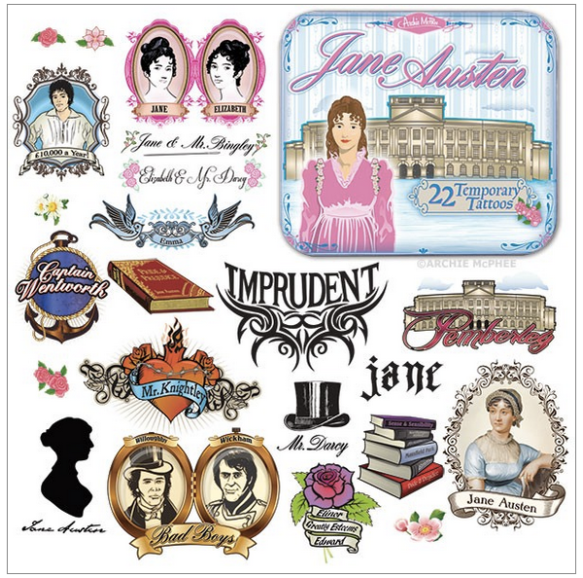
How better to celebrate the renowned work of author Jane Austen than with these temporary tattoos by Archie McPhee that literally let you wear your inner Lizzie Bennet on your sleeve. Read: Jane Austen Temporary Tattoos by Archie McPhee | Laughing Squid
Best Books: 36 Reads For Every Personality On Your List | HuffPost
The Readers: Books for Every Personality | ChaptersIndigo
7 Books That Are Perfect For Introverts | HuffPo
Here Is The One Perfect Book For Every Single Myers-Briggs Type | HuffPo
Need to figure out your M-B type? Check out: What Myers-Briggs Personality Type Are You? | LifeHacker or the MBTI Personality Types Socioeconomic Infographic.

October was chock-full of library-related articles and blog posts which were both educational and entertaining. My two favorite resources for the month would have to be the article illustrating 37 Ways To Proudly Wear Your Love Of Books, as well as the informative and thought-provoking article by Brian Mathews, Seven things to think about as wearable computing emerges. Here are all 30 of the library stories you may have missed out on last month.
Read: 30 Library Stories You May Have Missed in October | Ellyssa Kroski | OEDB.org.

 infophile