
Amanda Lenhart presented nine major themes from the Project’s five-report series on Teens and Online Privacy. In a talk delivered to the Family Online Safety Institute’s annual conference on November 7th, Amanda examined youth’s social media diversification and sharing practices, privacy choices, and the ways that youth concepts of privacy differ from adults.
Author Archives: infophile
Tinkers, Printers & Makers: Makerspaces in the Library | The Travelin’ Librarian
Interested in creating a Makerspace in your library? This program will discuss what a Makerspace is, how libraries of all types create and share Makerspaces with library customers and the community and feedback from users. Libraries are a much needed and often used third space, which are ideal for community Makerspaces to collaborate and encourage creativity among all users. There will be gadgets, hands-on demos and group discussion on the nuts & bolts necessary for Makerspace in the library as well as what products should be found in successful Makerspaces. Gordon Wyant will share how his library successfully wrote a grant for a 3D printer, and Michael Sauers will demo a range of new gadgets including a Raspberry Pi and LibraryBox.
Presenters: Marcia Dority Baker, University of Nebraska College of Law Library, Lincoln; Michael Sauers, Nebraska Library Commission; Gordon Wyant, Bellevue Public Library.
via Tinkers, Printers & Makers: Makerspaces in the Library | The Travelin’ Librarian
Related:
Library Used By Mexicans To Look At Drugs And Food Stamps, Says Racist Councilman | addictinginfo
Racism directed toward library patrons. Read the full story: “Library Used By Mexicans To Look At Drugs And Food Stamps”, Says Racist Councilman | addictinginfo
Originating story: Election 2013: Voters asked to rededicate library funding toward jail | Tri-Parish Times. See commentary in the STATE OF THE LIBRARY SYSTEM section.
Aside from his point that the system collects too much money, Toups does not philosophically agree with the library’s evolving role in the community.
“They’re teaching Mexicans how to speak English,” the council chairman said in reference to Biblioteca Hispana, a Hispanic-language segment of the Golden Meadow library branch. “Let that son of a bitch go back to Mexico. There’s just so many things they’re doing that I don’t agree with. … Them junkies and hippies and food stamps (recipients) and all, they use the library to look at drugs and food stamps (on the Internet). I see them do it.”
Book this librarian | The Hindu
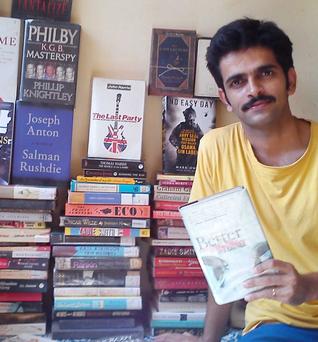
Pushpendra Pandya, a resident of Vasai in Mumbai, works six days a week as a copywriter. On Sundays, though, he hires a cab and travels to different localities in the city, collecting books from those who have either no need for them, or no space to keep them.
Last month he started a crowd-sourced library, and has since built a collection of 1200 titles with help from friends and strangers. The idea for the library came to Pandya in March last year when he started a book sharing arrangement with friends.“Just like we would share notes in college after bunking class to cover up, we started swapping books. I thought it could be taken to a larger audience,” says Pandya, who calls himself an old-fashioned book lover. “In spite of being in such a crowded city, people feel lonely here. You need some company sometimes, and books have been the greatest company for me so far.
Read the rest of the story: Book this librarian | The Hindu.
Mystery of 18th century music book| This Is Guernsey

Full Post
Historians are trying to trace the mysterious author of an 18th century music album that has been discovered in a library archive.
The untitled, leather-bound songbook was found by an archivist sorting through a catalogue of collections in the Watt Library in Greenock, Inverclyde.
The inside cover is signed by a Hugh Cameron and dated 1709 and it also contains poems, a book list and a series of religious writings.
The music, such as A Trumpet Air and Auld Robin Gray, were not written by Cameron but copied from a book of popular Scottish music. Cameron’s book has been described as an early example of a music album – a copy of music that can be performed by the owner at their leisure.
An expert from the Royal Conservatoire of Scotland has studied the unusual find and hopes to find out more about the person who wrote it.
Karen McAulay, music librarian at the Conservatoire, said: “A lot of the pieces in the manuscript have been copied out of one particular book.
“There was a publisher in Glasgow called Aird around that time and they published a series of books with fiddle tunes, mainly from Scotland but some from other countries as well, and when you go through this book you find that quite a lot of the tunes are from that one single volume (of the Aird book).
“These days you can quickly copy down with a photocopier or buy an album, but hundreds of years ago what you did was write your favourite tunes out and that’s exactly what this gentleman has done.”
The book is now going on display in the McLean Museum inside the library alongside other items from the archive, such as the Greenock Autograph Book which contains letters from Charles Dickens and Charles Darwin.
Library archivist Neil Dickson discovered the songbook last month when he was preparing the new display for Inverclyde Council.
He said: “The only reason it was found was because I was cataloguing the records which had previously never been catalogued before. We discovered the songbook and straight away I realised it was something special.
“It’s very unique and I always feel privileged to be doing the job I am and to make discoveries like this, because it’s essentially history that’s been untouched and it’s our job to explore and make it available, and hopefully we can find out more about the book and Hugh Cameron.”
Little else is known about the author and the library hope local people will be interested in the story.
Ms McAulay has researched Mr Cameron but has been unable to pinpoint exactly where he was from.
She said: “My guess is that he was possibly a schoolmaster. I found out that there were several Hugh Camerons who were schoolmasters at that time, one in Perthshire, and it could have been him, but I can’t be sure.
“What I can say is that he wasn’t a Church of Scotland minister because he was not in the minister listings for that time.
“The book is dated 1709 and the handwriting of the signature is very young but the handwriting of the lists of books is more mature so that would have been when the same person was a bit older. It may be something he’s added to over his life or it may be that a relative or someone else also used the book.”
The display is part of a nationwide Explore Your Archive campaign which aims to get people interested in local history.
Mr Dickson said: “Archives are very important, it’s essentially raw history.
“They’re usually the only resources we have for getting a detailed description of people’s life and society from the 17th century onwards.
“By searching through our archives in Inverclyde we’ve found some very, very special items and hopefully they can give people an insight in to the history of the area.”
Tradecraft Launches A School For Teaching Non-Technical Skills To Tech Workers | TechCrunch
For many companies in Silicon Valley, it’s fairly easy to find, train, and evaluate technical talent — for the most part, it’s easy to determine and quantify how well a person codes. But evaluating and training non-technical personnel is something many struggle with. To help change this, a new school called Tradecraft has emerged to help teach those seeking UX, growth, and sales positions the skills they need to succeed in the tech world.
Tradecraft was founded by Russ Klusas and Misha Chellam, who believe it (or something like it) is necessary to teach necessary skills to non-technical tech workers.
Read: Tradecraft Launches A School For Teaching Non-Technical Skills To Tech Workers | TechCrunch.
The Most Popular Books of All Time | Visual.ly

This Grad Student Hacked Semantic Search To Be Better Than Google | Co.Labs
Full Post
Google may be the dominant search engine, but it’s far from ideal. One major problem: How do you search for things you don’t know exist?
Using Google’s own experimental algorithms, a graduate student may have build a solution: a search engine that allows you to add and subtract search terms for far more intuitive results.
The new search engine, ThisPlusThat.Me, similarly looks for context clues among the terms. For instance: Entering the arithmetic search “Paris – France + Italy” gives the top result as “Rome,” but if I search the same thing in Google, I’ll get directions between Paris and Italy, restaurants in France and Italy, and a depressing Yahoo Answers of whether Italy is in Paris (or vice versa). “Rome,” on the other hand, is an association you, a human, would make (I wantThis, without That but including Those)–and the engine makes that decision based on each answer’s semantic value compared to your search.
Until now, search has been stuck in a paradigm of literal matching, unable to break into conceptual associations and guessing what you mean when you search. There’s a reason Amazon and Netflix have scored points for their item suggestions: They’re thinking how you think.
The engine, created by Astrophysics PhD candidate Christopher Moody, uses Google’s own open-source word2vec algorithm research to take the terms you searched for and ranks the query results by relevance, just like a normal search–except the rankings are based on “vector distances” that have a lot more human sense. So in the above example, other results could have been, say, Napoleon or wine–both have ties with the above search terms, but within the context of City – Country + Other Country, Rome is the vector that has the closest “distance.”
All the word2vec algorithm needs is an appropriate corpus of data to build its word relations on: Moody used Wikipedia’s corpus as a vocabulary and relational base–an obvious advantage in size, but it also had the added benefit of “canonicalizing” terms (is it Paris the city, or Paris from the Trojan War? In Wikipedia, the first is “Paris” and the second “Paris_(mythology).” But millions of search-and-replaces in Wiki’s 42 GB of text was intensive, so Moody used Hadoop’s Map functions to fan those search-and-replaces to several nodes.

A search query then spits out an 8 GB table of vectors with varying distances; Moody tried out a few data search systems before settling on Google’s Numexpr to find the term with the closest vector distance.
via This Grad Student Hacked Semantic Search To Be Better Than Google | Co.Labs | code + community.
‘Flowers In The Attic’ Trailer: Lifetime Takes On V.C. Andrews Novel | HuffPo
‘Flowers In The Attic’ Trailer: Lifetime Takes On V.C. Andrews Novel | HuffPo
Lifetime’s “Flowers In The Attic” has a spooky new trailer.
The hyped adaptation of V.C. Andrews’ classic novel will premiere on Lifetime on January 18. In the preview above, Kiernan Shipka (“Mad Men”) and Mason Dye (“Secret Diary of an American Cheerleader”) star as twins who develop a love affair while trapped in the family attic.
Featuring an all-star cast — Heather Graham plays the twins’ negligent mother and Academy Award-winner, Ellen Burstyn, is completely terrifying as the twins’ abusive grandmother — the trailer promises everything a Lifetime movie should: sex, terror and a whole lot of OMG-moments.
“Flowers in the Attic” premieres on Jan. 18 on Lifetime.
11 Indispensable Life Lessons Every Woman Can Learn From Anne Of Green Gables | HuffPo

Awesome, super popular post on HuffPo!!
Like all great children’s book heroines, Anne Shirley is just a bit odd. Okay, she’s very odd. Her crazy imagination and flowery diction differentiate her from most children you’re likely to meet, and despite a certain recent edition’s cover art, her hair is defiantly red. But somehow, her kooky adventures have spoken to generations of children, including me. Though in some ways L.M. Montgomery’s lesser-known heroine Emily Starr was more relatable to me as a kid — shy, withdrawn, bookish, and driven by professional ambition — lighthearted Anne is almost universally irresistible.
Anne is fearless. Anne is unpredictable. Anne is funny, though often unintentionally. Anne is smart, but not snobbish. Anne is so warm and caring you can feel it through the page. (And, cards on the table, her love interest Gilbert was my first literary crush.) Watching her grow up, stumbling from adventure to misadventure, was never dull. What’s more, it managed to teach young readers all about life without ever seeming preachy. Anne isn’t a model girl, but she’s figuring it out. Just like we all were at her age. Here are 11 of the most important lessons Anne Shirley taught me about life, love, and growing up.
Read: 11 Indispensable Life Lessons Every Woman Can Learn From Anne Of Green Gables | HuffPo.
 infophile