
MORE: 125 MOOCs Getting Started in May: Enroll in One Today | Open Culture
Category Archives: Education
Female Scientists Told to Get a Man to Help Them With Their Paper | Jezebel
This just in from the land of great sexism: two female scientists had a manuscript rejected by a peer-reviewed journal because they didn’t ask a man for help. An unnamed peer reviewer for the journal PLoS One suggested that Drs. Fiona Ingleby and Megan Head find male co-authors—any men at all—for a paper they’d written, in order to make sure they weren’t leaping to “ideologically biased assumptions.” READ MORE: Female Scientists Told to Get a Man to Help Them With Their Paper | Jezebel
MinecraftEdu Takes Hold in Schools | School Library Journal #minecraft #education
There aren’t any express objectives or any real way to win in Minecraft. It’s a “sandbox,” in gaming speak—offering free play without a specific goal and currently used by more than 18.5 million players, with some 20,000 more signing up every day. Users may choose between Creative Mode, in which they can build using unlimited resources by themselves or with friends, with no real danger or enemies, and Survival Mode, where they fend off enemies and other players and fight for resources and space. They can trade items and communicate using a chat bar. Modifications (or mods) can add complexity by creating things like economic systems that let players buy and sell resources from in-game characters using an in-game currency system. These downloadable mods can also add computer science concepts and thousands of additional features.
MINECRAFTEDU
Minecraft’s worlds and possibilities are truly endless—and increasingly, so are its educational adaptations for school use. Available on multiple platforms (Apple, Windows, Linux, PlayStation, Xbox, Raspberry Pi, iOS, Android, Windows Phone), the game’s flexibility and collaborative possibilities make it a favorite among devotees of gamification.
“Minecraft is like LEGOs on steroids,” says Eric Sheninger, a senior fellow at the International Center for Leadership in Education. “Learners of all ages work together to ultimately create a product that has value to them,” he adds. “The simple interface provides students in the classroom with endless possibilities to demonstrate creativity, think critically, communicate, collaborate, and solve problems.” A Swedish student research study also showed that collaboration in Minecraft provided a more immersive problem-solving experience than group LEGO building.
via MinecraftEdu Takes Hold in Schools | School Library Journal.
Stories For All (Diversity & Inclusion) | First Book #diversity #books
Although the First Book Marketplace is for educators (to purchase books and educational materials at low prices for children in need), the resource highlights books for children and youth that showcase topics of diversity and inclusion. You can explore books by themes that include African American Interest, Asian American & Pacific Islander, Global Stories, Immigrant Experience, Latino Interest, LGBTQ, Muslim American, Native American, Religion and Special Needs & Abilities. Browse the themes to discover books within each interest area. There are also resources recommended for other topics and themes such as STEM and Me & My Feelings, etc.
“Through the Stories for All Project™ First Book strives to provide all kids with diverse books that act as mirrors and windows. Kids feel valued and validated when they see their own experiences reflected on the pages of books, and they develop curiosity and empathy when they read about experiences different from their own. To help your kids grow as both readers and global citizens, [view] our ever-expanding selection of diverse books.”
Is Kim Kardashian a geek? ‘StarTalk’ host Dr. Neil deGrasse Tyson wants to know | Canada.com #science @neiltyson #startalktv
New science show ‘StarTalk’ hosted by Dr. Neil deGrasse Tyson premiers Monday 11pm EST on the National Geographic Channel.
BY VICTORIA AHEARN, THE CANADIAN PRESS
APRIL 17, 2015 6:20 PM
TORONTO – Kim Kardashian may not seem like a natural fit for “Star Talk,” the new talk show hosted by celebrity astrophysicist Dr. Neil deGrasse Tyson on the National Geographic Channel.
But once in his studio, he would help Kardashian and viewers realize that “science is everywhere and it manifests even in people you think of in pop culture,” he says.
“If I have the opportunity to get Kim Kardashian on ‘Star Talk’ … what will I talk about? … We’ll look at all the things she does,” Tyson says in a phone interview, noting he really would like to have her on the show.
“Does she use a hair straightener? What are the chemicals in that hair straightener? I’ll bring in a chemist to talk about cosmetics that she uses.
“Then all of a sudden you see pop culture analyzed from the point of view of science.”
Premiering Monday at 11 p.m. ET, the hour-long, weekly show sees Tyson interviewing various pop-culture personalities about the ways in which science has influenced their lives and livelihoods.
“How do you get people to think about science who don’t know that they like it, or know that they don’t like it? You have to give them some other reason to participate in a science conversation, and one way to do that is to comb the elements of pop culture,” says Tyson.
“Look around and say, ‘Are there singers, actors, directors, performers that have huge followings? Let’s get them on ‘Star Talk’ and we will find all the ways that science emanates from their profession, even in ways they might not have been aware of themselves.
“And in there we might find out that the guest has a little bit of geek in them.”
The series is based on Tyson’s radio show and podcast of the same name. Bill Nye the Science Guy appears in each episode.
“Star Trek” star George Takei is featured in the first instalment.
Future guests include former U.S. president Jimmy Carter (May 25), director-screenwriter Christopher Nolan (April 27) and retired Canadian astronaut Chris Hadfield (June 1).
Tyson says Hadfield sings the lullaby that he composed for his daughter while he was in space to sing her to sleep. He also talks about why and how he became an astronaut.
“It was a fun interview, and ideally every one of our interviews would go just that way,” says Tyson, who also hosted the miniseries “Cosmos: A Spacetime Odyssey.”
Hadfield isn’t the only thing about Canada that Tyson loves.
He also applauds our country’s $5 bill, which depicts Canadarm 2 and Dextre, a robot used on the International Space Station.
“That’s in all of my lectures, by the way,” Tyson says of the Canadarm.
via Is Kim Kardashian a geek? ‘Star Talk’ host Dr. Neil deGrasse Tyson wants to know | Canada.com
Readlang Helps You Learn a Foreign Language as You Surf the Web | LifeHacker #language
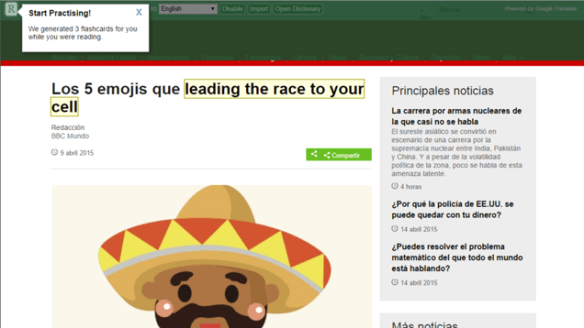
The most effective way to learn a foreign language is to immerse yourself as much as possible in it. Readlang is a webapp and Chrome extension that helps you learn by translating web sites and creating flashcards and word lists for you. READ MORE: Readlang Helps You Learn a Foreign Language as You Surf the Web | LifeHacker
The 10 Most Controversial Books of the Year | BookBub Blog #bannedbooks
As part of National Library Week, the American Library Association just released its annual State of America’s Libraries Report analyzing the shifting role libraries play in today’s society. The full report is interesting in and of itself, but it also includes one of the most fascinating book lists of the year — the most frequently challenged books of the year.
In 2014, the ALA received 311 requests to ban books from schools and libraries. [Here] are the top 10 books that caused the most controversy over the past year, including the reasons they were challenged, as well as each book’s publisher description. READ: The 10 Most Controversial Books of the Year | BookBub Blog
Blended Study: 10 Ways to Use Tech While You Learn | InformED #tech #students #blendedlearning
We hear a lot about blended learning from an instructor’s perspective, but what about from a student’s perspective? In what ways can students use technology to support learning inside and outside their course sessions?
Traditionally, studying involves a lot of passive reviewing. Reviewing texts, reviewing notes, reviewing lecture slides. But cognitive psychology tells us this isn’t the most effective way to retain information. The most effective learning is interactive, multi-modal, and based on science–in other words, qualities that technology can bring to the table. So what are some of the best uses of technology for students, not just educators? READ MORE: Blended Study: 10 Ways to Use Tech While You Learn | InformED
The 10 ways discussed in the post are listed below. Recommended tools are mentioned for each – see the link above.
- Time management apps
- Supplementary videos
- Open Educational Resources (OER)
- Online textbooks
- Self-quizzing apps
- Digital creation tools
- Productivity apps
- Mind mapping tools
- Digital learning portfolios
- Social media for learning
For Schools With No Books, A Digital Collection So They Can Have A Real Library | Co.Exist #education #digital #libraries #literacy
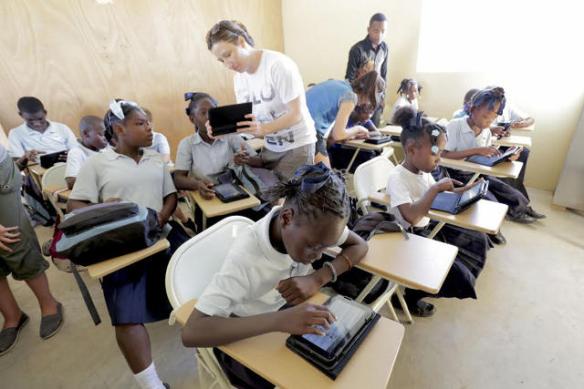
Library for All is now working in impoverished places around the world on a simple mission with a major impact. Rebecca McDonald came up with the idea for Library for All after visiting Haiti in 2010. The country had just experienced a major earthquake, and the schools there were having a tough time getting back to normal—even more so, because they lacked basic education materials.
“The reason we started the library was that, everywhere I went, they didn’t have any books. And if they did, they were in English when people either speak Haitian Creole or French. They were good paperweights, and that was about it,” McDonald says.
Library for All now works with 10 schools on the island, with plans to partner with nine more. The model is simple. The nonprofit assembles a highly curated local-language collection of books that schools access through Android tablets.
READ MORE: For Schools With No Books, A Digital Collection So They Can Have A Real Library | Co.Exist | ideas + impact.
A Pen For People With Parkinson’s | Co.Design

Lucy Jung never thought much about designing for sick people. Then she was diagnosed with a brain tumor. She recovered, and the experience has driven her toward what she now thinks of her calling: to use design to help improve the quality of life of hospital patients and those with chronic conditions.
It drove the 27-year-old designer to create the Arc, a pen for people with Parkinson’s disease. Along with three fellow students (Hwan Soo Jeon, Tian-jia Hsieh, and Danny Waklin) from the UK’s Royal College of Art and the Imperial College London who took part in the Innovation Design and Engineering joint masters course, Jung designed the pen to not only make it easier for people with Parkinson’s to write legibly, but to actually loosen up the muscles of their hands after they’ve put the pen down.
READ MORE: A Pen For People With Parkinson’s | Co.Design | business + design.
 infophile