Can #Reading Make You Happier? | The New Yorker #books #psychology #therapy


Several years ago, I was given as a gift a remote session with a bibliotherapist at the London headquarters of the School of Life, which offers innovative courses to help people deal with the daily emotional challenges of existence. I have to admit that at first I didn’t really like the idea of being given a reading “prescription.” I’ve generally preferred to mimic Virginia Woolf’s passionate commitment to serendipity in my personal reading discoveries, delighting not only in the books themselves but in the randomly meaningful nature of how I came upon them (on the bus after a breakup, in a backpackers’ hostel in Damascus, or in the dark library stacks at graduate school, while browsing instead of studying). I’ve long been wary of the peculiar evangelism of certain readers: You must read this, they say, thrusting a book into your hands with a beatific gleam in their eyes, with no allowance for the fact that books mean different things to people—or different things to the same person—at various points in our lives. I loved John Updike’s stories about the Maples in my twenties, for example, and hate them in my thirties, and I’m not even exactly sure why.

But the session was a gift, and I found myself unexpectedly enjoying the initial questionnaire about my reading habits that the bibliotherapist, Ella Berthoud, sent me. Nobody had ever asked me these questions before, even though reading fiction is and always has been essential to my life. READ MORE: Can Reading Make You Happier? | The New Yorker.
Copy of Original #StarWars Script Discovered in UNB Library | CBC News #libraries


Deep in the archives of the University of New Brunswick’s library in Saint John, a famous movie script sat forgotten and collecting dust. It tells the tales of a galaxy far, far away — and no one knows how it got there.

READ MORE: Copy of original Star Wars script discovered in UNB library | New Brunswick | CBC News.

These Female #Writers Want To Stop “Chick Lit” Being Used To Describe Work By #Women | BuzzFeed #books #diversity #genderequality


Bestselling novelist Marian Keyes recently called the term “chick lit” derogatory, and now other female writers are expressing how much they dislike the term. READ MORE: These Female Writers Want To Stop “Chick Lit” Being Used To Describe Work By Women | BuzzFeed

This Massive, Open Source Map Makes the World More Wheelchair Friendly | Gizmodo #maps #accessibility #disabilities


The world is tough place to navigate in a wheelchair. But finding ramps and elevators can be easier thanks to this handy map app that anyone can edit.

It’s called Wheelmap, and it tells you the accessibility status of public places all over the world. It’s free and grades locations in a traffic light-style, red-yellow-green scale of wheelchair accessibility. Developed by German nonprofit SOZIALHELDEN e.V., it’s now celebrating five years since launch. Since 2010, users have added nearly half a million entries across the globe.

“Accessible” means you can enter the place without steps, and that all rooms inside a building can be entered without steps, as well. “Limited accessibility” refers to entrances with a max of one step no higher than seven centimeters, and that the “most important rooms” can be entered without steps.

Wheelmap launched back in 2010, and since then, has become available in 22 languages. It’s available for both iOS and Android users.

READ MORE: This Massive, Open Source Map Makes the World More Wheelchair Friendly | Gizmodo

Myers-Briggs Personalities: A Book for Every Type | Flavorwire #MBTI #books


READ: Myers-Briggs Personalities: A Book for Every Type | Flavorwire.

Browse More Than 1,000 Original Sketches Of Mid-Century Fashion | Co.Design


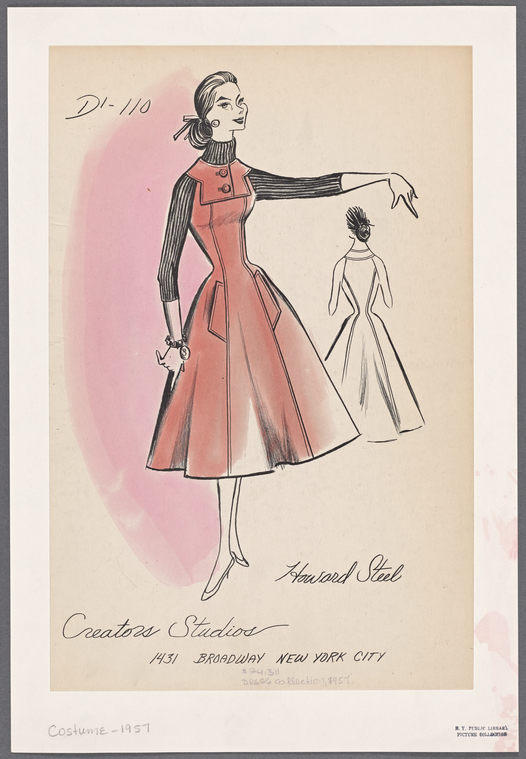
Browse More Than 1,000 Original Sketches Of Mid-Century Fashion | Co.Design | business + design

Image Credit: The New York Public Library Digital Collections: Art and Picture Collection

In 1957, three New York designers Walter Teitelbaum, Leo Boren, and Howard Steel founded a company called Creators Studio that produced fashion design concepts. With the tagline “Not yesterday’s but tomorrow’s fashions today,” they’d draw up original garments based upon notable fashion trends, and design manufacturers would receive these sketches on a subscription basis.

Walter Teitelbaum gifted the New York Public Library with 1,067 of these drawings of women’s and children’s ready-to-wear fashions from 1957 to 1969, and the collection has been digitized for you to explore online.

READ MORE: Browse More Than 1,000 Original Sketches Of Mid-Century Fashion | Co.Design | business + design.

A Cat Library in New Mexico Encourages Office Workers to Check Out #Kittens | Mashable #cats #libraries


IMAGE: CBS

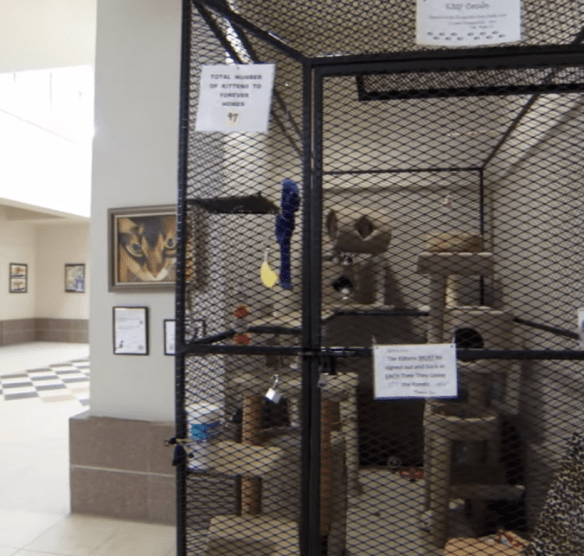
A county office in Las Cruces, New Mexico, is home to one of the most ingenious stress-relief ideas ever: a cat library, where office workers can check kittens in and out like books.

City officials installed a kitten playpen in lobby of the building in May 2012 as a way to promote the adoptable cats from local shelters. Inside the playpen are several cat condos, scratching posts and toys — and plenty of rescue kitties.

Visitors to the cat library can simply sign in, play with a kitten, then sign back out. READ MORE A cat library in New Mexico encourages office workers to check out kittens | Mashable

Why Do Presidents Get Their Own #Libraries? | Atlas Obscura #POTUS #museums


In May, the Obama Foundation announced that Chicago will be the future location of the Barack Obama Presidential Center, which will include a library and museum. The center will become the 14th institution in the National Archives and Records Administration’s presidential library system, which includes centers dedicated to all presidents from Herbert Hoover onwards.

Over the years, millions of public and private dollars and ostensibly, man hours, have been spent curating these institutions. Which begs the question: why?

Franklin D. Roosevelt began this tradition when, in 1939, he decided to hand over his personal and presidential records to the federal government when leaving office. Two years later, the Franklin D. Roosevelt Presidential Library and Museum was built in Hyde Park, New York to house these records. READ MORE: Why Do Presidents Get Their Own Libraries? | Atlas Obscura.

Is It Really Possible to Learn to Speed Read? | Gizmodo #reading


Ninety-five percent of college educated individuals read at a rate between 200-400 words per minute according to extensive research done by University of Massachusetts Amherst professor Dr. Keith Rayner. However, there exists a small, but rather vocal subset of people who insist that they can read several times faster than this using various speed reading techniques.

With very little searching, you’ll also find many-a-company claiming that after going through their program or using their app regularly, you can easily read even as many as 1,000 words per minute. Tim Ferriss of Four Hour Work Week fame offers a method for increasing speed in reading for free on his website, claiming with this method, you’ll see an average increase in reading speed of about 386% in just three hours of practice.

So is any of this really possible? READ MORE: Is It Really Possible to Learn to Speed Read? | Gizmodo

The Future Of #Museums Is Reaching Way Beyond Their Walls | Co.Exist #AMNH


The American Museum of Natural History has always been one of the most popular destinations in New York City. With about 5 million visitors a year, an increase from 3 million in the 1990s, it—along with the nearby Metropolitan Museum of Art—is among the top 10 most-visited museums in the world.

Even with this influx of people coming to its doorstep, however, the museum is now equally focused on drawing a crowd beyond its campus.

“In the old days, a visit to a museum like ours would be a one-off. You come, you visit you go home,” says Futter. “Now people have a relationships with us very often before they get here. They come, and [their visit] is like a giant exclamation point—and then they return home and continue to engage with us wherever they are.”

AMNH today is a sprawling outreach institution that is using apps, social media, and educational programs to slowly grow its reach. READ MORE: The Future Of Museums Is Reaching Way Beyond Their Walls | Co.Exist | ideas + impact.