Throwing the Books at Each Other | Inside Higher Ed


“…a large percentage of the library’s non-fiction collection was being removed in a hasty and ill-considered project driven by an awkward glitch in planning. Some temporary workers had been hired to insert RFID tags into the books and it seemed foolish not to remove outdated books from the collection first, particularly since the RFID tags had yet to arrive. So to make use of the workers who were already on the clock, that removal project was suddenly shifted into high gear, and soon the whole thing was smoking and the wheels fell off, but not before thousands of books were discarded.”

via Throwing the Books at Each Other | Inside Higher Ed

Urbana Free Library Scrutinized Over Book Weeding | Illinois Public Media

Illinois: “Library Director Says Mistake Was Made in Book ‘Weeding’” | InfoDocket – LibraryJournal

I’m sure the Annoyed Librarian is going to have a comment about this one!
Introducing the Mozilla Science Lab | The Mozilla Blog


We’re excited to announce the launch of the Mozilla Science Lab, a new initiative that will help researchers around the world use the open web to shape science’s future.

Scientists created the web — but the open web still hasn’t transformed scientific practice to the same extent we’ve seen in other areas like media, education and business. For all of the incredible discoveries of the last century, science is still largely rooted in the “analog” age. Credit systems in science are still largely based around “papers,” for example, and as a result researchers are often discouraged from sharing, learning, reusing, and adopting the type of open and collaborative learning that the web makes possible.

The Science Lab will foster dialog between the open web community and researchers to tackle this challenge. Together they’ll share ideas, tools, and best practices for using next-generation web solutions to solve real problems in science, and explore ways to make research more agile and collaborative.

via Introducing the Mozilla Science Lab | The Mozilla Blog

You may also like:

7 Responsive Design Tips to Revamp Your Workflow | Mashable


7 Responsive Design Tips to Revamp Your Workflow | Mashable

Tips discussed include:

  1. Mobile First
  2. Content Strategy
  3. Sketch and Prototype
  4. Frameworks
  5. Breakpoints
  6. Scalable Images
  7. Minification

There is a bonus highlighting 20 Stunning Responsive WordPress Themes.

How I Learned To Stop Comparing Myself To Others, And Love My Own Ideas | Fast Company | Business + Innovation


How I Learned To Stop Comparing Myself To Others, And Love My Own Ideas | Fast Company | Business + Innovation.

Quotable: “As I tried to navigate my way through the wading pool of rejection, creation, and then rejection again, my biggest downfall wasn’t funding, or a business plan, or office space. It was my habit of constantly comparing myself and my own progress to others that nearly led to my demise.”

Bill Gates, Benchmark And More Pour $35M Into ResearchGate, The Social Network For Scientists | TechCrunch


ResearchGate announced that it has closed a $35 million round of series C financing from Microsoft founder Bill Gates and Tenaya Capital, with participation from Dragoneer Investment Group and Thrive Capital. This hefty third-round of financing follows its series A and B rounds raised in 2010 and 2012, respectively. Short-term returns may not be part of the equation for ResearchGate’s investors, but Bill Gates, for one, hasn’t been shy about placing big bets on potentially high-impact education, energy and health-related technologies, even if those are long-term — or long shot — investments.

ResearchGate has endeavored to give researchers a platform where they can not only upload the journals they’ve been published in, but share raw data as well — along with experiments that failed or succeeded — in an effort to make that knowledge accessible in a broader context.

For the full article see:  Bill Gates, Benchmark And More Pour $35M Into ResearchGate, The Social Network For Scientists | TechCrunch.

ResearchGate

See also: Bill Gates Backs “Open Science” Social Network ResearchGate In Push For Nobel Prize | ReadWrite

How the Internet of Things Changes Everything – Stefan Ferber – Harvard Business Review


The fact that there will be a global system of interconnected computer networks, sensors, actuators, and devices all using the internet protocol holds so much potential to change our lives that it is often referred to as the internet’s next generation via How the Internet of Things Changes Everything – Stefan Ferber – Harvard Business Review.

The article provides a business perspective on the importance of the Internet of Things.

Jaron Lanier: The Internet destroyed the middle class – Salon.com


The article is an interview with the author who challenges our obsession with digital culture.

“Kodak employed 140,000 people. Instagram, 13. A digital visionary says the Web kills jobs, wealth — even democracy.”

“His book continues his war on digital utopianism and his assertion of humanist and individualistic values in a hive-mind world. But Lanier still sees potential in digital technology: He just wants it reoriented away from its main role so far, which involves “spying” on citizens, creating a winner-take-all society, eroding professions and, in exchange, throwing bonbons to the crowd.”

via Jaron Lanier: The Internet destroyed the middle class – Salon.com.

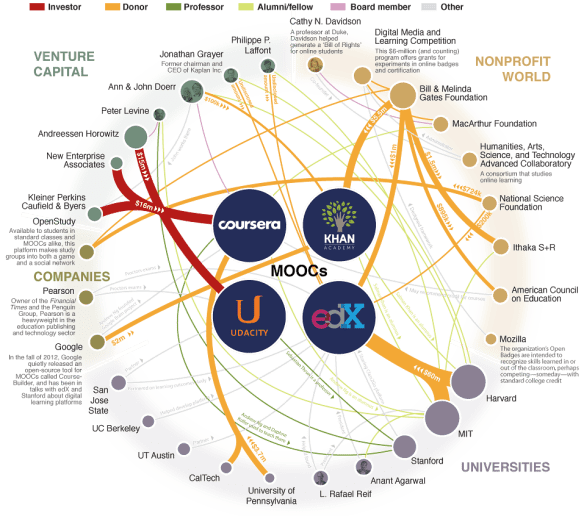
Major Players in the MOOC Universe – The Digital Campus 2013 – The Chronicle of Higher Education


Millions of students have signed up for massive open online courses, and hundreds of universities are offering some form of Web-based curriculum. Most students aren’t paying much for these classes, if they’re paying anything at all. So where is all that knowledge—and all the cash—coming from?  via Major Players in the MOOC Universe – The Digital Campus 2013 – The Chronicle of Higher Education.

MOOCs

What Job Candidates Really Want: Meaningful Work – Nathaniel Koloc – Harvard Business Review


What talented people want has changed. They used to want high salaries to verify their value and stable career paths to allow them to sleep well at night. Now they want purposeful work and jobs that fit clearly into the larger context of their career. And that means they want jobs that are sensible parts of an ongoing journey through a series of professional endeavors — not some supposedly linear path toward “success”.

via What Job Candidates Really Want: Meaningful Work – Nathaniel Koloc – Harvard Business Review.

WorldAffairs 2013 Keynote: Chris Anderson – The Maker Revolution | Stephen’s Lighthouse


WorldAffairs 2013 Keynote: Chris Anderson – The Maker Revolution | Stephen’s Lighthouse

Insightful keynote and Q&A discussing topics including industrial revolutions, manufacturing, machine power and brainpower. Desktop, digital and cloud = the third industrial revolution. Also some great anecdotes and stories on creating “things,” intellectual property, uses for drones, education and digital design, and more.

“Anything you can imagine you can make real.” – Chris Anderson