The Almost Completely Open Source Laptop Goes on Sale | WIRED


Andrew “bunnie” Huang and Sean “xobs” Cross want to sell you a laptop you can completely trust.

Earlier this year, the two Singapore-based engineers fashioned a laptop made almost entirely from open source hardware, hardware whose designs are freely available to the world at large. They called it Project Novena. Anyone could review the designs, looking for bugs and security flaws, and at least in theory, that meant you could be confident the machine was secure from top to bottom, something that’s more desirable than ever in the post-Edward Snowden age.

The original idea was simply to encourage others to build their own open source laptops at home. But now the pair are taking the project a step further. Starting today, you can order your own pre-built Novena laptop through the crowd-funding site Crowd Supply, and it will ship out in the coming months. Much like Kickstarter, Crowd Supply is place where you can put up money to help fund a company and then get a product in exchange.

The project is part of larger movement towards open source hardware. Open source software has become a mainstay across the web and inside many businesses, and now, open source hardware is beginning to find its own place in the world, not only among hobbyists but inside big companies such as Facebook. The idea is not only to improve security, but to help spur innovation. If you share designs, others can make them better. The new, commercial version of the Novena does include some parts that are closed source, such as the processor, but Huang and Cross have tried to minimize these as much as possible.

Read more: The Almost Completely Open Source Laptop Goes on Sale | Enterprise | WIRED.
Zuckerberg and Musk back software startup that mimics human learning | theguardian.com


San Francisco startup Vicarious aims to create ‘a computer that thinks like a person except it doesn’t need to eat or sleep’. via Zuckerberg and Musk back software startup that mimics human learning | Technology | theguardian.com.

This Scientist Uses The New York Times Archive To Eerily, Accurately Predict The Future | Co.Exist


The New York Times might be a widely respected chronicler of past events, but can we use it to divine the future? Kira Radinsky, a 27-year-old Israeli computer prodigy dubbed the “web prophet” says yes.

Radinsky, who appeared this year on MIT’s prestigious list of top 35 inventors under the age of 35 (previous winners include the likes of Mark Zuckerberg, Larry Page, and Sergey Brin), and who started university at the age of 15 and received her Ph.D. in computer science at 26, has developed a unique system which she claims has already predicted the first cholera epidemic in Cuba in many decades, many of the riots that started the Arab Spring, and other important world events.

The complex computer algorithms she wrote collect immense volumes of electronic data–most notably several decades of New York Times archives but also anything from Twitter feeds to Wikipedia entries–and processes it to extract little-known cause and effect patterns that can be used to predict future events.

Red more: This Scientist Uses The New York Times Archive To Eerily, Accurately Predict The Future | Co.Exist

Palette’s modular controller brings dials and sliders to your laptop (hands-on) | Engadget


Palette

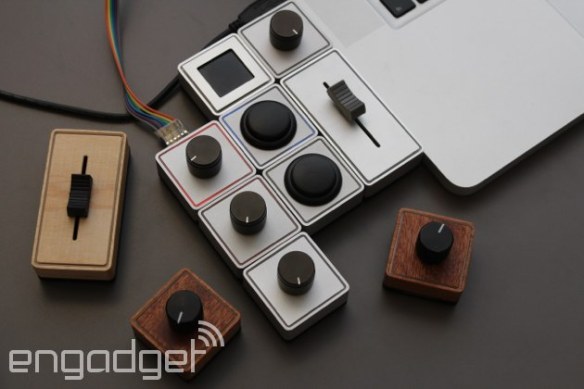
Palette co-founder Calvin Chu has a problem with how people work. “Creative professionals spend so much of their time on the computer, and at the moment, they still use a very generic one-size-fits-all keyboard and mouse interface.” It doesn’t make sense, he says — photographers, gamers, film editors, musicians and accountants all using the same interface? Surely there is a better way. “It should be specialized and made for your needs, and that’s where we came up for the idea for Palette.” Palette is Chu’s answer to a world that’s discarded tactile dials and switches for keyboards, mice and touch screens. It’s a modular collection of buttons, sliders and potentiometers that can be programmed to do almost anything on your PC. We took a look at an early prototype of the customizable controller to reacquaint ourselves with the tactile world.

Read: Palette’s modular controller brings dials and sliders to your laptop (hands-on)  | Engadget

The Best of Internet Librarian 2013 | Ellyssa Kroski | OEDB.org


Every year there are two amazing conferences focusing on information technology and libraries hosted by Information Today – Computers in Libraries and Internet Librarian. They feature the field’s top innovators sharing their insights, recent project experiences, and practical tips. If you couldn’t make this year’s event, here are 10 stellar presentations that will catch you up:

Presentation topics:

  • Managing Devices & Gadgets
  • Open Source Solutions & Apps
  • Project Management
  • Tech Tools for Engaging Communities
  • Usability Testing: On Board & On a Shoestring
  • Using Web Analytics for Site Improvement
  • Super Searcher Secrets
  • The New State of Search: Google, Discovery, & Apps
  • Clarifying Copyright for the Classroom Teacher
  • Embedded Librarianship With Google Docs

Access them here: The Best of Internet Librarian 2013 | Ellyssa Kroski | OEDB.org.

News: Education & Technology, Librarianship


Education & Technology

Librarianship

Are Digital Libraries A ‘Winner-Takes-All’ Market? OverDrive Hopes So | Forbes
“Schools and libraries in all forms are transitioning their spends from providing physical items that are being stored on shelves and branches to digital items — the fastest portion of their growth,” said Steve Potash  in a recent interview. Potash is President and CEO of OverDrive, the Cleveland-based provider of technology for managing and distributing digital content for lending libraries.

Gross: Fifty Shades of Grey goes viral – literally | theguardian
Library copies of the bestselling sadomasochistic romance were found to carry traces of herpes and cocaine.

Make Your Own Computer For $99 | Co.Design


For most of us, the inner-workings of a MacBook Air remain a pleasant, whirring mystery. That is until, something goes horribly south and we realize we need a Genius to fix it. But what if there was a way to demystify the mechanics of computing and simply build your own?

That’s the promise behind the new Kano computer kit, which is touting itself as “the first computer that anyone can make.”

Read: Make Your Own Computer For $99 | Co.Design | business + design.

A Girl Who Codes | Fast Company


A Girl Who Codes | Fast Company | Business + Innovation

Computing has always been a boys’ club. How 18-year-old nikita rau–and other young women like her–are finally changing that.

Read: A Girl Who Codes | Fast Company | Business + Innovation.

Watson Is Going To Be Open For Public Use on the Cloud | Gizmodo


Watson

Watson was always going to be more than just a successful game show contestant. Now, the computer is about to take on anything and everything, as it opens itself up to the public on the cloud.

IBM has announced that its supercomputer will be opened up to developers in 2014, using a new, open API that will allow people to write code which can directly take advantage of Watson’s natural language abilities. Developers will be able to ping Watson complex strings of questions and get answers in real time.

Read more: Watson Is Going To Be Open For Public Use on the Cloud | Gizmodo.

Touch Board kit combines an Arduino heart with touch sensors, conductive paint | Engadget


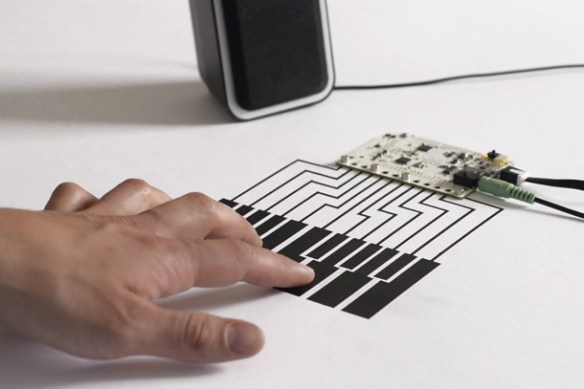
Capacitive sensing isn’t limited to your smartphone. In fact, you can use contact with human skin (or any other conductive surface) to trigger almost any circuit. And the Touch Board from Bare Conductive wants you to combine your DIY spirit with the ability to turn practically any surface into a sensor. At the heart is an Arduino compatible microcontroller (based on the Leonardo) with a few extras baked in, including a Freescale touch sensor connected to 12 electrodes and an audio processor for triggering MIDI sounds or MP3 files. While you can simply trigger the electrodes by touching them or connecting them to any conductive material, such as a wire, the Electric Paint Pen really opens up the input possibilities. It’s just like a paint marker, often used for small scale graffiti, except it spits out conductive black ink that can turn a wall, a piece of paper or almost anything else into a trigger. In fact, it

TouchBoard

‘s preloaded with a bunch of sample sounds on a microSD card so that you can simply paint a soundboard out of the box.

Read more: Touch Board kit combines an Arduino heart with touch sensors, conductive paint.