
Thanks to the internet, it has never been easier to steal other people’s work. There’s also a high risk you’ll be found out. So why do it? Rhodri Marsden goes in search of a little originality…via The big steal: rise of the plagiarist in the digital age | Technology | The Guardian.
Tag Archives: copyright
8 Years Later, Google’s Book Scanning Crusade Ruled ‘Fair Use’ | Wired.com
Full Post
Eight years after a group of authors and publishers sued Google for scanning more than 20 million library books without the permission of rights holders, a federal judge has ruled that the web giant’s sweeping book project stayed within the bounds of U.S. copyright law.
On Thursday morning, U.S. Circuit Judge Denny Chin dismissed a lawsuit from the Author Guild, ruling that Google’s book scans constituted fair use under the law. Though Google scanned those 20 million books in full and built a web service, Google Books, that lets anyone search the digital texts, users can only view “snippets” of a book if the right holder hasn’t given approval.
“In my view, Google Books provides significant public benefits,” the ruling reads. “It advances the progress of the arts and sciences, while maintaining respectful consideration for the rights of authors and other creative individuals, and without adversely impacting the rights of copyright holders.”
In a statement sent to WIRED, a Google spokesperson said the company was “absolutely delighted” with the ruling. “As we have long said, Google Books is in compliance with copyright law and acts like a card catalog for the digital age giving users the ability to find books to buy or borrow.”
Michael Boni, a partner with Boni & Zack, the law firm representing the Authors Guild, did not immediately respond to a phone message seeking comment. Nor did the Author’s Guild. But the Guild has told other news outlets it will appeal the decision.
“We disagree with and are disappointed by the court’s decision today. This case presents a fundamental challenge to copyright that merits review by a higher court,” reads a statement sent to GigaOm. “Google made unauthorized digital editions of nearly all of the world’s valuable copyright-protected literature and profits from displaying those works. In our view, such mass digitization and exploitation far exceeds the bounds of the fair use defense.”
The ruling comes two years after Judge Chin rejected a $125 million settlement between Google, the Author’s Guild, and the Association of American Publishers, which was also part of the original lawsuit against the web giant. After complaints over the settlement from outside organizations such as the Internet Archive and Google rivals such as Microsoft, Chin ruled the deal would give Google a de facto monopoly over so-called “orphan books,” scanned texts whose rights holders had not come forward to claim their share of the revenues Google would make from its book scanning endeavor.
A year after this ruling, the publishers agreed to another settlement with Google, and this one was not subject to approval from the court. But Chin allowed the case to continue as a class action, but an appeals court reversed this decision and told Chin to rule on the copyright issue.
Though Google limits how much book text you can view online — and though it doesn’t display ads on pages describing books it does not have rights to, the company, as the court explained, can still use its service to draw people to its websites and make money in other ways. But this commercial gain doesn’t necessarily mean copy infringement. Google Books, the judge ruled, doesn’t “negatively impact the market for books.”
On the contrary, Chin said, Google Books feeds the market for books. “A reasonable factfinder could only find that Google Books enhances the sales of books to the benefit of copyright holders,” the ruling reads. “Google Books provides a way for authors’ works to become noticed, much like traditional in-store book displays.”
via 8 Years Later, Google’s Book Scanning Crusade Ruled ‘Fair Use’ | Wired Business | Wired.com.
The Internet Archive Opens Its Historical Software Collection To All | Gizmodo, Internet Archive
Full Post
Gamers of a certain age will no doubt scream Oh wow, I remember that! as they click through the Internet Archive’s latest project.
The non-profit organization recently launched the Historical Software Collection, with the mission of making old programs accessible (including plenty of games!) that were originally released for platforms like Atari 2600, Apple II, and Commodore 64.
Software itself isn’t new to the Archive, but it’s spent the past couple of years making these programs playable in-browser. So whether it’s E.T. on Atari 2600 from 1982 or VisiCalc on the Apple II from 1979, there’s no need to download a heap of emulators to try them out.
Archiving video games can present special challenges, as David Gibson at the Library of Congress has explained so well. But the independent Internet Archive claims to have the largest software archive in the world, and it should be interesting to see how the next few years work out for them.
Perhaps one of the greatest challenges they’ll face is copyright. Technically, all of these programs are still covered under copyright law. And I have no doubt that the myriad companies responsible for managing the rights to something like E.T. are figuring out if they should intervene. Hopefully, no one will try to pull these programs. But if they do, it will be just one more example of how desperately broken our current copyright system is. [Internet Archive]
The Internet Archive Opens Its Historical Software Collection To All | Gizmodo
Video game studio uses copyright claims to censor bad reviews | The Daily Dot
A video game studio censored negative YouTube reviews of its latest title, using spurious copyright-infringement claims to get its way. And now the gaming world is hoisting its controllers in revolt.
via Video game studio uses copyright claims to censor bad reviews | The Daily Dot
You may also like: Want to Sell Your Game? Don’t Tick Off YouTubers | WIRED
How to Find Creative Commons Video Assets | Mashable
Creating a YouTube video is a breeze now that nearly every computer has built-in video editing software. But integrating images, music or other media into a video can be tricky. If you use copyrighted songs or pictures, your video may be removed, and YouTube may even suspend your account.
Advice for finding CC images, video clips, music, texts and fonts and other assorted media.
Infographic Shows Good News about Library Fair Use [Infographic] | ARL®

DragonCon Carpet Cosplayers Copyright | The Mary Sue
How about a Monday morning diversion?
At DragonCon last month, a couple of cosplayers decided to sidestep the usual fare of superheroes and cartoon characters in favor of dressing up as the carpet at the Marriott hotel where the con takes place. Yup, there was carpet-colored camo. That is a real thing that now exists. Naturally, other people wanted to emulate the design, but, alas, this psychedelic carpet army was not to be – because Courtisan Inc., the company that designed the original rug, issued a Cease and Desist soon after the design went up.

Volpin Props, the cosplay designer, posted on their facebook page about the incident and received almost 300 comments, ranging from serious discussion of copyright and intellectual property to expressions of surprise that anyone would admit to having designed such an ugly carpet. Still, Volpin Props has gracefully stated that they are “in complete agreement with [Courtisans] decision,” so it looks like anyone looking to blend in with the carpeting in the future will have to make their own costume. Or maybe they should try the wallpaper? Carpet controversy aside, I think that we all can rest easy knowing that this photo exists:
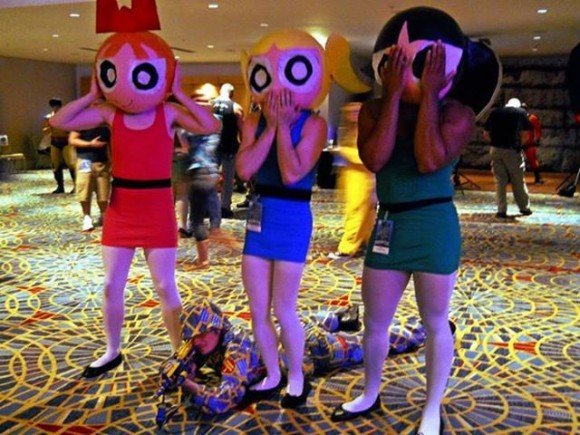
The moral of the story is A. Cosplayers are will always find new ways to be creative and awesome and B.You can’t sell carpets that don’t belong to you, no matter how ugly they are.
Recent Internet Censorship Stories You May Have Missed
Copyright Takedowns on Twitter Are Up 76 Percent | Gizmodo
Twitter just released its latest transparency report detailing government requests for information requests, content removal requests and copyright takedowns. Not just one or two but all three categories are up in the first half of this year.
The UK wants to filter porn. Here’s how it might hurt the Internet. | Washington Post
Prime Minister David Cameron announced a plan to filter online pornography by default for households in the United Kingdom, saying the initiative is about protecting children and “their innocence.”
U.K. to compel customers to opt-in for internet porn | CBC
British internet providers will begin blocking access to online pornography unless customers specifically opt-in to surf sexually explicit material.
Tim Berners-Lee warns against governments controlling the Web | CNET
“When you make something universal…it can be used for good things or nasty things…we just have to make sure it’s not undercut by any large companies or governments trying to use it and get total control.”
What Internet Freedom Means to Me (and You) | Information Space
For the fourth of July, I thought it would be fitting (and fun) to get people’s ideas on Internet freedom.
Internet porn ‘opt in’ is censorship, say Canadians | Your Community | CBC
All internet pornography should be preemptively blocked in Canada, says Conservative MP Joy Smith of Winnipeg, which would force those who want to access adult content to “opt in” with their internet service provider….Many of those within our comments and on social media say that making citizens opt in to access adult content through their ISP would be a form of censorship.
A Map of the Countries That Censor the Internet | Gizmodo
The classification of censorship depends on political censorship like human rights and government opposition, social censorship, conflict/security censorship and various Internet tool censorship.
The Most Convoluted DMCA Takedown Request of All Time | Gizmodo
Anti-Gay group Straight Pride UK is abusing the DMCA takedown process to censor work by a journalist. No surprise there—the DMCA is twisted for all kinds of dumb purposes. The inexplicable part? The hate group filed a takedown on… its own press release. How dare you say that we said the words that we wrote in a press release.
Google Copyright Infringement Reports to Quadruple This Year | Mashable
The rate of copyright infringement reports Google received in 2013 is on track to quadruple the number of reports received in 2012.
In the first seven months of 2013, publishers have submitted 110.2 million requests to remove copyright-infringing content, compared with 55.2 million requests in all of 2012.
via Google Copyright Infringement Reports to Quadruple This Year | Mashable.
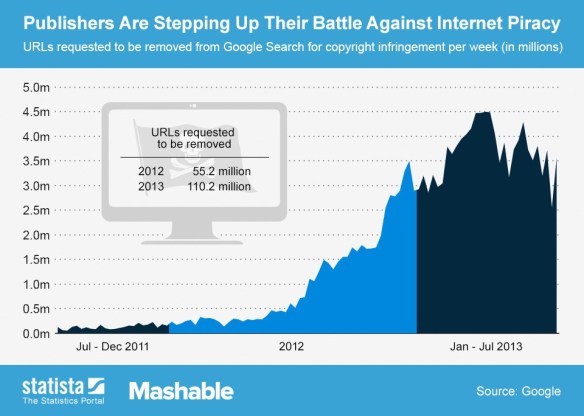
Image: Tony Karumba/AFP/Getty Images
You may also like:
Governments’ Attempts To Censor Google Have Doubled Since 2011 | TechCrunch
 infophile