This Sign Language Ring Translates Hand Movements Into Spoken Words | Fast Company


This Sign Language Ring Translates Hand Movements Into Spoken Words | Fast Company | Business + Innovation

A winner of the coveted red dot awards for design concept in 2013, Sign Language Ring is a device that detects sign language motion and “translates” that to voice by emitting audio through a speaker.

Comprising a bracelet and set of detachable rings worn on select fingers, Sign Language Ring was inspired by Buddhist prayer beads, according to its six designers from Asia University. The wearable device can also translate voice to text, transcribing spoken language picked up by a microphone into text that’s displayed on the bracelet’s screen.
Read: This Sign Language Ring Translates Hand Movements Into Spoken Words | Fast Company | Business + Innovation

Google Reveals Its 9 Principles of Innovation | Fast Company


Ever wonder what makes the Google the holy grail of productivity and creativity? There’s no magic in the drinking water at the Mountain View, CA company. The tech giant draws from what Google’s chief social evangelist, Gopi Kallayil, calls the nine core principles of innovation.

Kallayil shared his insights at this week’s San Francisco Dreamforce summit. Here are the nine rules that any enterprise, large or small, can adopt to steal Google’s innovative culture.

The principles:

  1. Innovation Comes From Anywhere
  2. Focus On The User
  3. Aim To Be Ten Times Better
  4. Bet On Technical Insights
  5. Ship And Iterate
  6. Give Employees 20 Percent Time
  7. Default To Open Processes
  8. Fail Well
  9. Have A Mission That Matters

Read more: Google Reveals Its 9 Principles of Innovation | Fast Company | Business + Innovation.

Make Your Own Computer For $99 | Co.Design


For most of us, the inner-workings of a MacBook Air remain a pleasant, whirring mystery. That is until, something goes horribly south and we realize we need a Genius to fix it. But what if there was a way to demystify the mechanics of computing and simply build your own?

That’s the promise behind the new Kano computer kit, which is touting itself as “the first computer that anyone can make.”

Read: Make Your Own Computer For $99 | Co.Design | business + design.

For the Music Librarians: Leonardo da Vinci piano hybrid heard after 500 years | CNET


An unusual musical instrument that combines keyboard and cellos has seen the light of day some 500 years after the Renaissance superman conceived it.

Leonardo’s viola organista has come to life through the passion of Polish pianist Slawomir Zubrzycki, who has played a lavishly designed version of it in concert.

Zubrzycki produced the mechanically bowed keyboard, which resembles a bowed clavier, based on a sketch and notes in Leonardo’s Codex Atlanticus, a collection of manuscripts covering miscellaneous subjects that is dated 1478 to 1519.

Read more: Leonardo da Vinci piano hybrid heard after 500 years | Crave | CNET

Making Your Library Promotion Pop | April Aultman Becker


18 of the Best Designs of All Time, Picked by Jony Ive and Marc Newson | Wired.com


Something unsurprising happens when you task two star designers to curate a catalog of their favorite objects: You end up with a collection of ridiculously well-designed products. This is exactly what happened when Sotheby’s tapped Jony Ive and Marc Newson to pull together a list of goods to be auctioned off at the (RED) Auction, which is raising money for the Global Fund to Fight AIDS, Tuberculosis and Malaria.

Read: 18 of the Best Designs of All Time, Picked by Jony Ive and Marc Newson | Wired Design | Wired.com


A Glowing Book That Illuminates More Than Just Your Brain | Gizmodo


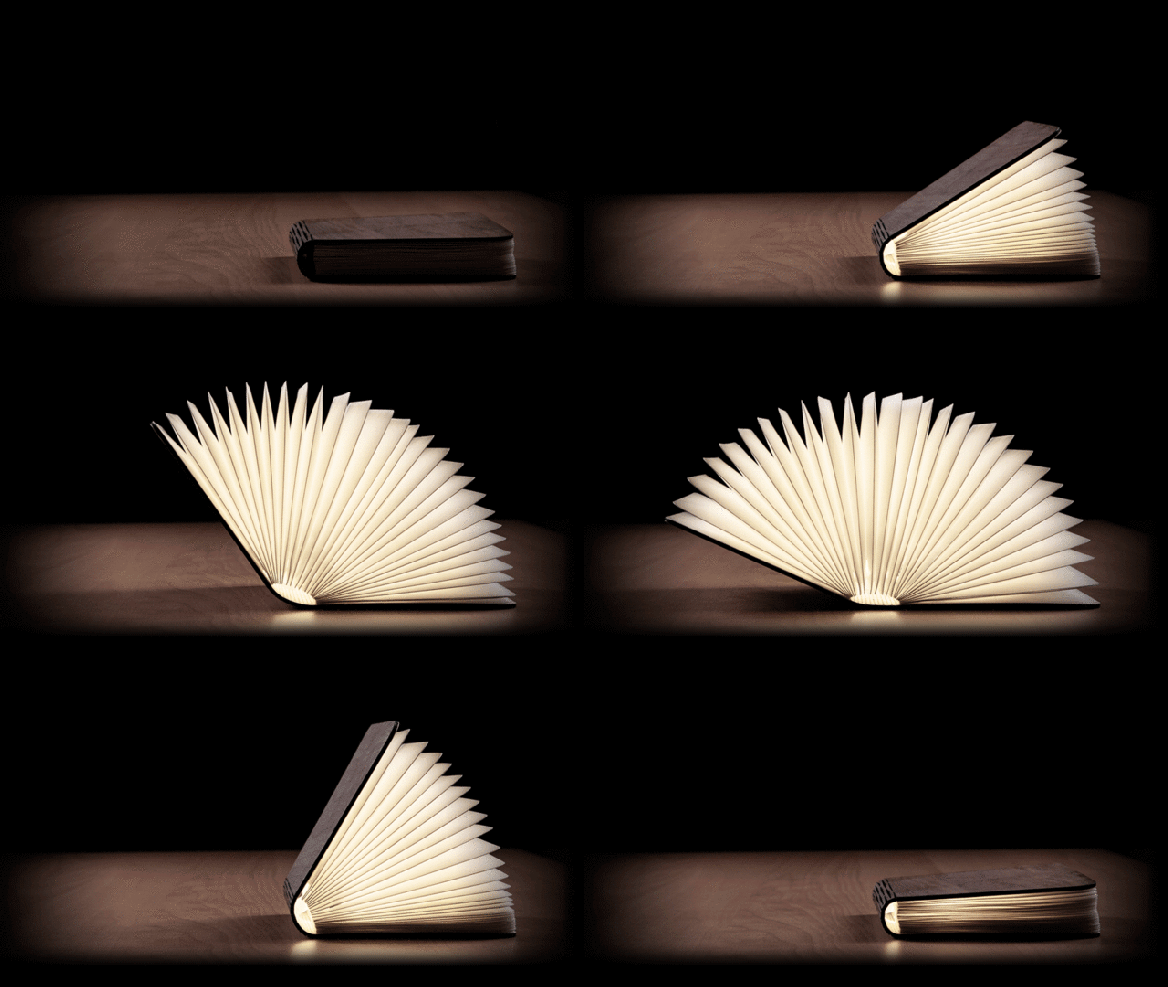
Max Gunawan’s wonderful Lumio accordion book lamp has been popping up on design sites for the past year or so. But after a successful Kickstarter campaign earlier this year, it’s finally available for purchase, bringing its soft glow to home libraries around the world

Read: A Glowing Book That Illuminates More Than Just Your Brain | Gizmodo

Book Lamp

MIT Invents A Shapeshifting Display You Can Reach Through And Touch | Co.Design


We live in an age of touch-screen interfaces, but what will the UIs of the future look like? Will they continue to be made up of ghostly pixels, or will they be made of atoms that you can reach out and touch?

At the MIT Media Lab, the Tangible Media Group believes the future of computing is tactile. Unveiled today, the inFORM is MIT’s new scrying pool for imagining the interfaces of tomorrow. Almost like a table of living clay, the inFORM is a surface that three-dimensionally changes shape, allowing users to not only interact with digital content in meatspace, but even hold hands with a person hundreds of miles away. And that’s only the beginning.

Read more: MIT Invents A Shapeshifting Display You Can Reach Through And Touch | Co.Design | business + design.

The Secrets Of A Memorable Infographic | Co.Design


Human memory is very fallible, but lately cognitive scientists have found that our minds capture much more visual detail in a moment than once believed. A 2008 paper reported that people who saw thousands of images for three seconds each over five hours later identified ones they’d seen over similar alternatives with nearly 90% accuracy. They didn’t just remember that they’d seen a cracked egg, they remembered that its egg white had formed a perfectly round puddle.

In other words, when we do retrieve a memorable image, a surprising amount of information comes with it, like a burr stuck to a sweater. That insight could have big implications for people who use visualizations in their everyday lives–graphic designers, for instance, or anyone on Tumblr. Above all, it suggests that memorability alone might enhance an infographic’s effectiveness. But it also prompts a question: How does an image become memorable in the first place?

Read: The Secrets Of A Memorable Infographic | Co.Design | business + design.

Chris Downey: Design with the blind in mind | TED.com


What would a city designed for the blind be like? Chris Downey is an architect who went suddenly blind in 2008; he contrasts life in his beloved San Francisco before and after — and shows how the thoughtful designs that enhance his life now might actually make everyone’s life better, sighted or not.

via Chris Downey: Design with the blind in mind | Video on TED.com.