Alabama Legislator Bill Holtzclaw Calls On Schools To Ban Toni Morrison Book | Huffington Post


An Alabama legislator who does not support efforts to repeal the sweeping U.S. education initiative known as the Common Core Standards says he believes the reading list issued in conjunction with the standards needs to be revised.

State Senator Bill Holtzclaw (R-Madison) told Alabama Media Group this week that he believes The Bluest Eye, by Toni Morrison, should be banned from high school libraries, despite the fact that this book is on the Common Core Standard’s recommended reading list for 11th-graders. 

See the full story: Alabama Legislator Bill Holtzclaw Calls On Schools To Ban Toni Morrison Book | Huffington Post.

Woman wants changes at library after grandson checks out erotic novel | Fox 59 News


Story about a woman challenging adult materials in a library’s collection. This incident would make a great case study for a course assignment in LIS school.

INDIANAPOLIS, Ind.– The library is a great place for children to explore new books and learn to love reading. However, what if your child came home from the library with an erotic romance novel?

Snips

Deeren said she followed library protocol in an attempt to get books like this removed. “This is what I did. I went through three different people, filled out paper and then they sent this back,” Deeren said, referring to a letter that was sent back to her.

The letter indicated that Night Games has been nominated for several awards and that it’s the guardian’s responsibility to monitor a child’s book selection, which is indicated in the library application for people 18 and younger.

************

“There is a place for these books and that’s an adult book store. If they want to keep it at a library, I want them to keep it behind a door,” Deeren said.

She is not giving up.

“I want to get this (Night Games) out of there. I want to just keep talking to people about getting these kinds of books out or putting them behind closed doors. One or the other,” Deeren said.

There is much more content to this story. See the full article:  Woman wants changes at library after grandson checks out erotic novel | Fox 59 News – fox59.com.

Libraries Weigh Accepting Paid Ads to Keep Afloat | American Libraries Magazine


With the Great Recession still affecting public service budgets nationwide, libraries continue to pursue new funding avenues. The latest foray into fiscal triage, undertaken by at least two libraries—Toronto (Ont.) Reference Public Library and the Port Chester –Rye Brook (N.Y.) Library—is to allow commercial enterprises to advertise their products and services in the library.

In both cases, the libraries have accepted a quid pro quo from ad placement companies. The firms provide a product for free to the library. In exchange, the company keeps whatever revenue comes from selling the ads displayed on that free product.

See the full article: Libraries Weigh Accepting Paid Ads to Keep Afloat | American Libraries Magazine.

Declaration for the Right to Libraries | American Libraries Magazine


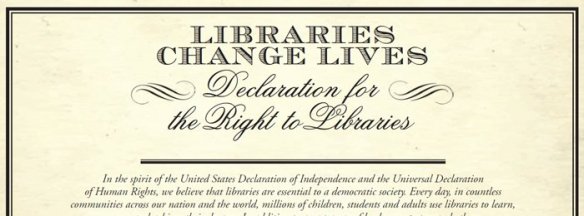
On July 30, ALA President Barbara Stripling unveiled the “Declaration for the Right to Libraries” during a signing ceremony at Nashville (Tenn.) Public Library. The Declaration is the cornerstone document of Stripling’s presidential initiative, “Libraries Change Lives,” which is designed to build the public will and sustain support for America’s right to libraries of all types—academic, special, school, and public. Stripling’s initiative will focus on transformative library practices in literacy, innovation, and community engagement.

via Declaration for the Right to Libraries | American Libraries Magazine.

Declaration for the Right to Libraries

The State of Digital Rights: A Discussion | Mashable


For the past few weeks, Mashable has been crowdsourcing a Digital Bill of Rights to highlight the digital freedoms and protections our readers feel each user should be guaranteed as a citizen of the Internet.

After hundreds of comments and contributions on the Google Doc and through social media, a Digital Bill of Rights by the Internet, for the Internet, has been created. The document, though, is a work in progress as more users from across the world continue to include their thoughts and additions to it.

via The State of Digital Rights: A Discussion | Mashable.

Quill & Quire | Guest opinion: why libraries should get into the book-selling business


In the June 2013 issue of Q&Q, Vancouver librarians Shirley Lew and Baharak Yousefi argue that libraries should get into the business of selling books.

See the full article: Quill & Quire | Guest opinion: why libraries should get into the book-selling business.

Quotable: “The loss of independent bookstores is accompanied by the loss of diversity, possibility, and sense of place. Publishers, writers, and the readers they serve all lose in a market that rewards blockbusters but ignores alternative voices and ideas. Instead of being bystanders to this devastation, libraries have compelling reasons to seize the opportunity it presents. We have a mandate to help preserve our literary and cultural landscape; we have the space, often in rent-controlled buildings; we know how to buy and promote books; and we are not constrained by the need to turn a profit. We are uniquely equipped to sell books and support writers, publishers, and reading in Canada.”

Related: Storify: should libraries sell books? [some Twitter reactions] | Quill & Quire

The Declassification Engine: Your One-Stop Shop for Government Secrets | Wired Enterprise | Wired.com


A fascinating article about researchers developing the “Declassification Engine” – a tool to analyze declassified documents in the United States.

In many cases, documents are declassified only because individuals will request them under the Freedom of Information Act, and this often means they’re spread to the four winds. “There are a lot of declassified documents out there. Some of them are in historians’ basements. Some are in specific libraries. Some are in digital archives. And they’re in different formats. No one has systematically collected them into a searchable, usable, user-friendly database,” says Columbia law professor David Pozen.

The Declassification Engine seeks to remedy this, but that’s only the first step. Columbia’s Matthew Connelly first dreamed up the idea when he realized that although more and more government documents are now created in electronic format, a dwindling percentage are declassified in electronic format. The rise of digital records, he told himself, should provide more opportunities for researchers, not less.

See the full article: The Declassification Engine: Your One-Stop Shop for Government Secrets | Wired Enterprise | Wired.com.

Top Ten (10) Social Media Competencies for Information Professionals | The Search Principle


Top Ten (10) Social Media Competencies for Information Professionals | The Search Principle

Pull Quote:

Top Ten (10) Social Media Competencies for Information Professionals (2013)

  1. Understand, explain and teach others about the principles and trends of social mediaweb 2.0 (and library 2.0 / archives 2.0)
  2. List major tools, categories and affordances of social media
  3. Apply social media to solve information problems, and communicate digitally with users
  4. Use social networking sites for promotional, reference and instructional services in libraries
  5. Navigate, evaluate and create content on social networking sites
  6. Follow netiquette, conform to ethical standards and interact appropriately with others online
  7. Explain copyright, security and privacy issues on social media to colleagues and user communities
  8. Understand the importance of digital identity and reputation management in a social media age
  9. Explain related terminology such as collaboration 2.0, remix and open source
  10. Renew social media competencies, advocate for institutional strategies and policiesand build evidence base in social media

City of New York settles with Occupy over destruction of the People’s Library » MobyLives


“The City of New York and Brookfield Properties has agreed to pay more than $233,000 to settle a lawsuit brought by Occupy Wall Street over the destruction of the People’s Library during the eviction of Zuccotti Park by the New York Police Department last fall. During the raid to clear the park in the early morning hours of November 15th 2011, the majority of the collection of more than 4,000 books donated by the public and organized by the Library Working Group was destroyed or damaged, an act roundly condemned by the  American Library Association, as did the New York Civil Liberties Union and the National Lawyers Guild.” via City of New York settles with Occupy over destruction of the People’s Library » MobyLives.

DMCA chilling effects: How copyright law hurts security research. – Slate Magazine


An informative exposition on the DMCA and security research. I thought the article interesting and a reminder of the power of political and lobbying bodies in the US. In Canada, we are weathering our own struggle against the muzzling of our scientific researchers and librarians by the PMO.

“The outdated copyright law doesn’t just hurt consumers—it cripples researchers.” via DMCA chilling effects: How copyright law hurts security research. – Slate Magazine.

You may also like: