Publishers Know You Didn’t Finish “The Goldfinch” — Here’s What That Means For The Future Of Books | BuzzFeed News


Millions may have held their suspicions, but last month the Canadian e-reader company Kobo confirmed it: Most people who buy The Goldfinch don’t actually finish it. According to the company’s data, less than half of Canadian and British Kobo readers in 2014 made it to the end of Donna Tartt’s behemoth novel, one of the best-selling of the year.

How did Kobo know this? Like every e-reader and reading-app maker today, the company, a subsidiary of the Japanese e-commerce titan Rakuten, has access to a comprehensive suite of data about the reading behavior of its users. In a white paper titled “Publishing in the Era of Big Data” and released this fall, the company announced that “with the onset of digital reading … it is now possible to know how a customer engages with the book itself — what books were left unopened, which were read to the very last word and how quickly.” In other words, if you read books digitally, the people who serve you those books more than likely know just what kind of reader you are…READ MORE: Publishers Know You Didn’t Finish “The Goldfinch” — Here’s What That Means For The Future Of Books | BuzzFeed News.
Windows Holographic: Microsoft Goes Full Throttle Into Virtual Reality | Mashable


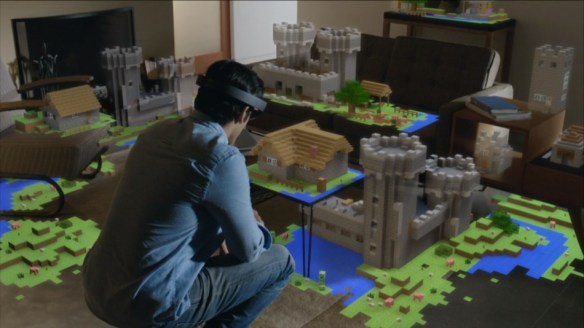
Microsoft introduced Windows Holographic, a technology that gives us a “world with holograms,” during its Windows 10 event on Wednesday. It would let a user transform one’s living room into a “surreal gaming environment,” according to the company.

There are no wires. No external cameras.

It works with Microsoft’s HoloLens headset, which allows users to wirelessly view holograms. Both the HoloLens and Windows 10 are slated to be available this fall.

READ MORE: Windows Holographic: Microsoft goes full throttle into virtual reality | Mashable

Google Cardboard Is The Right Virtual-Reality Gadget For Right Now. But What’s Next? | Fast Company


I’d like to try the Cardboard experience to compare to the Oculus Rift. I tried OR at Netspeed 2014, experiencing an under water universe (boring with unwieldy navigation) and a roller coaster (exciting; definitely created a unique, visceral experience that made me want to puke my guts out after). Looking forward to more virtual reality experiences as the tech and devices evolve.

Google Cardboard Is The Right Virtual-Reality Gadget For Right Now. But Whats Next? | Fast Company | Business + Innovation

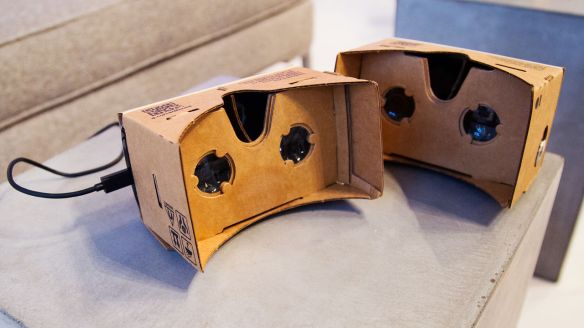
Google Cardboard has come a long way since Android honcho Sundar Pichai introduced it with a sheepish grin six months ago. The smartphone virtual reality viewer, made from folded-up cardboard with a pair of attached lenses—you supply an Android phone to provide computing power and a display—has shipped more than 500,000 units as of early December. (You can build your own Cardboard, or buy a ready-made version from not-quite-official sources for under $30.) Google has now added a Play Store showcase for the best Cardboard apps, and released a software development kit to spur even more VR app creation.

For a project that took mere weeks to throw together, Cardboard has done surprisingly well. But its success also puts it in an awkward position, somewhere between the oddball project that Cardboard appeared to be back in June and the serious business that prompted Facebooks $2 billion acquisition of Oculus VR in February. As virtual reality matures, is Cardboard prepared to mature with it?

READ MORE: Google Cardboard Is The Right Virtual-Reality Gadget For Right Now. But What’s Next? | Fast Company | Business + Innovation.

The Top UX Predictions for 2015 | UX Magazine


Top UX predictions for 2015 from UX Magazine contributors. The Top UX Predictions for 2015 | UX Magazine

The Future of the Book | The Economist


“The digital transformation of the way books are written, published and sold has only just begun.” Essay on The Future of the Book | The Economist. Listen. Scroll. Flip.

AI, Robotics, and the Future of Jobs | Pew Research Centers Internet & American Life Project


The vast majority of respondents to the 2014 Future of the Internet canvassing anticipate that robotics and artificial intelligence will permeate wide segments of daily life by 2025, with huge implications for a range of industries such as health care, transport and logistics, customer service, and home maintenance. But even as they are largely consistent in their predictions for the evolution of technology itself, they are deeply divided on how advances in AI and robotics will impact the economic and employment picture over the next decade.

READ MORE: AI, Robotics, and the Future of Jobs | Pew Research Centers Internet & American Life Project.

Woman Puts Deus Ex On Computer Chip In Her Hand | Kotaku


Zoe Quinn doesn’t just make heartfelt, experimental games like Depression Quest. She’s also pretty set on becoming a cyborg, judging from the cyberpunk as hell implants she’s gotten over the last couple of years.

READ MORE: Woman Puts Deus Ex On Computer Chip In Her Hand | Kotaku

10 New Breakthrough Technologies 2014 | MIT Technology Review


Technology news is full of incremental developments, but few of them are true milestones. Here we’re citing 10 that are. These advances from the past year all solve thorny problems or create powerful new ways of using technology. They are breakthroughs that will matter for years to come.

  1. Agricultural Drones
  2. Ultraprivate Smartphones
  3. Brain Mapping
  4. Neuromorphic Chips
  5. Genome Editing
  6. Microscale 3-D Printing
  7. Mobile Collaboration
  8. Oculus Rift
  9. Agile Robots
  10. Smart Wind and Solar Power

READ MORE ON EACH STORY: 10 New Breakthrough Technologies 2014 | MIT Technology Review

Why the Smart Reading Device of the Future May Be … Paper | WIRED


Paper books were supposed to be dead by now. For years, information theorists, marketers, and early adopters have told us their demise was imminent. Ikea even redesigned a bookshelf to hold something other than books. Yet in a world of screen ubiquity, many people still prefer to do their serious reading on paper.

Count me among them. When I need to read deeply—when I want to lose myself in a story or an intellectual journey, when focus and comprehension are paramount—I still turn to paper. Something just feels fundamentally richer about reading on it. And researchers are starting to think there’s something to this feeling.

READ MORE: Why the Smart Reading Device of the Future May Be … Paper | Science | WIRED.

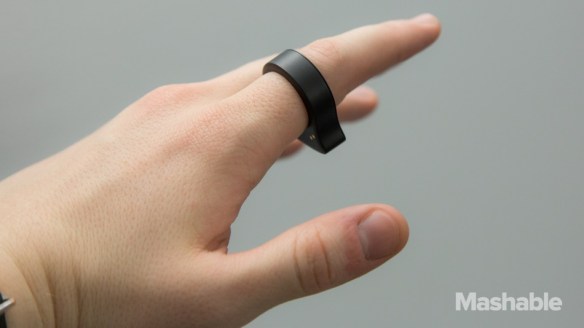
Nod Bluetooth Ring Controls All Your Smart Devices | Mashable


As our primary computing environment gradually shifts from the desktop to mobile, so too will our interface needs. To that end, a group engineers in Mountain View, Calif. believe that they have the solution for the next phase of interfaces, and it comes in the form of a ring.

The Nod ring is a Bluetooth-enabled gesture controller that connects to your smartphone to accomplish a number of input and controller tasks all by using natural motions with your finger.

In addition extending the capabilities of your smartphone, the ring can also be connected to other smart devices, such as a smart television and other Internet-connected devices like the Nest. If a device doesn’t have Bluetooth capability, you can connect the ring to your smartphone, which will then connect to the device via Wi-Fi. Read more: Nod Bluetooth Ring Controls All Your Smart Devices | Mashable