
The most difficult problems of scanning books have been solved including flattening curve ,erasing fingerprint, smart edge-cutting and so on. All of these can be done automatically.
Tag Archives: gadgets
Clinical Trial Will Test if #GoogleGlass Can Help #Kids with #Autism | WIRED #assistive #tech #gadgets #devices #disabilities #learning
For Voss, Wall, and their colleague Nick Haber, a Stanford post-doc, the idea is that their Glass software will help autistic children recognize and understand facial expressions and, through them, emotions. It operates like a game or, as Voss calls it, an “interactive learning experience.” Through the Google Glass eyewear, children are asked to, say, find someone who is happy. When they look at someone who is smiling, the app recognizes this and awards “points.” The system also records what the child does for later review. “You can plot, as they wear the glasses, how they’re improving, where they’re improving,” Wall says. “You can look at video to understand why.” READ MORE: Clinical Trial Will Test if Google Glass Can Help Kids with Autism | WIRED
Typewriter-Inspired Mechanical #Keyboard | QWERKYWRITER #gadgets #devices #typewriters #digital #tech

We spend a lot of time on our digital devices and we should be able to express ourselves through them. Unfortunately it’s all beige and brushed aluminum these days. We at Qwerkytoys are about to shake things up with our first product, the Qwerkywriter. Qwerkywriter connects wirelessly via Bluetooth to iPhones, iPads, iMacs, MacPros, Macbooks, Android Tablets Devices, Windows Tablets, and more. MORE: QWERKYWRITER | Typewriter-Inspired Mechanical Keyboard
Related: Qwerkywriter’s retro iPad keyboard is a flawed masterpiece | Engadget
Are #Tablets Harming Our Children’s Ability to Read? | Technology | The Guardian #reading #kids #tech #devices
The last few years have seen the biggest change in how young people spend their time since the invention of the television – but is it a good thing? READ MORE: Are tablet computers harming our children’s ability to read? | Technology | The Guardian.
@Google Just Created a Stupidly Simple #WiFi #Router | WIRED #tech
As a comparison, my Apple Airport Extreme is sleek, minimalistic, functional and costs CAD$249.
[T]he company is launching a new device called the OnHub, in partnership with router-maker TP-Link. For $199, it promises to make your Wi-Fi faster and more reliable, and to give you the ability to update and fix your connection. (You know, for the rare times unplugging it and plugging it back in just won’t do.) The most striking thing about the OnHub is the way it looks. It’s not your average router, with wires and antennas poking out from every side; it’s a large cylindrical device with a blinking light on the top…Its outer shell is removable, and comes in either blue or black (more colors are coming…). READ MORE: Rejoice: Google Just Created a Stupidly Simple Wi-Fi Router | WIRED.
13 #Ideas in #Fashion and #Interactive #Tech #Wearables
Beyond Wearables: New Frontiers in Interactive Tech | WIRED
IN THE FINAL months of 2014, wearable technology sparked significant media and consumer attention – not least thanks to the announcement of the Apple Watch. But as wearables move from the margins into the mainstream, it’s time to consider the next wave of interactive technology.
Programmable Clothes Are Going Commercial | Co.Design
Clothes speak volumes about us, conveying messages about wealth, taste, and personal beliefs. So in this age of ubiquitous screens and social sharing, it’s no surprise that textiles have become another platform for electronic communication. But two new efforts are commercializing the technology, creating consumer fashions that allow the wearer to project any electronic text or image she desires.
Somehow Teen Girls Get the Coolest Wearable Out There | WIRED
JEWELBOTS ARE BRACELETS with programmable plastic flowers made for middle-school girls. They’re also the most interesting wearable I’ve seen this year. Their creators describe them as “friendships bracelets that teach girls to code.”
This Jacket Is a Dream Come True and I Need It Now | Jezebel
The BauBax jacket—which CNN quite accurately refers to as “the Swiss Army knife of
travel wear”—which debuted on Kickstarter last week with a goal of raising $20,000. They have since raised over $600,000 because it is a stunningly good idea. The jacket contains 15 pockets and a slew of built-in doodads.

These Strange Clothes Came Out of a Regular Old 3-D Printer | WIRED
Paired with new cellular structures being devised by 3-D printing re
searchers, the material allowed Peleg to create “lace-like textiles” that she could work with
“just like cloth.” She printed them using a Witbox—a $1,800 machine. [Image: Danit Peleg]
These Mathematical Scarves Are Designed By a Computer Algorithm | Gizmodo
It’s still summer, but these mathematical merino scarves designed with a computer algorithm are getting us in the mood for colder temps. They’re called KnitYak: black-and-white merino scarves that each have a snowflake-unique design that’s generated by a computer algorithm.

A Paper-Thin Solar Panel Can Charge Your Phone on the Go | Lifehacker
Solar panels keep getting lighter and tinier—good news for rugged on-the-go types who can charge their devices on the trail with sun-fueled chargers. And this particular solar charger on Kickstarter is so thin, you can slip it in your Lonely Planet while it feeds your phone battery.
Disney’s $1 Billion Bet on a Magical Wristband | WIRED
The MagicBands look like simple, stylish rubber wristbands offered in cheery shades of grey, blue, green, pink, yellow, orange and red. Inside each is an RFID chip and a radio like those in a 2.4-GHz cordless phone. The wristband has enough battery to last two years. It may look unpretentious, but the band connects you to a vast and powerful system of sensors within the park.
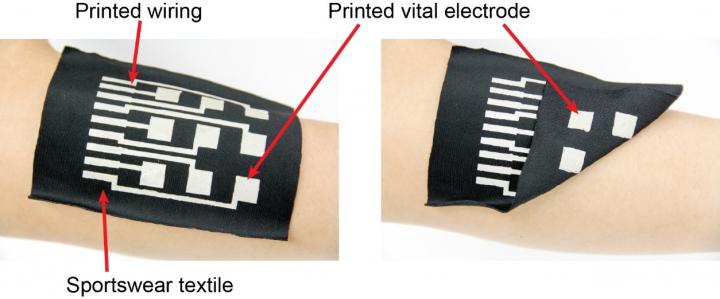
New Process Can Print Stretchy Electronics Onto Your Clothes | TechCrunch
Researchers at the University of Tokyo have created a single-step process to print conductive material on cloth, allowing manufacturers to build stretchable wearables that can test vital signs like heart rate and muscle contraction.
Google’s Project Jacquard Aims To Make “Activewear” A Reality | ReadWriteWeb
What’s really fascinating about Project Jacquard…the clothing itself ought to be an interactive thing. It ought to provide us an opportunity to interact with devices around us. That’s the breakthrough that Project Jacquard is really talking about—now, instead of just passive data collection, your clothing is an opportunity for you to interact with devices.
Sensory Fiction | Felix | VIMEO
Sensory fiction is about new ways of experiencing and creating stories. Traditionally, fiction creates and induces emotions and empathy through words and images. By using a combination of networked sensors and actuators, the Sensory Fiction author is provided with new means of conveying plot, mood, and emotion while still allowing space for the reader’s imagination.
How to Print a Super-Thin Touchscreen Display on Just About Anything | Gizmodo
[T]his award-winning paper is perhaps the coolest we’ ve seen: It lays out a new technique for printing cheap, simple touchscreen displays with conventional printers. It’s called PrintScreen, and it’s a system that allows the user to print on nearly a
ny material.
From The Designers Of Fitbit, A Digital Tattoo Implanted Under Your Skin | Co.Design
We asked NewDealDesign, the design consultancy behind projects like the Fitbit line of activity trackers, and Google’s modular Project Ara smartphone, what things might look like when technology and fashion reach beyond the wrist. In response, they created Project Underskin. It’s a concept for a smart digital tattoo which would be implanted in your hand and interact with everything you touch. It can unlock your front door, trade data with a handshake, or even tell you if you have low blood sugar.

Related
The Case for Unlimited Tablet Time for Toddlers [Opinion] | Public Health Perspectives #tech #kids #parenting
This sounds extreme, but first let me ask: how many parents do you think actually keep track of their kids’ screen time? If the TV is on but one of the children wanders out of the room, does that count? What if they’re following along to a yoga video? What if the kid borrows Mom’s phone at dinner to ask Google what snails eat?
Guidelines abound that encourage limiting “screen time.” The American Academy of Pediatrics, for example, recommends two hours or less per day, and says screens “should be avoided” for kids under 2. While I hate to see kids vegging out in front of the TV, I think these limits are based more on knee-jerk reactions (kids these days and their screens!) than on anything that’s actually meaningful to kids’ development. READ MORE: The Case for Unlimited Tablet Time for Toddlers | Public Health.
You May Also Like: Concerns About Children, Social Media and Technology Use | July 16, 2015 | Pew Research Center Snip: “In this survey, 33% of parents said they have had concerns or questions about their child’s technology use in the past 12 months. Mothers and fathers are equally likely to have had concerns and questions. Parents who have children over the age of 5 are significantly more likely than parents who only have children under age 5 to say they have had questions or concerns of this type over the past year (36% vs. 21%).”
Can These Tiny #Robots Teach Fourth Graders How To Code? | Fast Company #coding #kids #tech #makerspaces
I’m in a laboratory at Drexel University watching a remote-controlled robot do a spastic breakdance across the floor. The fist-sized, brightly colored bot looks simple enough: It has two wheels, two antennae, and what appears to be a friendly face. But it has a mission much bigger and more ambitious than its tiny form factor: This thing wants to teach kids how to become programmers.
This freewheeling toy android comes from a young startup called LocoRobo. Its moves are set using a mobile app that allows the user to program simple actions: go forward, accelerate, spin around, stop. And while plenty of kids would be content to play with a smartphone-controlled toy robot, LocoRobo wants to let them dig much deeper into the code and sensors that make it work. READ MORE: Can These Tiny Robots Teach Fourth Graders How To Code? | Fast Company | Business + Innovation.
Vortex Is A Toy Robot That Teaches #Kids How To Code | TechCrunch #robots #kids #coding #makerspaces
DFRobot, a company that has been building robots for the education market since 2008, this week introduced its first attempt at making a robot accessible to all children, with the debut of Vortex – an interactive, programmable robot aimed at kids 6 and up. The Vortex robot pairs with iOS and Android smartphones or tablets over Bluetooth, and lets kids control its movement by tapping the screen in the Vortex app to initiate commands. It also comes four free, pre-programmed games – “bumping fight,” “virtual golf,” “driving,” and “robot soccer,” which can later be customized by the child to create their own play experience. READ MORE: Vortex Is A Toy Robot That Teaches Kids How To Code | TechCrunch.
BBC Experiment Lets You Control iPlayer With Your Mind | Engadget #gadgets #disabilities #tech
http://www.bbc.co.uk/programmes/p02tx270/player
Instead of grabbing the remote or poking at your smartphone, the BBC thinks the future of TV navigation could lie in mind control. For its latest experiment, the broadcaster is testing a brainwave reading headset developed by This Place that lets you launch iPlayer and choose programmes with your thoughts. READ MORE: BBC experiment lets you control iPlayer with your mind | Engadget
 infophile