Kobo and Free the Children Partner to Advance Literacy of Aboriginal Youth Across Canada | Kobo Cafe


“Toronto, September 17, 2013 – Kobo, a global leader in eReading, and Free The Children, today announced a year-long partnership focused on supporting literacy among Aboriginal youth in Canada. Both organizations share a commitment to making Reading more accessible and are working together to support literacy programs in Aboriginal communities across the country. Kobo has donated 3,500 of its award-winning Kobo Touch™ eReaders as well as $100,000 to develop a program designed to cultivate a love and passion for reading. The program includes a speaking tour to educate youth about literacy in Aboriginal communities and encourage them to explore their own culture through digital reading.”

The Full Story: Kobo and Free the Children Partner to Advance Literacy of Aboriginal Youth Across Canada | Kobo Cafe.

23 Resources for Getting Published in the Library Field | Ellyssa Kroski – OEDB.org


Are you wondering how to break into the publishing world as a librarian? If so, here are over 20 resources to get you started on your journey to publication bliss!

See 23 Resources for Getting Published in the Library Field | Ellyssa Kroski – OEDB.org.

Dr. Seuss Available as eBooks for First Time | GoodReader


Random House Children’s Books, the publisher of multi-award winning and best-selling children’s author Dr. Seuss’ entire catalog of children’s content, announced today that it would begin releasing most of the author’s forty-four books as ebooks for young readers, starting with fifteen titles near the end of this month. The ebooks will keep the original layout and beloved illustrations, but will also incorporate a read-aloud narration.

Dr. Seuss Ebooks

See the full story: Dr. Seuss Available as eBooks for First Time | GoodReader.

Digital magazines: how popular are they? | theguardian.com


The latest magazine circulation figures show promising digital results for the industry – but is it enough to offset the fall in print?

Digital edition circulation statistics of predominantly UK magazine readership.

See the full story: Digital magazines: how popular are they? | News | theguardian.com.

Google Copyright Infringement Reports to Quadruple This Year | Mashable


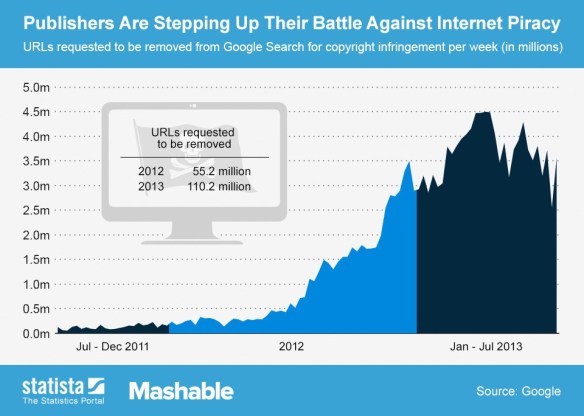
The rate of copyright infringement reports Google received in 2013 is on track to quadruple the number of reports received in 2012.

In the first seven months of 2013, publishers have submitted 110.2 million requests to remove copyright-infringing content, compared with 55.2 million requests in all of 2012.

via Google Copyright Infringement Reports to Quadruple This Year | Mashable.

Image: Tony Karumba/AFP/Getty Images

Image: Tony Karumba/AFP/Getty Images

You may also like:

Governments’ Attempts To Censor Google Have Doubled Since 2011 | TechCrunch

Jonathan Zittrain: ‘Digital books are under the control of distributors rather than readers’ (Wired UK)


Digital books and other texts are increasingly coming under the control of distributors and other gatekeepers rather than readers and libraries. Though you can read a book through, say, Google Books, or on a Nook or Kindle, it’s laborious to save what you see to your computer and truly make the book your own. With cloud-based services, one “master” copy of the book is always online, but that makes it vulnerable to manipulation or even deletion.

Quotable: “To meet these challenges, libraries should be given an opportunity to escrow copies of publicly available but still all-too-controllable texts. They can compare their own banked copies with what’s currently on offer to the public, looking for changes to the integrity of texts.”

See the full article: Jonathan Zittrain: ‘Digital books are under the control of distributors rather than readers’ (Wired UK).

For the First Time, You Can Actually Own the Digital Comics You Buy | Underwire | Wired.com


SAN FRANCISCO, Calif. — If you’ve ever bought a digital comic book, your experience probably went something like this: You opened up an app like ComiXology, paid around $1.99 to $3.99 — likely, the same price as a print issue — but never downloaded the file for the comic to your hard drive. That’s because you don’t really own it — you’ve simply licensed the right to look at it in someone else’s library.

It’s a digital sales model that has been adopted by every major U.S. comics publisher and was inspired by fears that piracy of digital copies could hurt not just digital but also print sales. It has also essentially prevented the comic book readership (or at least, the legal comic book readership) from truly owning any of the books they buy. At least until this morning, when comic book publisher Image Comics announced that it will now sell all of its digital comics as downloadable via its website for both desktop and mobile users, making it the first major U.S. publisher to offer DRM-free digital versions of comics.

See the full article: For the First Time, You Can Actually Own the Digital Comics You Buy | Underwire | Wired.com.

Why Genre Rules e-Books, and What the Big Publishers Are Doing About It | Wired


One of the biggest success stories in U.S. publishing in recent years has been the continued growth of digital book publishing. Last year, total revenue for e-book sales in the United States reached $3.04 billion, a 44.2% increase on 2011′s numbers and a figure all the more impressive when you realize that growth is additive to the print publishing industry. Even more surprising, publishers have focused much of their attention on genres like sci-fi, fantasy, mystery and romance fiction – markets that have traditionally lagged behind “literary fiction” in terms of sales.

See the full article: Why Genre Rules e-Books, and What the Big Publishers Are Doing About It | Wired

Told in pictures | Eye Magazine


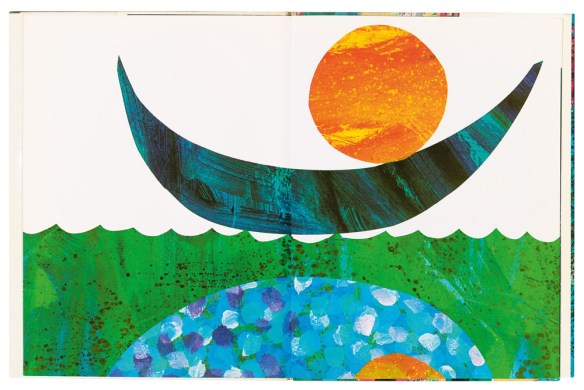
What distinguishes the picturebook as a genre within children’s publishing is the way the images work with the words. Rather than merely illustrating the words, the images carry equal weight to them, achieving a harmonious balance between the two where each element adds something to the whole that the other does not. But there is an entire sub-genre of picturebook that eschews a written text altogether, relying entirely on a sequence of images to tell a story or create a meaning.

See the full story at Told in pictures Eye Magazine

New DRM Will Change the Words in Your E-Book | Gadget Lab | Wired.com


The next e-book you buy might not exactly match the printed version. And those changes are there to make sure you’re not a pirate.

German researchers have created a new DRM feature that changes the text and punctuation of an e-book ever so slightly. Called SiDiM, which Google translates to “secure documents by individual marking,” the changes are unique to each e-book sold. These alterations serve as a digital watermark that can be used to track books that have had any other DRM layers stripped out of them before being shared online. The researchers are hoping the new DRM feature will curb digital piracy by simply making consumers paranoid that they’ll be caught if they share an e-book illicitly.

via New DRM Will Change the Words in Your E-Book | Gadget Lab | Wired.com

It will be interesting to see if those publishers who have recently moved to open access on ebooks reverse their stance due to this new technology. I’m sure libraries will be having many discussions about the implications of this new technology on ebook lending and relationships with publishers.

You may also like:

Digital Rights Management (DRM) & Libraries | American Library Association