Video gaming boosts certain brain regions, study says | CNET


This is your brain. This is your brain on Super Mario 64. See how the gray matter is increased? A new study published in the journal Molecular Psychiatry suggests a whole lot of benefits to playing video games.

The study concludes that “video gaming causes increases in the brain regions responsible for spatial orientation, memory formation, and strategic planning, as well as fine motor skills.”

Read: Video gaming boosts certain brain regions, study says | Crave – CNET.

Recent Pew Research Links


Broadband Adoption: The Next Mile | Statement of Aaron Smith (Senior Researcher, Pew Research) | Pew Internet

The New Library Patron from Pew Research Center’s Internet & American Life Project
Lee Rainie, Director of the Pew Research Center’s Internet & American Life Project, will discuss the Project’s new research about library patrons and non-patrons: who they are, what their information needs are, what kind of technology they use, and how libraries can meet the varying needs of their patrons.

Photo and Video Sharing Grow Online | Pew Internet
A new study by the Pew Research Center’s Internet Project shows that 54% of internet users have posted original photos or videos to websites and 47% share photos or videos they found elsewhere online. Also: AFP: Smart phones boost photo, video sharing: study and from TIME: One Stat that Explains Why Instagram Is Adding Ads.

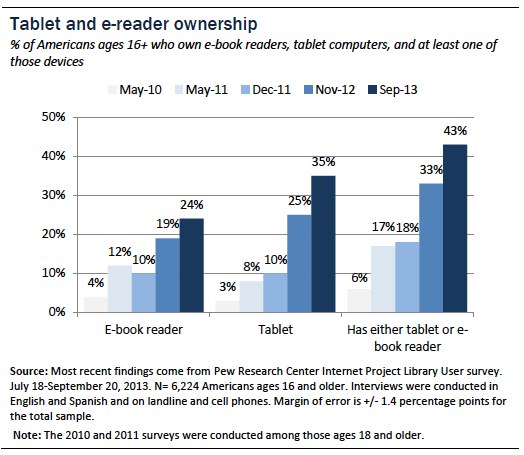
Tablet and E-reader Ownership Update | Pew Internet
The number of Americans ages 16 and older who own tablet computers has grown to 35%, and the share who have e-reading devices like Kindles and Nooks has grown to 24%. Overall, the number of people who have a tablet or an e-book reader among those 16 and older now stands at 43%.

1 in 7 Americans is offline. Why? It’s complicated | Kathryn Zickuhr, Pew Research | CNBC

Pew Data on News Consumption: Millennials Lead the Shift to Web Use | ContentBlogger

Mobile Health in Context: How Information is Woven Into Our Lives from Pew Research Center’s Internet & American Life Project

Digital Kids: how children are using devices, apps and media in 2013 | theguardian.com


A day-long liveblog covering the latest research, trends and views on childrens changing media habits…blending research links, videos, infographics and snapshots of previous Guardian coverage on children’s changing media habits, as well as some first-hand views from kids.

Includes clinks to media literacy reports, charts, survey results, etc.

Sample of the topics/questions:

  • Can Minecraft create the next generation of quantum scientists?
  • Question: where to start teaching my kids to code?
  • What do tablets do to children’s developing minds?

Read: Digital Kids: how children are using devices, apps and media in 2013 | Technology | theguardian.com.

Recent Research Studies Links


Study: 38 Percent of Toddlers Have Used a Mobile Device | PCMag
According to a recent Common Sense Media research study, 38 percent of kids under two years old have used a mobile device — with a watchful eye from their parents, surely. In 2011, that number reached only 10 percent.

Pediatricians: Limit kids’ media use to 2 hours a day | CNET
American Academy of Pediatrics also tells parents to discourage any screen time for children 2 and younger and keep Internet-connected devices out of kids’ bedrooms.

Report: Piracy Isn’t Killing Content | Gizmodo
Contrary to what the popular press might have us believe, piracy isn’t killing content. At least, that’s what a team of scholars from the London School of Economics has found after conducting a deep analysis of the situation.

Deloitte Survey Finds 18% of U.S. College Students Own Tablets, 14% Own E-Readers | InfoDocket

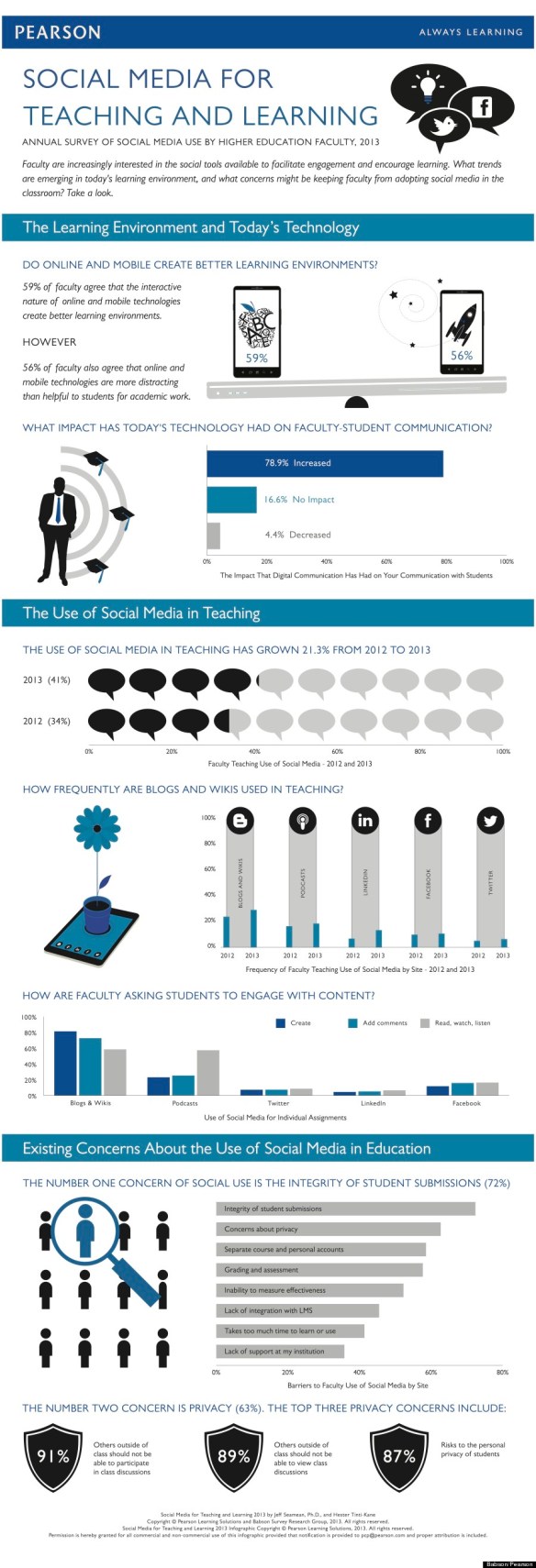
How Professors Are Using Social Media (INFOGRAPHIC) | HuffPost


Article in Full

Professors aren’t so different from the regular populace when it comes to their views on social media.

Just over 70 percent used social media in their personal lives, a survey released last week by Babson Survey Research Group andPearson found. This figure mirrors usage among the general population, according to the Pew Research Center.

Babson and Pearson surveyed 8,000 faculty members from all disciplines in higher education for their report, “Social Media for Teaching and Learning.”

Faculty personally choose to use Facebook more than any other type of social media outlet, according to the report, but were more likely to use blogs and wikis for classroom assignments.

Less than half of faculty — 41 percent — use social media as a tool in class, but that’s up from 33.8 percent in last year’s survey.

“Faculty are not only expanding their use of social media, but also becoming more sophisticated in their use,” Jeff Seaman, co-director of the Babson Survey Research Group, said in a statement. “We see steady growth in adoption year over year; however, there are still great concerns that we hear from every age group, and that holds educators back from full adoption in their teaching.”

Faculty cited “integrity of student submissions” and privacy as their main concerns with social media use. Privacy was a large concern among previous surveys of the general population as well.

Social Media for Teaching and Learning

Libraries and communities | Pew Research Center


Lee Rainie, the Project Director, describes the findings from the nationally representative survey that asked Americans what types of services they value in their libraries and what additional services they would like their libraries to offer.

Online Dating [Infographic], Online Dating & Relationships Report | Pew Research Center; How I Hacked Online Dating | Amy Webb | TED


Online Dating & Relationships | Pew Research Center

Overview
One in ten Americans have used an online dating site or mobile dating app; 66% of these online daters have gone on a date with someone they met through a dating site or app, and 23% have met a spouse or long term partner through these sites. Public attitudes toward online dating have become more positive in recent years, but many users also report negative experiences.

These are among the results of a national survey of dating and relationships in the digital era, the first dedicated study of this subject by the Pew Research Center’s Internet Project since 2005. Key findings include:

  • 11% of internet users (representing 9% of all American adults) say that they have personally used an online dating site. As recently as 2008, just 3% of American adults had used online dating sites.
  • 7% of cell phone apps users (representing 3% of all American adults) say that they have used a dating app on their cell phone.

Taken together, 11% of all American adults are “online daters”—meaning they have used a dating site or mobile dating app. Online dating is especially common among the college-educated and those in their mid-20’s through mid-40’s, and 38% of Americans who are currently single and actively looking for a partner have used online dating at one point or another. See the online report or download the pdf.

Amy Webb: How I hacked online dating | TED.com
Amy Webb was having no luck with online dating. The dates she liked didn’t write her back, and her own profile attracted crickets (and worse). So, as any fan of data would do: she started making a spreadsheet. Hear the story of how she went on to hack her online dating life — with frustrating, funny and life-changing results.

Online Dating [Infographic] | Pew Research Center’s Internet & American Life Project

Dating Digitally: Pew

You may also like:

Tablet and E-reader Ownership Update | Pew Research Center


The number of Americans ages 16 and older who own tablet computers has grown to 35%, and the share who have e-reading devices like Kindles and Nooks has grown to 24%. Overall, the number of people who have a tablet or an e-book reader among those 16 and older now stands at 43%.

Up from 25% last year, more than half of those in households earning $75,000 or more now have tablets. Up from 19% last year, 38% of those in upper-income households now have e-readers.

Tablet and E-reader Ownership Update | Pew Research Center's Internet & American Life Project

Read the full report or download the pdf.

via Tablet and E-reader Ownership Update | Pew Research Center’s Internet & American Life Project.

Alessandro Acquisti: Why privacy matters | TED.com


The line between public and private has blurred in the past decade, both online and in real life, and Alessandro Acquisti is here to explain what this means and why it matters. In this thought-provoking, slightly chilling talk, he shares details of recent and ongoing research — including a project that shows how easy it is to match a photograph of a stranger with their sensitive personal information.What motivates you to share your personal information online? Alessandro Acquisti studies the behavioral economics of privacy and information security in social networks.

via Alessandro Acquisti: Why privacy matters | Video on TED.com.

The 15 Countries Where The Most Young People Are Online | Co.Exist


Full Article

What did children do before computers? If the future goes the way of babies with iPads, it’s a question we might be asking ourselves soon. But if you’re between 15 and 24 years old and live in the United States, there’s already a good chance you grew up playing around with MS Paint. According to a new report out from the UN’s International Telecommunication Union (ITU), growing up with the Internet qualifies you as a “digital native,” and some countries have a far higher proportion of them than others.

The results, however, might surprise you.
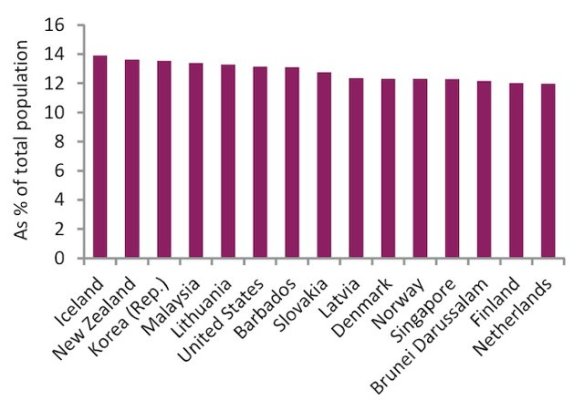
The 15 Countries Where The Most Young People Are Online | Co.Exist | ideas + impactSource: ITU

Out of a global population of 7 billion, 363 million of us have grown up “surrounded by and using tools and toys of the digital age.” China and India boast the largest number of these people, but digital natives only make up a relative minority of their respective populations. When it comes to countries with the highest percentages of digital natives, the United States actually comes in sixth place, below Lithuania and Malaysia.

Iceland, however, ranks number one in digital native penetration, with 14% of the Icelandic population having grown up on computers. That makes sense, given that Iceland has the highest percentage of young people in Europe (and a small population). New Zealand makes number two on the list for the same reason. South Korea, meanwhile, ranks third largely because of high Internet use among all youth and its government’s aggressive investment in educational technology: By 2015, all Korean schools will provide cloud-based learning services to students.

Malaysia comes in fourth place on the list, and for striking reasons. Unlike Iceland or New Zealand, Malaysia doesn’t have a particularly high concentration of 15-to-24 year-olds. But like South Korea, the young people who do live in Malaysia have spent more time with the Internet: By 2012, 74.4% of youths had at least five years of Internet experience under their belts. Much of that, explains the report, can be attributed to the fact that the Malaysia has brought so many of its schools online, and by 2000 had already stocked 31% of its primary schools and 54% of its secondary schools with computer facilities.
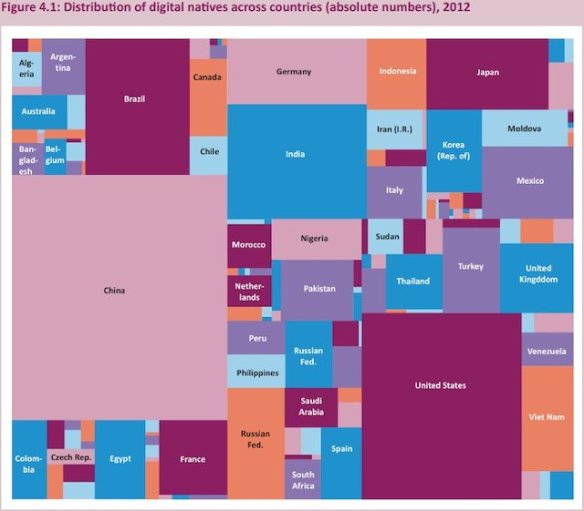
The 15 Countries Where The Most Young People Are Online | Co.Exist | ideas + impactAbsolute numbers of digital natives by country. Source: ITU

Starting in January of this year, Malaysian 21-to-30-year-olds have been able to score $65 rebates on certain smartphones, courtesy of government subsidies. The country’s National Broadband Initiative has set about dramatically lowering costs of accessing the Internet, including launching the 1 Million Netbooks program, which distributes netbooks to low-income families.

The report notes that proportions of digital natives largely stick to levels of economic development. In high-income, developed countries, digital natives with five years of Internet experience or more make up 86% of young Internet users, while in the developing world, digital natives only count as 47% of young Internet users. The global average comes to slightly more: Digital natives make up 56% of all young Internet users–more than 362 million people worldwide.

via The 15 Countries Where The Most Young People Are Online | Co.Exist | ideas + impact.