
Startup VA-ST thinks its depth-sensing glasses can help people with little sight get around more easily. READ MORE: Augmented-Reality Goggles Aim to Help Legally Blind See | MIT Technology Review
Tag Archives: science
Researchers Demonstrate ‘No-Ink’ Color Printing with Nanomaterials | KurzweilAI #nano

Image Credit: Missouri University of Science and Technology
Researchers at Missouri University of Science and Technology have developed a “no-ink” color printing process using nanomaterials, with features visible only with the aid of a high-powered electron microscope.
READ MORE: Researchers demonstrate ‘no-ink’ color printing with nanomaterials | KurzweilAI.
Is It Really Possible to Learn to Speed Read? | Gizmodo #reading
Ninety-five percent of college educated individuals read at a rate between 200-400 words per minute according to extensive research done by University of Massachusetts Amherst professor Dr. Keith Rayner. However, there exists a small, but rather vocal subset of people who insist that they can read several times faster than this using various speed reading techniques.
With very little searching, you’ll also find many-a-company claiming that after going through their program or using their app regularly, you can easily read even as many as 1,000 words per minute. Tim Ferriss of Four Hour Work Week fame offers a method for increasing speed in reading for free on his website, claiming with this method, you’ll see an average increase in reading speed of about 386% in just three hours of practice.
So is any of this really possible? READ MORE: Is It Really Possible to Learn to Speed Read? | Gizmodo
This robot learns new skills just like a human | Mashable #robots
A robot is only as smart as its programming. Learning on the go has been the sole purview of living things.
That was, until a team of scientists at UC Berkeley programmed a robot to learn simple tasks through trial and error, just like humans do.
The robot itself, a Willow Garage PR-2, is not new. But researchers applied a relatively new form of artificial intelligence, known as Deep Learning, to give it a kind of primitive learning ability.
With it, the robot or BRETT, (Berkeley Robot for the Elimination of Tedious Tasks) can use visual and sensory information about itself, its environment and the objects before it. It uses them like LEGO, building little neural networks of information, basically figuring out how to do something (how to put two real-life blocks together, say, or put a ring on a peg).
READ MORE: This robot learns new skills just like a human | Mashable
We Can Now Make Computer Chips Out of Wood | Gizmodo
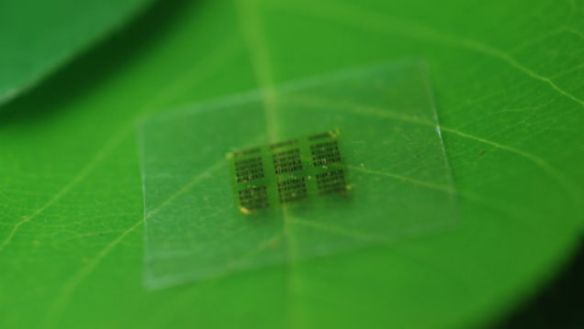
We’re one step closer to biodegradable gadgets. These computer chips are made almost entirely out of wood. Scientists at the University of Wisconsin, Madison teamed up with the U.S. Department of Agriculture’s Forest Products Laboratory to fashion the new semiconductor chip. The paper was published today in Nature Communications.
See, most of a computer chip is composed of a “support” layer that cradles the actual chip. The research team replaced that support layer’s non-biodegradable material with something called cellulose nanofibril (CNF), which is flexible, wood-based, biodegradable—all things that can make a device way less hazardous.
Image credit: University of Wisconsin
READ MORE: We Can Now Make Computer Chips Out of Wood | Gizmodo
8 STEM Toys for Pint-Sized Einsteins | Mashable #kids #STEM #toys #play
Often times, parents want the toys their children play with to teach STEM skills — recently updated to STREAM, or Science, Technology, Reading, Engineering, Arts and Math.
At the 2015 International American Toy Fair, there was a bevy of toys that were anything but mindless. Better yet, they’re made to get kids interested in one of these educational topics — without slathering on the “learning” part so they will be disinterested.
Here are some of our favorites that will keep kids learning beyond the classroom.
Video Game Link to Psychiatric Disorders Suggested by Study | The Guardian #gaming #psychology
People who regularly play action video games could be at increased risk of developing neurological and psychiatric disorders, a study suggests.
The research, published in a Royal Society journal on Wednesday, found that people who played games such as Call of Duty, Grand Theft Auto V and Tomb Raider were more likely to employ navigational strategies associated with decreased grey matter in the hippocampus part of the brain.
Decreased volume in the hippocampus has been associated with disorders such as schizophrenia, post-traumatic stress disorder, depression and Alzheimer’s disease.
The lead study author, Prof Greg West, from the University of Montreal’s department of psychology, said the paper indicated that benefits of video games, such as improved attention and perception, highlighted in previous studies, could come at a price.
READ MORE: Video game link to psychiatric disorders suggested by study | Technology | The Guardian
‘The X-Files’ Six-Episode Series Premieres January 24th | Engadget/Fox #XFiles
Back in March, Fox confirmed that FBI agents Mulder and Scully would return to television, and now we know when. The network announced that The X-Files six-episode run will begin on January 24th at 10 PM ET, following the NFL’s NFC Championship Game. There’s sure to be a load of interested viewers already marking down the date, but Fox is looking to rope in a few more by debuting the miniseries right after a big playoff game. The show’s premiere is a two-night event with the second episode following on Monday, January 25th at 8 PM ET in what will be the regular time slot. If you’ll recall, show creator Chris Carter will handle director and executive producer duties while David Duchovny and Gillian Anderson reprise their roles as the Bureau’s paranormal investigating duo.
via ‘The X-Files’ six-episode series premieres January 24th | Engadget/Fox
Scientists are Brewing Medieval Potions to Fight Hospital Superbugs | Gizmodo #ancientbooks #medievalbooks
Last month, a microbiology lab in Nottingham, England made international headlines when it unearthed a substance that kills methicillin-resistant staph, one of the deadliest superbugs of modern times. The most astounding part about the find? It was a 1,000-year-old Viking potion. “This is something we never, ever expected,” said Christina Lee, the Viking scholar at the University of Nottingham who translated the recipe from Old English. “When this tested positive against MRSA, we were just bowled over.”
Bald’s eye salve, intended to vanquish a stye, was discovered in Bald’s Leechbook, an Old English medical primer that hails from 9th century England. The recipe, which claimed to be “the best leechdom” in existence, caught the eye of Freya Harrison, a microbiologist at the University of Nottingham who moonlights as an Anglo-Saxon warrior on the weekends, as a member of the UK’s oldest and largest Viking reenactment society.
“This all kinda started from me being a big nerd,” Harrison told me over Skype. “When I met Christina, she was eager to talk with a microbiologist, because she has an interest in the history of infection. One of the things she had always wanted to do was test some of these medieval remedies out, to see whether they actually work.”
Together with microbiologist Steve Diggle, the three pooled resources to begin the “AncientBiotics” project, which would identify promising Anglo-Saxon remedies and test their medicinal value using modern science. They never expected their first attempt at replicating a medieval potion would be such a roaring success.
“To be honest, I didn’t think anything would come of this,” Diggle, whose interests lie in bacterial communication and evolution, told me over Skype. “For me, one of the most interesting aspects is asking whether this was a true scientific attempt at a recipe for treating an infection. If so, that completely changes our perspective on Anglo-Saxon medicine.”
READ MORE: Scientists are Brewing Medieval Potions to Fight Hospital Superbugs | Gizmodo
A few popular fiction titles I’ve enjoyed reading relating to medieval/historical “primers,” “recipe books” or books of knowledge are:
Female Scientists Told to Get a Man to Help Them With Their Paper | Jezebel
This just in from the land of great sexism: two female scientists had a manuscript rejected by a peer-reviewed journal because they didn’t ask a man for help. An unnamed peer reviewer for the journal PLoS One suggested that Drs. Fiona Ingleby and Megan Head find male co-authors—any men at all—for a paper they’d written, in order to make sure they weren’t leaping to “ideologically biased assumptions.” READ MORE: Female Scientists Told to Get a Man to Help Them With Their Paper | Jezebel
 infophile