
Tag Archives: self-improvement
How Daydreaming Can Actually Make You Smarter | HuffPost
Psychology was my undergrad major. I have always been fascinated by theories of intelligence, cognitive development and memory. I’m one of those people who like to take personality and IQ tests. I believe in the value of reading to increase our emotional development and improve communication skills. Its great to see new research challenging our preconceived notions of intelligence.
Daydreaming gets a pretty bad rap. It’s often equated with laziness, and we tend to write off people with wandering minds as being absent-minded “space cadets” who can’t get their heads out of the clouds.
Though we all spend close to 50 percent of our waking lives in a state of mind-wandering, according to one estimate, some research casts daydreaming in a negative light. A 2010 Harvard study linked spacing out with unhappiness, concluding that “a wandering mind is an unhappy mind.” But could these unconscious thinking processes actually play a pivotal role in the achievement of personal goals?
In a radical new theory of human intelligence, one cognitive psychologist argues that having your head in the clouds might actually help people to better engage with the pursuits that are most personally meaningful to them. According to Scott Barry Kaufman, NYU psychology professor and author of Ungifted: Intelligence Redefined, we need a new definition of intelligence — one that factors in our deepest dreams and desires.
Read the full story: How Daydreaming Can Actually Make You Smarter | HuffPost
You may also like: The Case for Preserving the Pleasure of Deep Reading | MindShift | The Modern MLIS
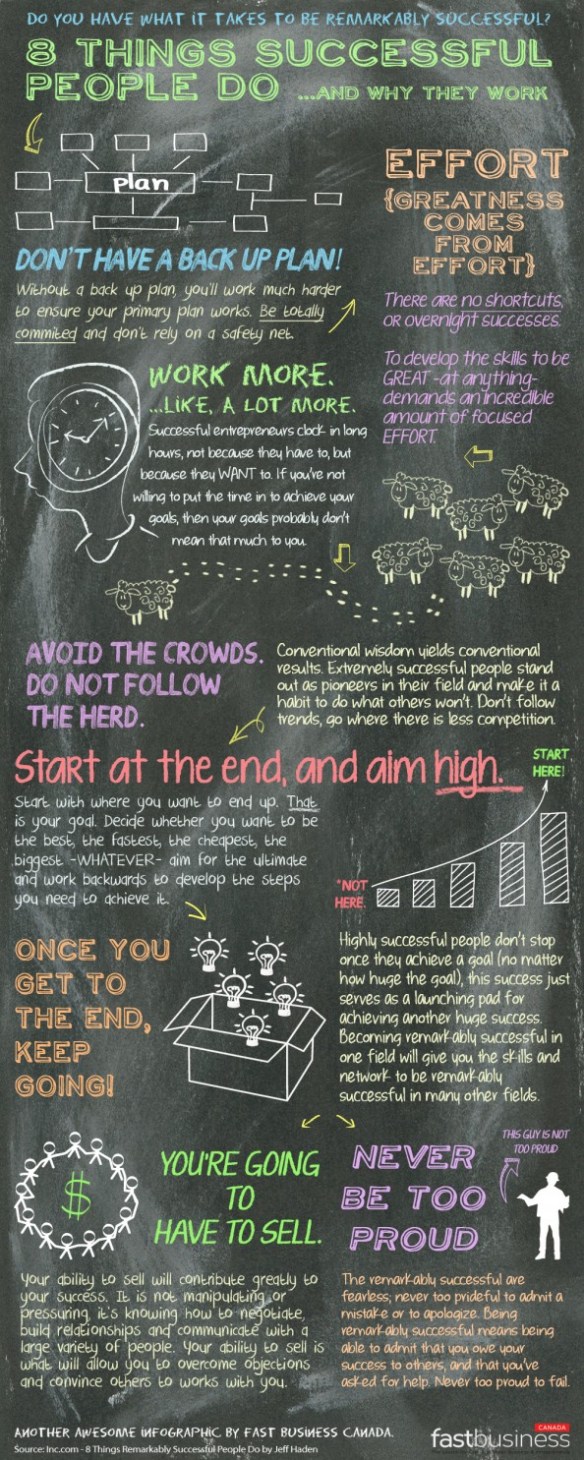
8 things successful people do, and why they work [Infographic] | Visual.ly
Classic Leadership Skills You Should Apply to Your Social Life | LifeHacker
What makes a great leader makes a great friend. Nobody wants to think of their social life as a business that needs management, but many of the best leadership techniques can apply to our lives outside of work. Here’s a look at some people who have set good examples in their respective professions, and how you can apply those things to your daily social life.
Read the full story: Classic Leadership Skills You Should Apply to Your Social Life | LifeHacker.
Didn’t Get the Job? You’ll Never Know Why | WSJ.com
You aced the interview, your résumé sings, but in the end, you didn’t get the job. Chances are, you’ll never know why.
It is a painful conundrum of the job search process: Rejected candidates want to understand why they didn’t get hired, but employers, fearing discrimination complaints, keep silent. And those who do speak up offer little more than platitudes.
Without specifics, candidates are left to repeat the same mistakes, while hiring managers complain they’re swamped with applicants who miss the mark.
Read the full story: Didn’t Get the Job? You’ll Never Know Why | WSJ.com.
Short on social skills? Debrett’s to teach young jobseekers manners (at £1,000 a go) | theguardian.com
Snip: They are not ignoring new technology, and will offer guidance on “netiquette”: when to put a smiley face or kisses on an email (never in the workplace) and why you should never text the boss unless they have texted you first. Debrett’s developed its programme on “social intelligence” for under-30s after a survey of business leaders threw up some serious issues around young people entering the modern workplace.
Read the full story: Short on social skills? Debrett’s to teach young jobseekers manners (at £1,000 a go) | theguardian.com.
The Science Behind What Naps Do For Your Brain–And Why You Should Have One Today | Fast Company
Studies of napping have shown improvement in cognitive function, creative thinking, and memory performance. Ready, set . . . Snooze.
The full story: The Science Behind What Naps Do For Your Brain–And Why You Should Have One Today | Fast Company | Business + Innovation.
The HLS Guide to Library School | Simple Book Production
This ebook contains some new content but mostly posts that have appeared previously on the blog. It is not necessarily a compilation of the best of Hack Library School or even indicative of the breadth of our content; instead, we have selected content based on the most practical advice we could give to others to–you guessed it–hack library school. We’ve divided the content into three main sections: Before Library School, During Library School, and After Library School. Within these sections, you will also find sub-sections intended to help organize the content meaningfully.
See more: The HLS Guide to Library School | Simple Book Production.
The Hack Library School blog is a great resource for library school students. They posts interviews with LIS professionals on employing and interviewing LIS graduates. There are also posts by guest editors. Here’s a direct link to the pdf of the free eBook.
11 Simple Concepts to Become a Better Leader | Stephen’s Lighthouse
By David Kerpen (CEO, Likeable Local, NY Times Best-Selling Author & Keynote Speaker) via LinkedIn
FULL POST
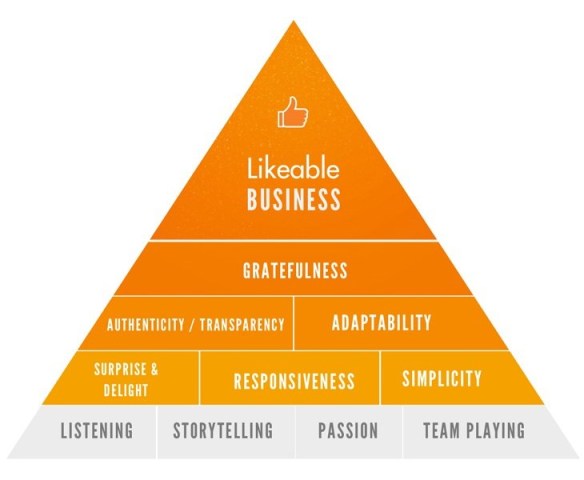
Being likeable will help you in your job, business, relationships, and life. I interviewed dozens of successful business leaders for my last book, to determine what made them so likeable and their companies so successful. All of the concepts are simple, and yet, perhaps in the name of revenues or the bottom line, we often lose sight of the simple things – things that not only make us human, but can actually help us become more successful. Below are the eleven most important principles to integrate to become a better leader:
1. Listening
“When people talk, listen completely. Most people never listen.” – Ernest Hemingway
Listening is the foundation of any good relationship. Great leaders listen to what their customers and prospects want and need, and they listen to the challenges those customers face. They listen to colleagues and are open to new ideas. They listen to shareholders, investors, and competitors. Here’s why the best CEO’s listen more.
2. Storytelling
“Storytelling is the most powerful way to put ideas into the world today.” -Robert McAfee Brown
After listening, leaders need to tell great stories in order to sell their products, but more important, in order to sell their ideas. Storytelling is what captivates people and drives them to take action. Whether you’re telling a story to one prospect over lunch, a boardroom full of people, or thousands of people through an online video – storytelling wins customers.
3. Authenticity
“I had no idea that being your authentic self could make me as rich as I’ve become. If I had, I’d have done it a lot earlier.” -Oprah Winfrey
Great leaders are who they say they are, and they have integrity beyond compare. Vulnerability and humility are hallmarks of the authentic leader and create a positive, attractive energy. Customers, employees, and media all want to help an authentic person to succeed. There used to be a divide between one’s public self and private self, but the social internet has blurred that line. Tomorrow’s leaders are transparent about who they are online, merging their personal and professional lives together.
4. Transparency
“As a small businessperson, you have no greater leverage than the truth.” -John Whittier
There is nowhere to hide anymore, and businesspeople who attempt to keep secrets will eventually be exposed. Openness and honesty lead to happier staff and customers and colleagues. More important, transparency makes it a lot easier to sleep at night – unworried about what you said to whom, a happier leader is a more productive one.
5. Team Playing
“Individuals play the game, but teams beat the odds.” -SEAL Team Saying
No matter how small your organization, you interact with others every day. Letting others shine, encouraging innovative ideas, practicing humility, and following other rules for working in teams will help you become a more likeable leader. You’ll need a culture of success within your organization, one that includes out-of-the-box thinking.
6. Responsiveness
“Life is 10% what happens to you and 90% how you react to it.” -Charles Swindoll
The best leaders are responsive to their customers, staff, investors, and prospects. Every stakeholder today is a potential viral sparkplug, for better or for worse, and the winning leader is one who recognizes this and insists upon a culture of responsiveness. Whether the communication is email, voice mail, a note or a tweet, responding shows you care and gives your customers and colleagues a say, allowing them to make a positive impact on the organization.
7. Adaptability
“When you’re finished changing, you’re finished.” -Ben Franklin
There has never been a faster-changing marketplace than the one we live in today. Leaders must be flexible in managing changing opportunities and challenges and nimble enough to pivot at the right moment. Stubbornness is no longer desirable to most organizations. Instead, humility and the willingness to adapt mark a great leader.
8. Passion
“The only way to do great work is to love the work you do.” -Steve Jobs
Those who love what they do don’t have to work a day in their lives. People who are able to bring passion to their business have a remarkable advantage, as that passion is contagious to customers and colleagues alike. Finding and increasing your passion will absolutely affect your bottom line.
9. Surprise and Delight
“A true leader always keeps an element of surprise up his sleeve, which others cannot grasp but which keeps his public excited and breathless.” -Charles de Gaulle
Most people like surprises in their day-to-day lives. Likeable leaders underpromise and overdeliver, assuring that customers and staff are surprised in a positive way. There are a plethora of ways to surprise without spending extra money – a smile, We all like to be delighted — surprise and delight create incredible word-of-mouth marketing opportunities.
10. Simplicity
“Less isn’t more; just enough is more.” -Milton Glaser
The world is more complex than ever before, and yet what customers often respond to best is simplicity — in design, form, and function. Taking complex projects, challenges, and ideas and distilling them to their simplest components allows customers, staff, and other stakeholders to better understand and buy into your vision. We humans all crave simplicity, and so today’s leader must be focused and deliver simplicity.
11. Gratefulness
“I would maintain that thanks are the highest form of thought, and that gratitude is happiness doubled by wonder.” -Gilbert Chesterton
Likeable leaders are ever grateful for the people who contribute to their opportunities and success. Being appreciative and saying thank you to mentors, customers, colleagues, and other stakeholders keeps leaders humble, appreciated, and well received. It also makes you feel great! Donor’s Choose studied the value of a hand-written thank-you note, and actually found donors were 38% more likely to give a 2nd time if they got a hand-written note!
The Golden Rule: Above all else, treat others as you’d like to be treated
By showing others the same courtesy you expect from them, you will gain more respect from coworkers, customers, and business partners. Holding others in high regard demonstrates your company’s likeability and motivates others to work with you. This seems so simple, as do so many of these principles — and yet many people, too concerned with making money or getting by, fail to truly adopt these key concepts.
via 11 Simple Concepts to Become a Better Leader | Stephen’s Lighthouse.
Do books have the power to heal? | Macleans.ca
Most of Ella Berthoud’s patients are young professionals: cosmopolitan careerists in their 30s or 40s. Some are burdened with anxiety. Some feel adrift in their mid-lives. Many are approaching rites of passage: a first child, retirement, a gap year in India, the death of a spouse. But others have more singular afflictions. One patient was hooked on chick lit, and “terrified of reading anything more demanding.” A young couple was eager to rekindle a fizzling romance. Berthoud—a London-based “bibliotherapist”—has heard it all. In each case, the prescription is the same: Read a book.
via Do books have the power to heal? | Macleans.ca.
The post also includes a transcript of today’s (September 10, 2013) live chat with Ella Berthoud.
 infophile