The 10 Governments That Requested (And Got) The Most Facebook User Data | Co.Exist


74 countries sought data from Facebook for 38,000 of the network’s total 1.15 billion users.

Requests for Facebook data made from Jan to June 2013 (some requests include multiple users):

  1. United States (11,000-12,000 requests, 79% success)
  2. India (3,245 requests, 50% success)
  3. United Kingdom (1,975 requests, 68%success)
  4. Germany (1,886 requests, 37% success)
  5. Italy (1,705 requests, 53% success)
  6. France (1,574 requests, 39% success)
  7. Brazil (715 requests, 33% success)
  8. Australia (546 requests, 64% success)
  9. Spain (479 requests, 51% success)
  10. Poland (233 requests, 9% success)

The full discussion: The 10 Governments That Requested (And Got) The Most Facebook User Data | Co.Exist | ideas + impact.

Social Media’s Seven Deadly Sins | The Proverbial Lone Wolf Librarian’s Weblog


Social Media’s Seven Deadly…09.05.13 | The Proverbial Lone Wolf Librarian’s Weblog.

Google Translate adds African languages | theguardian.com


Google is planning to add Somali, Igbo, Hausa, Yoruba and Zulu to its list of language options on Google Translate, the search engine giant’s free automatic translation service.

A post published [on August 27, 2013] on the Google Africa page on Google+ called on users to evaluate the translation quality of the five languages. After assessing passages that are translated into English and vice versa, users can rate them as Excellent, Good, Fair or Poor.

via Google Translate adds African languages | World news | theguardian.com.

Governments Requested Information On 38,000 Facebook Users In The First Half Of 2013 | Fast Company


Facebook received about 38,000 data requests from government agents in 71 countries in the first half of 2013, according to the company’s first Global Government Requests Report, which it published [Tuesday]. The report comprises both criminal and national security requests made in the first six months of the year, with half of those requests coming from the United States.

via Governments Requested Information On 38,000 Facebook Users In The First Half Of 2013 | Fast Company | Business + Innovation.

Shanghai Metro offers passengers books to borrow | chinadaily.com.cn


Shanghai’s Metro Line 2 is turning a new page with a library taking literally an online approach.

Passengers will be able to select a book at one station, and return it to any of the other stations with customized bookshelves.

Readers do not have to pay a deposit or any rent for the books and magazines they take. Instead, they are encouraged to donate 1 yuan (16 US cents) to charity at the bookshelf.

“Now you can read a real book, rather than staring at the cellphone through the metro ride,” said Zou

Shuxian, a spokeswoman for the Aizhi bookstore, which initiated the project jointly with Hujiang.com and Shanghai Metro Line 2.

“This will encourage more people to read on the Metro and improve the atmosphere of the whole city,” said Chen Kuang, a spokesman with Shanghai No 2 Metro Co Ltd.

The Chinese Academy of Press and Publication released a survey recently that said the general public between the ages of 18 to 70 read 4.39 books in 2012, much fewer than in Western countries.

The program announced its official kickoff on Aug 18, after a trial operation over a period of months.

It has been a resounding success with office workers. Waiting lines have developed during rush hour.

“Most people returned the books after reading, and many left a coin for our charity initiative,” said a staff member for Aizhi at the Nanjing Road West Station.

“Even if some books are not returned, we believe the overall benefit is worthwhile,” another staff member surnamed Li said.

All the books have green tape on the cover to inform people about the program. “Also to remind people it is borrowed and should be returned,” Li said.

Hujiang.com, an online education provider, and Aizhi, a bookstore chain, joined hands to launch the project last year. It called on people to donate their used books to the 20 Aizhi bookstores at the metro stations.

The program allows Hujiang to publicize its educational program.

The public offered more than 100,000 books in eight months. Many were given to schools in less well-off areas. The rest, and magazines, were used for the program.

The trial operation began near office buildings in Zhangjiang, a high-tech park in Shanghai, and then expanded to the Metro.

“We also have a few shops along Metro Lines 3 and 4, and we hope to expand the service,” she said.

“It is a great idea to have books used rather than leaving them to gather dust,” said Yue Tingting, a PR official with Hujiang.

“You can’t force people to read by regulations, but it is sensible to encourage people to read,” said Huang Yuning, head of the literature department at Shanghai Translation Publishing House.

The digital age has seen book sales decline, but this shows there may be a twist in the tale, said Feng Tao, an editor and colleague of Huang.

In order to encourage more people to read, the General Administration of Press and Publication of China plans to issue a guideline promoting reading.

via Shanghai Metro offers passengers books to borrow | Society | chinadaily.com.cn.

Basic Tips for Working with Patrons with Disabilities | Hack Library School


Although I’ve been interested in making libraries and archives more accessible to persons with disabilities for a while now, I’ve been spending this summer specifically working on learning more about laws, programs, and first-person perspectives on disability. While it’s a challenge to learn about what’s out there, working with patrons with disabilities doesn’t have to be complex.

See the full story: Basic Tips for Working with Patrons with Disabilities | Hack Library School.

So what the heck is wearable tech, anyway? | CNET


“Wearable tech” is the latest hot buzz phrase, and its been surging in consumer electronics circles. But despite how simple the label sounds on the surface, its a category thats extremely tricky to pin down.

Wearable Tech

See the full story: So what the heck is wearable tech, anyway? | Wearable tech – CNET Reviews.

LinkedIn Growing Up: Opens Up To High School Students Over 13, Launches Dedicated Pages For Universities Worldwide | TechCrunch


[T]oday LinkedIn made a bold move to start reaching out itself to this very lucrative, if fickle, audience: is beginning to promote itself to high school students (“13+ for most countries around the world” a spokesperson explains to me) and it has launched University Pages, dedicated pages for universities for people to add to their profiles and to reach out to people. LinkedIn hopes that both moves will not only expand the reach of how people use its site as their default anchor for resume-style information online. And also how it, too, could potentially tap into this user base to begin long-term relationships.

Both of these are getting rolled out globally, with the younger users starting to get accepted beginning September 12.

See the full story: LinkedIn Growing Up: Opens Up To High School Students Over 13, Launches Dedicated Pages For Universities Worldwide | TechCrunch.

Facebook Leads an Effort to Lower Barriers to Internet Access | NYTimes.com


About one of every seven people in the world uses Facebook. Now, Mark Zuckerberg, its co-founder and chief executive, wants to make a play for the rest — including the four billion or so who lack Internet access.

On Wednesday, Facebook plans to announce an effort aimed at drastically cutting the cost of delivering basic Internet services on mobile phones, particularly in developing countries, where Facebook and other tech companies need to find new users. Half a dozen of the world’s tech giants, including Samsung, Nokia, Qualcomm and Ericsson, have agreed to work with the company as partners on the initiative, which they call Internet.org.

The companies intend to accomplish their goal in part by simplifying phone applications so they run more efficiently and by improving the components of phones and networks so that they transmit more data while using less battery power.

There is considerably more content to this article. See the full story:  Facebook Leads an Effort to Lower Barriers to Internet Access | NYTimes.com.

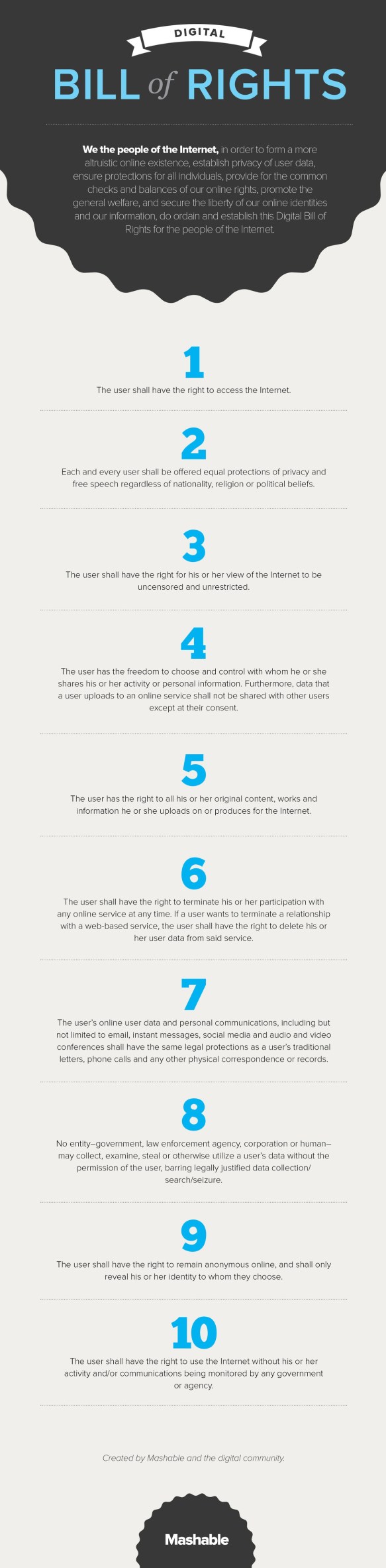
Explore Mashable’s Crowdsourced Digital Bill of Rights


After six weeks of public discussions, document updates and changes, as well as incorporating input from digital rights experts, Mashable is pleased to unveil its first-ever Digital Bill of Rights, made for the Internet, by the Internet.

via Explore Mashable’s Crowdsourced Digital Bill of Rights.

Digital Bill of Rights