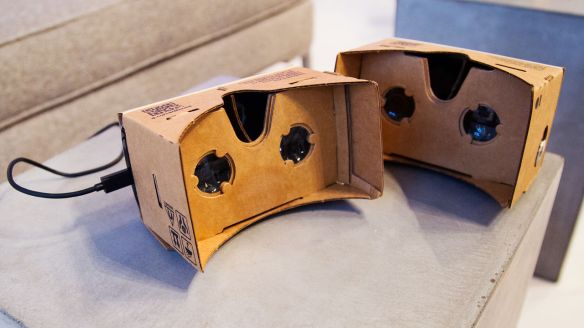
3 Google Cardboard Articles | WIRED, Engadget, TechCrunch #GoogleCardboard #virtualreality @googlecardboard #makerspaces


Google Cardboard is VR’s Gateway Drug | WIRED
There’s no reason not to try Cardboard now. It’s cheap, it’s easy, it works with your phone. It’s still a million miles away from the best VR demos out there; Oculus, HTC’s Vive, and Project Morpheus all blow Cardboard out of the water—which they should, because they’re not made of cardboard. But Cardboard more than accomplishes what it’s supposed to: It transports you.

Google’s Cardboard Design Lab teaches VR with (what else) VR | Engadget
Google debuted its larger and more robust Cardboard VR headset at I/O yesterday, now it needs some apps that actually run on it. However, designing a program in a virtual 3D environment is quite different than designing one to run on a 2D touchscreen. That’s why Google has also released the Cardboard Design Lab, an app that teaches you the basics of VR design from within a VR environment. The program runs through 10 fundamental design aspects — from “Using a Reticle” and “Keeping the User Grounded” to “Guiding with Light” and “Gaze Cues” — all from within the confines of the Cardboard headset. It won’t transform you into an VR hacking wizard overnight (as it’s not designed to) but CDL will give neophyte coders a solid overview of what they’re getting themselves into. And while the lessons learned here can just as easily be applied to designing for the Rift as Cardboard, the app is currently only available on Android.

Google’s Cardboard VR Now Works (Very Well) With iPhone | TechCrunch
Google’s Cardboard VR app first appeared last year at I/O 2014, but the initial version was somewhat limited in terms of device support. A new version released this year works with devices with screen sizes ranging up to 6 inches, but the more exciting news for many might be that it now also works with iPhone.

The new Cardboard for iOS app is available in the U.S. store now, and includes the same demo apps, as well as the same QR-code based pairing process to make sure it’s optimized for whichever generation of headset you have. Cardboard for iOS is a free download, and works with iPhone 5 and up.

Video Game Link to Psychiatric Disorders Suggested by Study | The Guardian #gaming #psychology


People who regularly play action video games could be at increased risk of developing neurological and psychiatric disorders, a study suggests.

The research, published in a Royal Society journal on Wednesday, found that people who played games such as Call of Duty, Grand Theft Auto V and Tomb Raider were more likely to employ navigational strategies associated with decreased grey matter in the hippocampus part of the brain.

Decreased volume in the hippocampus has been associated with disorders such as schizophrenia, post-traumatic stress disorder, depression and Alzheimer’s disease.

The lead study author, Prof Greg West, from the University of Montreal’s department of psychology, said the paper indicated that benefits of video games, such as improved attention and perception, highlighted in previous studies, could come at a price.

READ MORE: Video game link to psychiatric disorders suggested by study | Technology | The Guardian

Say Hello to the Final Oculus Rift—Coming 2016 | Gizmodo #virtualreality #OculusRift


I’ve been fortunate to experience a prototype Oculus Rift…the consumer version looks way cool and much more refined.

Virtual reality is coming—and now, we finally know when. You will actually be able to buy a real, consumer version of the Oculus Rift in the first quarter of next year. You’re looking at it right now. Let me repeat: this is not another prototype. READ MORE: Say Hello to the Final Oculus Rift—Coming 2016 | Gizmodo

Chris Milk: How Virtual Reality Can Create the Ultimate Empathy Machine | TED.com #virtualreality #psychology


Chris Milk uses cutting edge technology to produce astonishing films that delight and enchant. But for Milk, the human story is the driving force behind everything he does. In this short, charming talk, he shows some of his collaborations with musicians including Kanye West and Arcade Fire, and describes his latest, mind-bending experiments with virtual reality.

via Chris Milk: How virtual reality can create the ultimate empathy machine | Talk Video | TED.com

Projection Mapping Brings an Ancient Greek Statue to Life | WIRED


PURISTS WILL SCOFF, but we could be nearing a future where new technologies make art museums come to life. Not hyperbolically, in the sense that virtual reality displays and touchscreen tablets let you interact with art in new ways (we’re already seeing that in spades, thanks to smart renovations at places like the Cleveland Museum of Art and the new Cooper Hewitt.)

This is more literal. In this near-future, works of art might actually register facial expressions. They might blink, or look right at you. READ MORE: Projection Mapping Brings an Ancient Greek Statue to Life | WIRED.

Windows Holographic: Microsoft Goes Full Throttle Into Virtual Reality | Mashable


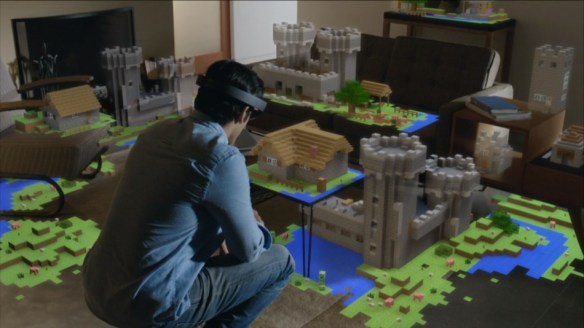
Microsoft introduced Windows Holographic, a technology that gives us a “world with holograms,” during its Windows 10 event on Wednesday. It would let a user transform one’s living room into a “surreal gaming environment,” according to the company.

There are no wires. No external cameras.

It works with Microsoft’s HoloLens headset, which allows users to wirelessly view holograms. Both the HoloLens and Windows 10 are slated to be available this fall.

READ MORE: Windows Holographic: Microsoft goes full throttle into virtual reality | Mashable

Disabled Boy Learns to Play Piano With His Eyes Using Virtual-Reality Headset | The Guardian


Eye Play the Piano is the work of Japanese VR headset manufacturer Fove, working with the University of Tsukuba. The project is pitched as a “universal piano” which children can play using eye movements while wearing the headset.

Through the use of Fove’s eye-tracking technology, the headmount recognises the user’s eye movement. The user blinks on one of the many panels within the interface to trigger the preferred note, which is then conveyed to the piano,” explains the Eye Play the Piano website.

READ MORE: Disabled boy learns to play piano with his eyes using virtual-reality headset | Technology | The Guardian.

Google Cardboard Is The Right Virtual-Reality Gadget For Right Now. But What’s Next? | Fast Company


I’d like to try the Cardboard experience to compare to the Oculus Rift. I tried OR at Netspeed 2014, experiencing an under water universe (boring with unwieldy navigation) and a roller coaster (exciting; definitely created a unique, visceral experience that made me want to puke my guts out after). Looking forward to more virtual reality experiences as the tech and devices evolve.

Google Cardboard Is The Right Virtual-Reality Gadget For Right Now. But Whats Next? | Fast Company | Business + Innovation

Google Cardboard has come a long way since Android honcho Sundar Pichai introduced it with a sheepish grin six months ago. The smartphone virtual reality viewer, made from folded-up cardboard with a pair of attached lenses—you supply an Android phone to provide computing power and a display—has shipped more than 500,000 units as of early December. (You can build your own Cardboard, or buy a ready-made version from not-quite-official sources for under $30.) Google has now added a Play Store showcase for the best Cardboard apps, and released a software development kit to spur even more VR app creation.

For a project that took mere weeks to throw together, Cardboard has done surprisingly well. But its success also puts it in an awkward position, somewhere between the oddball project that Cardboard appeared to be back in June and the serious business that prompted Facebooks $2 billion acquisition of Oculus VR in February. As virtual reality matures, is Cardboard prepared to mature with it?

READ MORE: Google Cardboard Is The Right Virtual-Reality Gadget For Right Now. But What’s Next? | Fast Company | Business + Innovation.