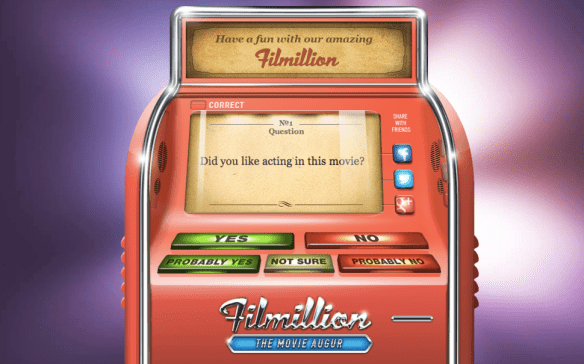
Fun time waster alert: Filmillion. It’s a movie guessing machine website that can figure out the movie you’re thinking of by asking you 30 yes or no questions.
Read: This Website Can Guess the Movie You’re Thinking of After 30 Questions | Gizmodo.

Fun time waster alert: Filmillion. It’s a movie guessing machine website that can figure out the movie you’re thinking of by asking you 30 yes or no questions.
Read: This Website Can Guess the Movie You’re Thinking of After 30 Questions | Gizmodo.
We’ve been featuring different websites for LIS job hunters for about six months now, and I thought it was time to share our list.
So, in alphabetical order, here are the websites we’ve featured since starting with INALJ on December 6, 2012.
See the list of links: Job Hunters’ Web Guide Guide | Hiring Librarians.
See the story for the full discussion: The 10 Commandments of Content | Co.Create | creativity + culture + commerce
I don’t know what to say about Riptide, the massive oral history of digital journalism that popped up on the Web tonight.
That’s because I’ve been looking at it for a couple hours, and have no idea how much of it I’ve consumed.
But it doesn’t seem like a very significant percentage: The project, sponsored by Harvard’s Joan Shorenstein Center, revolves around interviews with more than 60 people who have played key roles in the way news and the news business has transformed in the last few decades.
There are more than 50 hours of video on the site.
via Riptide Digital News History Interviews with Google, Twitter, NYT – Peter Kafka | AllThingsD.
10 Great Sites for Bored History Nerds | Flavorwire.
See the post for links to an eclectic list of history websites.
I recommend Jane Austen’s World, PBS History Detectives and Best of History Websites (a comprehensive resource portal).
Excerpt of article content specific to libraries:
Tools in a digital library context often provide similar benefits, although they tend to be different in nature. I would say that a basic tool for any digital librarian is likely a computer running a LAMP stack:
L = Linux
A = Apache web server
M = MySQL
P = A “P” programming language such as Perl or Python
With that, there is very little you can’t do. Well, that is, once you install the dependencies of whatever else you’re wanting to run. But you get the idea. It’s a basic platform from which much else is made possible. It’s an essential tool set.
Some of the other digital library tools in my repertoire include:
Swish-e – I’ve used this indexing software since the mid-90s, and haven’t seen a reason to change. With it, I’ve set up and maintained a variety of web sites that function as if they are database-supported but in fact are simply flat XML files that are indexed using Swish-e (see, for example, FreeLargePhotos.com).
XSLTProc – Sure, there are many options for XML processing out there and I won’t attempt to defend this particular decision except to say that it is easy to use and does what I need it to do (process XSLT stylesheets against specified XML files). Again, it underpins a number of my web sites.
Nano – You can stop laughing now. Seriously. Stop laughing. I mean it. Nano is a simple text editor (before it was Pico, which was what the PINE linemode email system used for message editing). I use it to do simple editing tasks in text files and programs on the server. I know it isn’t nearly as cool emacs, or even vi, but hey, it’s what I’m used to.
Tools are power. They give you capabilities you would not have without them.
There are the obvious music sites that everyone reads — Pitchfork, Stereogum, Spin, Resident Advisor (if you’re into electronic music), etc. But there are a galaxy of other sites out there, so here are our favorites: 25 of the sites you may not be reading already, but probably should be.
See the full story: The 25 Best Websites for Music Lovers | Flavorwire.
You may also like: My long list of Music Discovery resources. | The Modern MLIS
A free app providing a tour of Edinburgh’s 53 bookshops has been released onto iTunes.
The Bookshops Trail app has been created to mark Edinburgh’s status as a UNESCO City of Literature and gives users an overview of each bookshop and its individual specialisms, opening times, contact details and the quickest way to get there. The app covers independent bookshops, chain retailers and secondhand sellers.
Bookshops featured include the Owl & Lion Gallery, Free Church Books, Peter Bell Books, Old Children’s Books, Pulp Fiction and Fruitmarket Gallery, as well as branches of Blackwell’s and Waterstones.
A What’s On feature also provides up-to-date information for all literary events taking place across Edinburgh.
A spokesperson said: “Free and a must-have for the travelling booklover, this app will give users a visual and informative guide to Edinburgh’s bookshops. Edinburgh is the world’s first UNESCO City of Literature, one of six cities worldwide to receive UNESCO’s City of Literature designation.”
The app is supported by the City of Literature website.
If you’re looking for a creative space–a place to work that truly fosters collaboration, a place to learn new skills, a community of like-minded artists and entrepreneurs–you probably look on Yelp or do a Google search. That won’t yield much. These spaces are scattered across Yelp categories, and a Google search for “creative spaces” shows just a smattering of local spots. That’s what Berlin-based consulting studio ignore gravity discovered while researching creative spaces around the world.
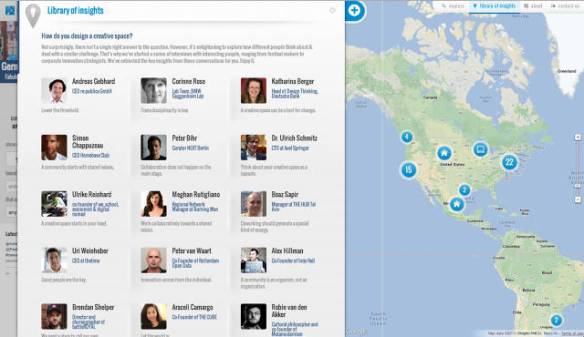
So the studio pulled together data on hundreds of creative spaces and presented them in the Creative Space Explorer, a tool that lets users pinpoint creative spaces on a global map–and add their own. ” We define ‘creative space’ as an enviro that consciously is set up to trigger collaboration in a creative way,'” explains Max Krüger, one of the creators of Creative Space Explorer.
See the full article: Mapping Creative Spaces Around The World | Co.Exist | ideas + impact.
 infophile