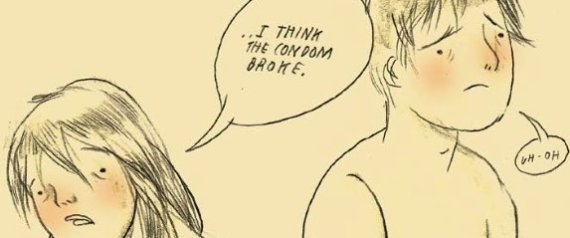
One woman is on a mission to demystify the realities of abortion — using illustrations. Writer and artist Leah Hayes created an illustrated book, Not Funny Ha-Ha: A Handbook for Something Hard, which takes readers through the thought processes of two women who choose to have abortions — one medical, the other surgical. She hopes the book will chip away at the stigma that often surrounds abortion. READ MORE: A Woman Made A Comic Book About Abortion And It’s Awesome | Huffington Post
As part of our series about technology in prisons called “Jailbreak,” we paid a visit to a new program that uses technology to fill an important role in the development of the children of those who are incarcerated.
Organizers say the TeleStory program the first of its kind in the country. At the main branch of the Brooklyn Public Library in New York, families of inmates bring their children to a special room filled with toys and books. Even more unique: the room is virtually connected to a prison on Rikers Island. via Connecting inmates with their children through books | Marketplace.org.
Researchers at the University Of Tennessee At Knoxville have confirmed what my kids believe they already know – that some video gaming can be as physically intense for younger gamers as playing outside.
You’ve got your warm bath, your bubbles, your glass of cheap wine and your book club book. Was there ever a better recipe for relaxation? That is, until — plunk! No thanks to slippery fingers and that glass of cheap wine, your just-purchased novel has taken a dive.
While the stress of keeping hold of a book with pruney fingers may fit the tone of, say, a heart-pounding thriller, it doesn’t exactly allow a reader to nestle into the worlds crafted by writers like Twain and Yeats. To provide a solution to the eternal book-bath struggle, Amsterdam-based couple Jasper Jansen and Wing Weng set to work to found Bibliobath, a company in its nascent stages that aims to publish waterproof works of classic literature.
This professor’s assignment is an inspiration and sounds like the most perfect summer ever!
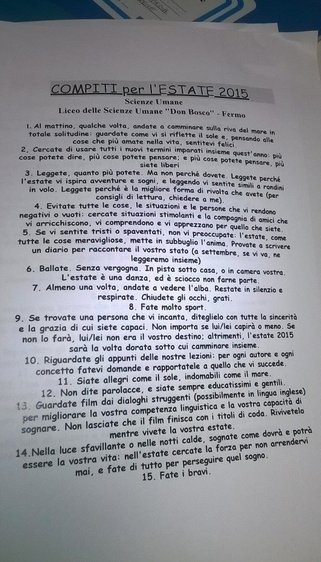
A summer homework list assigned by Cesare Catà of Don Bosco High School in Fermo, a small town on the Adriatic Sea in northeastern Italy, is currently going viral across that country.
Instead of giving his students required reading assignments, Catà gave them a prescription for how to live an inspired life, telling them that in the next few months, they should take time to admire a sunrise, dream about the future and read, because reading is “the best form of rebellion you have.”
The Huffington Post interviewed Catà, who said he models his teaching methods on Mr. Keating, Robin Williams’ character in the 1989 film “Dead Poets Society.”
Good news for those who’ve had to choose between after-work schmoozing over cocktails or sweating through a cardio session: a new hybrid concept called “sweatworking” lets you connect with clients, colleagues, or other contacts while exercising. Generations of businessmen have bonded with business contacts through rounds of golf, but now a broader range of networking activities are gaining popularity, thanks to a greater emphasis on active lifestyles.
Several years ago, I was given as a gift a remote session with a bibliotherapist at the London headquarters of the School of Life, which offers innovative courses to help people deal with the daily emotional challenges of existence. I have to admit that at first I didn’t really like the idea of being given a reading “prescription.” I’ve generally preferred to mimic Virginia Woolf’s passionate commitment to serendipity in my personal reading discoveries, delighting not only in the books themselves but in the randomly meaningful nature of how I came upon them (on the bus after a breakup, in a backpackers’ hostel in Damascus, or in the dark library stacks at graduate school, while browsing instead of studying). I’ve long been wary of the peculiar evangelism of certain readers: You must read this, they say, thrusting a book into your hands with a beatific gleam in their eyes, with no allowance for the fact that books mean different things to people—or different things to the same person—at various points in our lives. I loved John Updike’s stories about the Maples in my twenties, for example, and hate them in my thirties, and I’m not even exactly sure why.
But the session was a gift, and I found myself unexpectedly enjoying the initial questionnaire about my reading habits that the bibliotherapist, Ella Berthoud, sent me. Nobody had ever asked me these questions before, even though reading fiction is and always has been essential to my life. READ MORE: Can Reading Make You Happier? | The New Yorker.
People who regularly play action video games could be at increased risk of developing neurological and psychiatric disorders, a study suggests.
The research, published in a Royal Society journal on Wednesday, found that people who played games such as Call of Duty, Grand Theft Auto V and Tomb Raider were more likely to employ navigational strategies associated with decreased grey matter in the hippocampus part of the brain.
Decreased volume in the hippocampus has been associated with disorders such as schizophrenia, post-traumatic stress disorder, depression and Alzheimer’s disease.
The lead study author, Prof Greg West, from the University of Montreal’s department of psychology, said the paper indicated that benefits of video games, such as improved attention and perception, highlighted in previous studies, could come at a price.
Last month, a microbiology lab in Nottingham, England made international headlines when it unearthed a substance that kills methicillin-resistant staph, one of the deadliest superbugs of modern times. The most astounding part about the find? It was a 1,000-year-old Viking potion. “This is something we never, ever expected,” said Christina Lee, the Viking scholar at the University of Nottingham who translated the recipe from Old English. “When this tested positive against MRSA, we were just bowled over.”
Bald’s eye salve, intended to vanquish a stye, was discovered in Bald’s Leechbook, an Old English medical primer that hails from 9th century England. The recipe, which claimed to be “the best leechdom” in existence, caught the eye of Freya Harrison, a microbiologist at the University of Nottingham who moonlights as an Anglo-Saxon warrior on the weekends, as a member of the UK’s oldest and largest Viking reenactment society.
“This all kinda started from me being a big nerd,” Harrison told me over Skype. “When I met Christina, she was eager to talk with a microbiologist, because she has an interest in the history of infection. One of the things she had always wanted to do was test some of these medieval remedies out, to see whether they actually work.”
Together with microbiologist Steve Diggle, the three pooled resources to begin the “AncientBiotics” project, which would identify promising Anglo-Saxon remedies and test their medicinal value using modern science. They never expected their first attempt at replicating a medieval potion would be such a roaring success.
“To be honest, I didn’t think anything would come of this,” Diggle, whose interests lie in bacterial communication and evolution, told me over Skype. “For me, one of the most interesting aspects is asking whether this was a true scientific attempt at a recipe for treating an infection. If so, that completely changes our perspective on Anglo-Saxon medicine.”
SOCIAL NETWORKS ASPIRE to connect people, which is a noble but naive goal. When we uncritically accept connection as a good thing, we overlook difficult, important questions: Are some forms of virtual communication more nourishing than others? Might some in fact be harmful? Is it possible that Facebook, for instance, leaves some people feeling more lonely? No one knows for sure. We tend to build things first and worry about the effects they have on us later.
Robert Morris is taking the opposite approach. Starting with the desired effect of helping people deal with depression, he developed Panoply, a crowdsourced website for improving mental health. The site, which was the focus of his doctoral thesis at MIT Media Lab, trained users to reframe and reassess negative thoughts, embedding an established technique called cognitive behavioral therapy in an engaging, unthreatening interface. After a study confirmed the site’s effectiveness, Morris formed a company and is now working on turning the idea into a polished consumer app.
Like other social networks, Panoply will take up that noble goal of connection, but in a more specific, structured way. As software goes, it’s something of a novelty—a product that aims to enrich lives through precise, clinically-proven means, rather than merely assuming enrichment as a byproduct of its existence. READ MORE: A Social Network Designed to Combat Depression | WIRED
 infophile