London book benches: are you sitting comfortably? | The Guardian


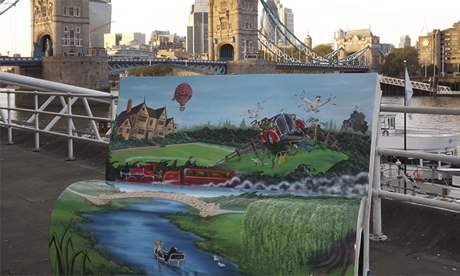
Visitors to London will able to enjoy books in a new way next summer – by sitting on them. Benches resembling giant open books, the volumes ranging from Kenneth Grahame’s Wind in the Willows to George Orwell’s 1984, will be installed at various sites in the capital for a stretch of 10 weeks.

London Book Benches

Read: London book benches: are you sitting comfortably? | Books | The Guardian.

18 Insanely Addictive Font Games | Mashable


Typography helps you engage your audience and establish a distinct, unique personality on your website. Knowing how to use fonts to build character in your design is a powerful skill, and exploring the history and use of typefaces, as well as typographic theory, can help.

But it doesn’t have to be boring. This selection of online and mobile font games will help test and expand both your knowledge and identification skills.

See: 18 Insanely Addictive Font Games | Mashable.

50 More Great Apps for Patrons, Professionals and Newbies | Richard Le & Tom Duffy, Jr.


Infographic: Social Media For Social Good | Marketing Technology Blog

Image


Social Media for Social Good

Support Ever, Jane: The Virtual World of Jane Austen by Judy L. Tyrer |Kickstarter


The Ever, Jane Kickstarter project is ~$14,000 short of its $100,000 goal with only 51 hours to go @ 6pm MST Friday, November 29th. You can support the project by pledging as low as $1.00!!!

Ever, Jane is a virtual world that allows people to role-play in Regency Period England. Similar to traditional role playing games, we advance our character through experience, but that is where the similarities end. Ever, Jane is about playing the actual character in the game, building stories.  Our quests are derived from player’s actions and stories. And  we gossip rather than swords and magic to demolish our enemies and aid our friends.

Support Ever, Jane: The Virtual World of Jane Austen by Judy L. Tyrer | Kickstarter.

Storytelling in 2014 | Gary Vaynerchuk


The Best of Internet Librarian 2013 | Ellyssa Kroski | OEDB.org


Every year there are two amazing conferences focusing on information technology and libraries hosted by Information Today – Computers in Libraries and Internet Librarian. They feature the field’s top innovators sharing their insights, recent project experiences, and practical tips. If you couldn’t make this year’s event, here are 10 stellar presentations that will catch you up:

Presentation topics:

  • Managing Devices & Gadgets
  • Open Source Solutions & Apps
  • Project Management
  • Tech Tools for Engaging Communities
  • Usability Testing: On Board & On a Shoestring
  • Using Web Analytics for Site Improvement
  • Super Searcher Secrets
  • The New State of Search: Google, Discovery, & Apps
  • Clarifying Copyright for the Classroom Teacher
  • Embedded Librarianship With Google Docs

Access them here: The Best of Internet Librarian 2013 | Ellyssa Kroski | OEDB.org.

Primo Is An Arduino Robot That Teaches Kids Programming Logic Through Play [Kickstarter] | TechCrunch


Dan Shapiro’s Robot Turtles board game Kickstarter showed there is serious appetite for kids’ games that aren’t just fun to play with but also sneakily teach core coding principles. Instead of the $25,000 he was aiming for, Shapiro raised more than $630,000. Geeky moms and dads clearly have money, and will spend it on the right bit of educational kit.

With that kind of Kickstarter community response, it’s pretty likely we’re set to see a wave of educational toys doing cool fun stuff with programming principles. To wit, meet Primo: a physical programming interface that teaches children programming logic while they control the movements of an Arduino-powered robot.

Read: Primo Is An Arduino Robot That Teaches Kids Programming Logic Through Play | TechCrunch.

How Braille Was Invented | Gizmodo


Braille Alphabte

Braille was invented by a nineteenth century man named Louis Braille, who was completely blind.

Braille’s story starts when he was three years old. He was playing in his father’s shop in Coupvray, France, and somehow managed to injure his eye. Though he was offered the best medical attention available at the time, it wasn’t enough—an infection soon developed and spread to his other eye, rendering him blind in both eyes. While a tragedy for him, had this accident not happened, we wouldn’t have braille today.

There was a system of reading in place for the blind at the time, which consisted of tracing a finger along raised letters. However, this system meant that reading was painfully slow and it was difficult to discerning by touch the relatively complex letters of the alphabet. As a result, many people struggled to master the embossed letter system.

Read the rest of the story: How Braille Was Invented | Gizmodo

World’s most expensive printed book sells for $14.2 million | AFP