5 Big Happiness Myths Debunked–And The Power Of Negative Thinking | Fast Company


It sometimes feels as if the “happiness industry”–the self-help books, motivational speakers, corporate consultants and the rest–makes its money by being useless.

It’s an ingenious business model, when you think about it: promise to help people think positive, then when your techniques fail, conclude that they weren’t thinking positively enough–sending them back for more. Among the many myths and misconceptions dogging the subject of happiness, here are five of the worst, along with some suggestions for what to do instead.

Myths debunked:

  1. It’s Crucial To Maintain A Positive Mindset
  2. Ambitious Goals, Relentlessly Pursued, Are The Key To Success
  3. The Best Managers Are Those Who Make Work Fun
  4. Higher Self-esteem Equals Greater Happiness
  5. Avoid Pessimists At All Costs

Read: 5 Big Happiness Myths Debunked–And The Power Of Negative Thinking | Fast Company | Business + Innovation.

The Ultimate Guide to the Invisible Web | OEDB.org


Search engines are, in a sense, the heartbeat of the internet; “googling” has become a part of everyday speech and is even recognized by Merriam-Webster as a grammatically correct verb. It’s a common misconception, however, that googling a search term will reveal every site out there that addresses your search. In fact, typical search engines like Google, Yahoo, or Bing actually access only a tiny fraction – estimated at 0.03% – of the internet. The sites that traditional searches yield are part of what’s known as the Surface Web, which is comprised of indexed pages that a search engine’s web crawlers are programmed to retrieve.

So where’s the rest? The vast majority of the Internet lies in the Deep Web, sometimes referred to as the Invisible Web. The actual size of the Deep Web is impossible to measure, but many experts estimate it is about 500 times the size of the web as we know it.

Deep Web pages operate just like any other site online, but they are constructed so that their existence is invisible to Web crawlers. While recent news, such as the bust of the infamous Silk Road drug-dealing site and Edward Snowden’s NSA shenanigans, have spotlighted the Deep Web’s existence, it’s still largely misunderstood.

Read more: The Ultimate Guide to the Invisible Web | OEDB.org.

Eye-opening and informative post. Topics discussed:

  • Search Engines and the Surface Web
  • How is the Deep Web Invisible to Search Engines?
  • How to Access and Search for Invisible Content
  • Invisible Web Search Tools

The Secrets Of A Memorable Infographic | Co.Design


Human memory is very fallible, but lately cognitive scientists have found that our minds capture much more visual detail in a moment than once believed. A 2008 paper reported that people who saw thousands of images for three seconds each over five hours later identified ones they’d seen over similar alternatives with nearly 90% accuracy. They didn’t just remember that they’d seen a cracked egg, they remembered that its egg white had formed a perfectly round puddle.

In other words, when we do retrieve a memorable image, a surprising amount of information comes with it, like a burr stuck to a sweater. That insight could have big implications for people who use visualizations in their everyday lives–graphic designers, for instance, or anyone on Tumblr. Above all, it suggests that memorability alone might enhance an infographic’s effectiveness. But it also prompts a question: How does an image become memorable in the first place?

Read: The Secrets Of A Memorable Infographic | Co.Design | business + design.

Touch Board kit combines an Arduino heart with touch sensors, conductive paint | Engadget


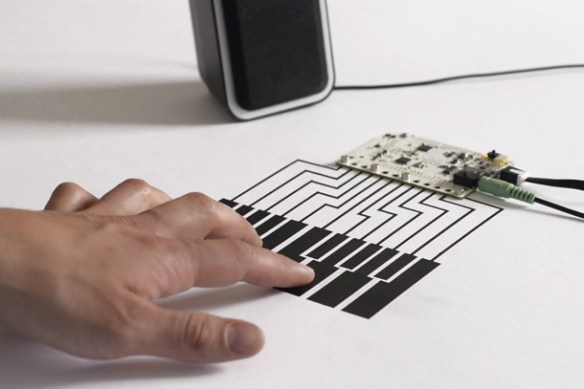
Capacitive sensing isn’t limited to your smartphone. In fact, you can use contact with human skin (or any other conductive surface) to trigger almost any circuit. And the Touch Board from Bare Conductive wants you to combine your DIY spirit with the ability to turn practically any surface into a sensor. At the heart is an Arduino compatible microcontroller (based on the Leonardo) with a few extras baked in, including a Freescale touch sensor connected to 12 electrodes and an audio processor for triggering MIDI sounds or MP3 files. While you can simply trigger the electrodes by touching them or connecting them to any conductive material, such as a wire, the Electric Paint Pen really opens up the input possibilities. It’s just like a paint marker, often used for small scale graffiti, except it spits out conductive black ink that can turn a wall, a piece of paper or almost anything else into a trigger. In fact, it

TouchBoard

‘s preloaded with a bunch of sample sounds on a microSD card so that you can simply paint a soundboard out of the box.

Read more: Touch Board kit combines an Arduino heart with touch sensors, conductive paint.

Chris Downey: Design with the blind in mind | TED.com


What would a city designed for the blind be like? Chris Downey is an architect who went suddenly blind in 2008; he contrasts life in his beloved San Francisco before and after — and shows how the thoughtful designs that enhance his life now might actually make everyone’s life better, sighted or not.

via Chris Downey: Design with the blind in mind | Video on TED.com.

News: Books & Publishing, Music & Film


Books & Publishing

‘City on Fire,’ a Debut Novel, Fetches Nearly $2 Million | TNYT
Donna Tartt’s novel “The Goldfinch” has 771 pages. “The Luminaries” by Eleanor Catton, winner of the 2013 Man Booker Prize, is 834 pages long. And then there is “City on Fire,” the 900-page debut novel that took the publishing industry by storm last week. It was even more evidence that the long novel is experiencing a resurgence, as a dozen publishers competed for the rights to release the book, set in New York City in the 1970s.

Music & Film

Hey MPAA, Why Are PG-13 Movies More Violent Than R-Rated Ones? | Flavorwire
A new study from the Annenberg Public Policy Center finds something more disturbing: though initial PG-13 films contained about as much gun violence as G or PG-rated pictures, “since 2009, PG-13-rated films have contained as much or more violence as R-rated films” (emphasis mine). And hey, funny story, that rise matches gun violence off-screen too.

News: Education & Technology, Librarianship


Education & Technology

The LA Times Trolls Innocent Teachers | TechCrunch
The once-respectable LA Times is leveraging its dwindling platform to attack individual teachers under the guise of data transparency. The editorial board won a court case allowing them to use a highly contentious, self-designed algorithm to rank the best and worst teachers in the Los Angeles Unified School District. Neither the suicide of one of the shamed teachers, nor the widespread criticism of the statistical methods have aroused the editorial board’s better judgment.

Google Earth Tour Builder lets you tell stories through maps | Engadget
Google has used Earth and Maps to tell tales of unfolding tragedies and soldiers fighting for our country. Now its opening up those tools to the public, allowing users to build what they’re calling “Tours” through Google Earth. Tour Builder was released in honor of Veterans Day and it allows users to create narratives tied to points on a map. More Google news: Google Quick Actions Let Users Act on Emails Without Opening Them | MashableYour Face and Name Will Appear in Google Ads Starting Today | Gizmodo and Apple maps: how Google lost when everyone thought it had won | theguardian

Librarianship

Community Is Key to Successful Library Maker Spaces | The Digital Shift


The most important resource for creating a successful library maker space—whether in a school or public library—is one’s own community, according to librarians Justin HoenkeAmy Koester, and Michelle Cooper. Strong relationships and community involvement, not big budgets and high-tech gadgetry, are key to reaching children and teens, the trio of makers say.

The experts shared details of their programming for kids and their top maker strategies during “The Community Joins In: Library Maker Spaces,” a midday session of The Digital Shift: Reinventing Libraries (#TDS13) webcast on October 16, moderated by Hoenke, the new teen librarian at the Chattanooga (TN) Public Library and 2013 Library Journal Mover &  Shaker. And since the event, the trio has created a Pinterest page filled with maker space advice, links, and takeaways.

Read more: Community Is Key to Successful Library Maker Spaces | The Digital Shift.

You may also like:

Super Searcher Tips | Mary Ellen Bates


The Beginner’s Guide to SoundCloud | Mashable


Read: The Beginner’s Guide to SoundCloud | Mashable

You may also like: