It’s hard to beat classic episodes of Sesame Street for timeless, near-universal educational appeal, but engineer and Adafruit Industries founder Limor Fried still saw an unmet need in the educational-video space. “We looked around and didn’t see an ‘Elmo for engineering’ or a kid’s show that celebrated science and engineering,” she tells Co.Design. “Every kid seems to have a cell phone or a tablet, but they know more about SpongeBob than how a LED works on the device or TV they’re watching, and we wanted to change that.” So she and her team at Adafruit created Circuit Playground, a Youtube series that combines chirpy puppets with hackery know-how via A Web Series For Kids Aims To Be The “Elmo for Engineering” | Co.Design: business + innovation + design.
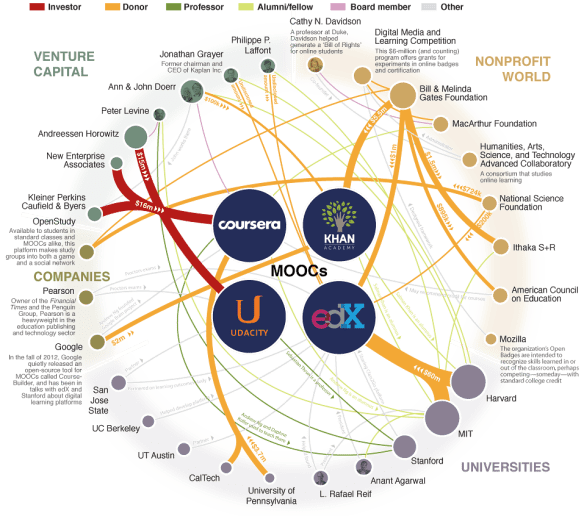
Millions of students have signed up for massive open online courses, and hundreds of universities are offering some form of Web-based curriculum. Most students aren’t paying much for these classes, if they’re paying anything at all. So where is all that knowledge—and all the cash—coming from? via Major Players in the MOOC Universe – The Digital Campus 2013 – The Chronicle of Higher Education.
As the coding education bubble swells, there’s room for some companies to target more specific audiences, including women exclusively. Fifty percent of the female population isn’t exactly a niche group, but it’s not a frequently targeted market in the technology industry, either.
“After two and a half years of planning, the Digital Public Library of America (DPLA), the U.S.’s first public online-only library, opened its doors today — or at least was made publicly available on the Internet.
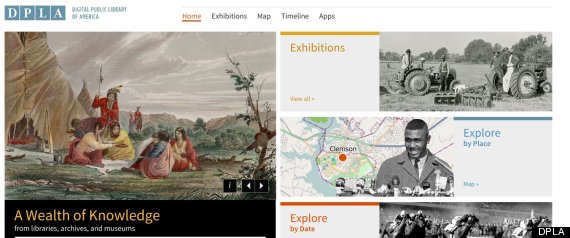
The DPLA is a free, open-source resource that makes a number of digital collections and archives across the country available in one place. It launched as a series of partnerships with the Smithsonian, the National Archives, New York Public Library, the University of Virginia, Harvard, Digital Library of Georgia, Minnesota Digital Library, Mountain West Digital Library and others. All of the text, photos, videos and audio contained in the DPLA can be searched, or browsed by place or time on the DPLA website” via Digital Public Library Of America (DPLA) Launches To Public | Mashable.
Vision of the DPLA Website:
The vision of a national digital library has been circulating among librarians, scholars, educators, and private industry representatives since the early 1990s. Efforts led by a range of organizations, including the Library of Congress, HathiTrust, and the Internet Archive, have successfully built resources that provide books, images, historic records, and audiovisual materials to anyone with Internet access. Many universities, public libraries, and other public-spirited organizations have digitized materials, but these digital collections often exist in silos. The DPLA brings these different viewpoints, experiences, and collections together in a single platform and portal, providing open and coherent access to our society’s digitized cultural heritage.
Quotable: “There are two key points about what the DPLA “is,” at least as of April 2013. First, the DPLA will be what we, the people, decide to make of it, as a shared, public-spirited resource. Second, the DPLA is the community of people who have devoted themselves (ourselves, in fact) to pursuing an ambitious, public-spirited vision of what the future might hold. On day one, we will present a radically open platform that will make a lot of exciting material available more broadly, as well as a lot of code and services with which technologists can do interesting things.”
Its just amazing how apps are transforming not only the technology sector but education, health care, business, etc. All one needs is an idea, a presentation and either partners/funders or access to platforms like KickStarter.
The clincher, the thing that made Quick Key go viral, was a poorly-lit video of an excitable guy holding his iPhone up to a Scantron page, one of those test pages you used to fill out in school. He thumbs through page after page, making comments on students’ performance as the app scans the page and instantly reports a grade. The video was amazingly compelling. The creator, Walter O. Duncan IV, can barely contain his excitement. His app looked great, it worked seamlessly, and the video struck a nerve with students and teachers, pocketing 260,000 views on YouTube and popping up on the front page of Reddit.
This, my friends, is how you do a viral video.
Duncan’s company is called Design by Educators, Inc and has raised over $99,500 to build the app and begin bringing on beta testers. The other co-founders are Isaac D. Van Wesep, and Marlon Davis.
“We worked hard to build an amazing prototype. But now we need real teachers to beta test Quick Key. My goal was to recruit 100 teachers with the video. As of tonight, over 1,000 people have signed up to learn about beta testing,” said Duncan.
A 13-year veteran school teacher, Duncan knows how to reach a crowd. He’s worked in inner-city districts in Detroit, DC, LA, and Brooklyn. He’s also host of a Facebook group called Teacher’s Round Table and is still a full-time teacher in Cambridge, Mass. His co-founders, Davis and Van Wesep, are also experience educators and entrepreneurs.
“We do not have customers as we are pre-beta but the video did drive over 10,000 visitors to our site in 48 hours,” said Van Wesep. “Our company is the only one making a product like Quick Key with real working K-12 teachers on the founding team. Since teachers designed Quick Key, it actually works for teachers, instead of making work for teachers.”
The product’s origin story began in 2007 when Duncan began giving his students “exit tickets,” short quizzes on the knowledge learned that day. This helped the teachers know what the students retained and, more importantly, what they’d have to cover again the next day.
“But there was a cost: grading of the exit tickets was done by hand, and all results had to be entered into the school’s central digital electronic grade book, or school management system,” said Van Wesep. “With some 90 students in his care, Walter was spending nearly two hours a night, just grading the exit tickets, and transcribing the results. It was mind-numbing.”
The solution came to him in 2011 when he realized the easiest way to scan these tickets was with a hand-held device – his phone. Thus Quick Key was born.
“If teachers make the best assessments, and the best lesson plans, and the best teaching materials, won’t they make the best software too? the response to Quick Key is bearing out that theory,” he said.
The app is still in early beta but a number teachers have already signed up to try it and they’re working on improving it for general use. It’s rare to see an app go so viral so quickly and it’s a testament to the dedication of a group of teachers and entrepreneurs that they’ve been able to go from zero to viral in a few short hours.
For Libraries, MOOCs Bring Uncertainty and Opportunity | Wired Campus A lot of the discussion about massive open online courses has revolved around students and professors. What role can academic librarians play in the phenomenon, and what extra responsibilities do MOOCs create for them?
Chronicle of Higher Education Blog Highlights Key Points from MOOCs and Libraries Event | Stephen’s Lighthouse “The “MOOCs and Libraries: Massive Opportunity or Overwhelming Challenge?” event, hosted by OCLC Research and the University of Pennsylvania on 18-19 March, featured thoughtful and provocative presentations about ways libraries are getting involved with massive open online courses (MOOCs), including the challenges and strategic opportunities they are facing.”
MOOCs and Libraries Event | The OCLC Research Channel (YouTube) Playlist includes videos of the sessions from the “MOOCs and Libraries: Massive Opportunity or Overwhelming Challenge?” event that took place 18-19 March 2013 in which OCLC Research and the University of Pennsylvania Libraries presented thoughtful and provocative presentations about how libraries are already getting involved with MOOCs. Also see this SlideShare presentation from OCLC: MOOCs & Libraries: Massive Opportunity or Overwhelming Challenge.
10,000 Free Courses Listed in a Massive Open Courses Directory | iLibrarian The OEDb has just launched a massive Free Online Open Courses Directory organizing nearly 10,000 free courses in the liberal arts and sciences. The courses are available in a variety of formats including full courses, video lectures, audio lectures, text articles, and mixed media.
10 Incredibly Interesting Free Online Courses I’d Like to Take for Fun | iLibrarian It’s amazing just how many colleges and universities are offering free open education courses that people can take from the convenience of their own computers. I’ve been investigating the offerings at many of these including MIT, University of Notre Dame, UC San Diego and others, and there are many classes that I’d enjoy taking just for fun. Here are ten of my choices, but click into the programs for listings of hundreds more!

 infophile