
So here it is my final blog post for Hack Library School. As I type these words on the keyboard, my eyes are flooded with tears…of joy! It means that by now you have another set of awesome writers who are sharing wonderful insight to a new generation of LIS students. READ MORE: 4 Things That Will Never Happen When You Become a Librarian | hls.
Category Archives: MLIS
Teaching Kids to Code, Using Minecraft’s Building Blocks | CNET #Minecraft #coding #STEM #kids @YouthDigital
Parents might be happy to know their kids can get a head start in the competitive slipstream of computer programming by doing something they already enjoy — playing video games.
That’s the goal of Server Design 1, a new online course rolled out Tuesday by Youth Digital, a tech education company that teaches kids to code, develop apps, and design 3D modeling. The company’s new program allows kids to create their own worlds, with their own rules, all while playing the popular video game Minecraft with their friends.
READ MORE: Teaching kids to code, using Minecraft’s building blocks | CNET
Note that Youth Digital offers many other online coding and design courses for children – not free though!
So you want to be a Data Visualization Librarian? | hls #librarians #dataviz #MLIS
So you know that you want to be a librarian, but have you thought about specializing in a certain field? Maybe you have an interest in emerging technologies or you want to work with researchers and students across the disciplines? Data visualization is a hot topic in librarianship, and specializations in data analytics and visualization is an exciting area of growth in the profession. I sat down with four visualization specialists who work within the University of Michigan Library system to get an idea of what their jobs entail.
READ MORE: So you want to be a Data Visualization Librarian? | hls.
Capitalizing on Your Skill Set as an Information Professional | Easter Digangi | Slideshare #MLIS
Brooklyn Author Recreates Borges’ Library of Babel as Infinite Website | Flavorwire
Reading this article, it struck me that the website Jonathan Basile has created would be a great premise for an MLIS student’s research paper on multimedia literacies. Or at least continue to inspire others to create online and/or virtual worlds based on ideas and settings as described in fiction.
“When it was proclaimed that the Library contained all books, the first impression was one of extravagant happiness,” wrote Jorge Luis Borges in his classic of philosophical fiction, “The Library of Babel.” One of the most revered stories-as-thought-experiments ever committed to print, Borges’ fiction posits the Universe as a library (“composed of an indefinite and perhaps infinite number of hexagonal galleries”) that contains every possible text. This intellectual vision, at once playful and poised, has stirred authors (like Umberto Eco and Terry Pratchett) and philosophers (W.V.O. Quine and Daniel Dennett) alike for more than 75 years.
And now it exists! Recently, Jonathan Basile, a Brooklyn author and Borgesian Man of the Book, taught himself programming so that he could recreate Borges’ Universal Library as a website. The results are confounding.
READ MORE: Brooklyn Author Recreates Borges’ Library of Babel as Infinite Website | Flavorwire.
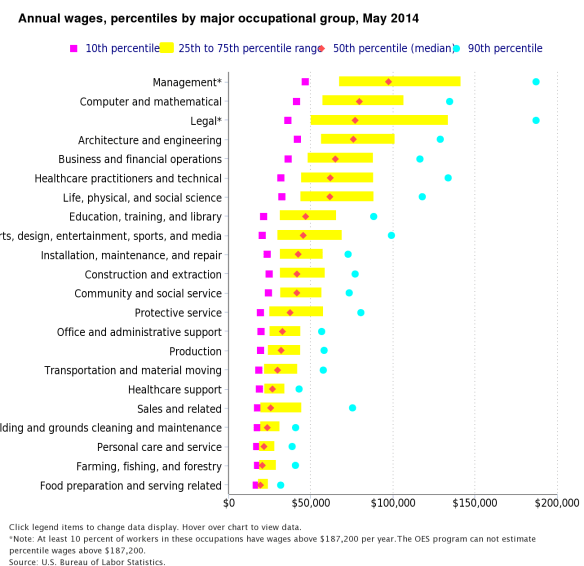
What Every Major Job Category Pays, In One Chart | Vox #employment #MLIS
Of interest to librarians and information services professionals note major job category “Education, training, and library.” See Bureau of Labor Statistics website for interactive charts and chart data.
New data from the Bureau of Labor Statistics lets us see the average pay for every major occupational group and also the distribution of pay at each level for these groups. READ MORE: What every major job category pays, in one chart | Vox
Further Thoughts On Tech Roles + Librarianship | LITA Blog
Given the overwhelming response to Bryan’s post, “What is a Librarian?” and Michael’s follow up post, “Librarians: We Open Access,” a few more of the LITA bloggers thought we’d weigh in on our roles and how they fit within the profession. READ MORE: Further Thoughts On Tech Roles + Librarianship | LITA Blog.
Emerging Roles and Possible Futures for Librarians and Information Professionals | Emerald Group Publishing
What professional roles do you play as a librarian/information professional? How have they changed during your career? And perhaps most important, how do you see them changing and evolving in the future?
These issues are discussed in an intriguing recent article in New Library World, “A systematic literature review informing library and information professionals’ emerging roles.” Evgenia Vassilakaki and Valentini Moniarou-Papaconstantinou, of the Library Science & Information Systems Department of TEI of Athens, Greece, uncovered their findings from peer-reviewed literature published between 2000 and 2014.
Although a variety of libraries were included, the authors state that “the majority of the literature focused on academic libraries.” All of the papers are in English, and “the majority of studies reported on research conducted in the United Kingdom and North America.”
Their findings have implications given the changes taking place in work, society and education, and how those changes affect our institutions. Six emerging roles were discovered, all of which would seem to be applicable within many types of libraries and information centres…READ MORE: Emerging roles and possible futures for librarians and information professionals | Emerald Group Publishing
Poster Sessions – A Beginner’s Guide [Originally Posted December 2013] | Hack Library School
Though June, July and August might seem like ages away, many conferences use January as their deadline for submissions from students. So today is as good a time as any to talk about a type of submission that can seem foreign to a lot of library students- the poster session. Let’s dive in! READ MORE: Poster Sessions – A Beginner’s Guide | Hack Library School
So you wanna be a data scientist? A guide to 2015’s hottest profession | Mashable
Are you good at math? Like, really good at math? Do you also know Python and, oh yeah, have deep knowledge of a particular industry?
On the off chance that you possess this agglomeration of skills, you might have what it takes to be a data scientist. If so, these are good times. LinkedIn just voted “statistical analysis and data mining” the top skill that got people hired in 2014.
Glassdoor reports that the average salary for a data scientist is $118,709 versus $64,537 for a programmer. A McKinsey study predicts that by 2018, the U.S. could face a shortage of 140,000 to 190,000 “people with deep analytic skills” as well as 1.5 million “managers and analysts with the know-how to use the analysis of big data to make effective decisions.” READ MORE: So you wanna be a data scientist? A guide to 2015s hottest profession | Mashable
 infophile