The Most Popular Websites in the World, Country-by-Country | Gizmodo


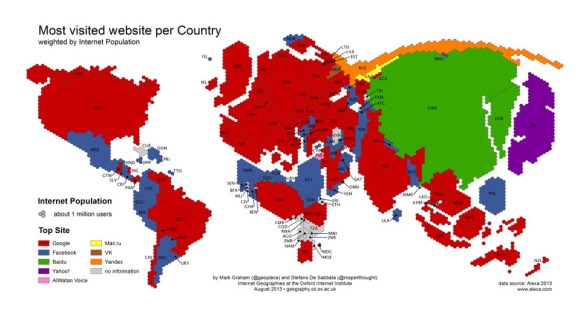
If you’ve ever wondered what the go-to web page was around the rest of planet, wonder no longer. This map shows the most visited websites around the world, broken down country-by-country.

Most visited website per country

Read: The Most Popular Websites in the World, Country-by-Country | Gizmodo.

The New Library | Pew Research Center


Intel launches Galileo, an Arduino-compatible development board | Engadget


Notice how so many maker projects require open-source hardware like Arduino and Raspberry Pi to function? Intel has, and the company is leaping into bed with the former to produce the Galileo development board.

Read: Intel launches Galileo, an Arduino-compatible development board  | Engadget.

Adobe Gets Hacked, Product Source Code And Data For 2.9M Customers Likely Accessed | TechCrunch


Now this is interesting and worrying. Source code being accessed is a very big deal, especially the company being Adobe. Subversive response to the move to subscription-based cloud services perhaps?? Hijacking code to exploit vulnerabilities…insert viruses…gain access to even more data. Very worrisome.

Article in Full from TechCrunch

“Uh oh — Adobe has just disclosed that one of their servers has been hacked.

While their investigations are still ongoing, Adobe has shared a few details on what they believe could have been accessed and obtained in the hack — and it’s a big one.

From what Adobe has shared so far, it sounds like the hackers had access to encrypted data for as many as 2.9 million customers. While Adobe stresses that the data is encrypted and that they “do not believe the attackers removed decrypted credit or debit card numbers”, that data — encrypted or not — is definitely not something they want out in the wild.

Adobe has yet to disclose how that data was encrypted, so it’s currently unclear just how secure it is.

Meanwhile, it also appears that the hackers may have been able to access the source code for at least three of Adobe’s products: Acrobat, ColdFusion, and ColdFusion Builder. This goes hand in hand with a report from Brian Krebs this morning, who noted that he and a fellow researcher had discovered at least 40GB of Adobe source code available on a hacking group’s private server.

Beyond the obvious business implications of having your otherwise locked down source code floating around in the wild, there are potentially massive security concerns here. Once you’ve got the source code for an application in hand, it becomes much easier to dig up the stealthy lil’ security screw ups that might otherwise go unnoticed. Combine this new potential for big zero-day exploits with the many, many millions of Adobe Acrobat (Adobe’s official PDF reader) installs around the world, and this all starts to get pretty worrisome.”

via Adobe Gets Hacked, Product Source Code And Data For 2.9M Customers Likely Accessed | TechCrunch.

Epic Rap Battle: Nerd vs. Geek | Rhett & Link | YouTube


via ▶ Epic Rap Battle: Nerd vs. Geek  | Rhett & Link | YouTube

300+ Followers, Quick Feedback Poll


With the blog reaching 300+ followers, I thought this would be a great opportunity for a quick feedback poll. News curation is a delicate balance. I’m sure many of you follow the same news sources I scan to repost to this blog. So when I’m scanning news items I always have in the back of my mind to post on average 5 to 10 items daily. I don’t want to spam your email inboxes, so anything over 15 posts is excessive in my mind and I try to avoid this. I overflow posts onto weekends when news becomes backlogged.

I also try to balance the types of daily posts across human interest, technology, librarianship, the MLIS and mentoring. This sometimes results in more dated news items and diversions being posted.

Here’s a quick poll asking the number of your daily post preferences. I also welcome any feedback you have, good or bad. So please leave your comments in the comment section below or email me via this contact form.

Open Source Solve[d] J.K. Rowling Mystery | The Official Rackspace Blog


The software…used—the Java Authorship Attribution Program—is open source and freely available on GitHub for download. The academics studied the machine-readable text of Cuckoo’s and compared it to Rowling’s previous novel. In the course of doing so, they discovered a number of linguistic signatures that pointed to the author of Harry Potter. The software is predicated on the analysis of syntax, style and punctuation, but just as importantly on the distinctive use of prepositions and articles. It turns out writers can change sentence length and rhythm and can cater to a new audience, but they’re unlikely to change how they use “around” and “at” and “on.”

Read the full story: Open Source Solve[d] J.K. Rowling Mystery – The Official Rackspace Blog.

A Scientific Guide To Maximizing Your Impact On Twitter, Facebook, And Other Digital Media | Fast Company


When is the best time to tweet on Twitter, post on Facebook, and email newsletters to reach the most people? Let’s find out…I’ve collected research and stats on Twitter, Facebook, email and blogging to help you find the best time to communicate with others in each format.

Read: A Scientific Guide To Maximizing Your Impact On Twitter, Facebook, And Other Digital Media | Fast Company | Business + Innovation

Top 100 Tools for Learning 2013 | Jane Hart | Centre for Learning and Performance Technologies


100 Great Children’s Books | 100 Years | NYPL


The New York Public Library releases a list of the top 100 greatest children’s books from the past 100 years. You can browse the list on the website or download a pdf of the list.

Great stories never grow old! Chosen by children’s librarians at The New York Public Library, these 100 inspiring tales have thrilled generations of children and their parents — and are still flying off our shelves. Use this list and your library card to discover new worlds of wonder and adventure!

via 100 Great Children’s Books | 100 Years | The New York Public Library.