The Abomination of Ebooks: They Price People Out of Reading | Wired Opinion | Wired.com


This is not one of those rants about missing the texture, touch, colors, whatever of paper contrasted with the sterility of reading on a tablet. No, the real abomination of ebooks is often overlooked: Some are so ingrained in the product itself that they are hiding in plain sight, while others are well concealed beneath layers of commerce and government.

The real problem with ebooks is that they’re more “e” than book, so an entirely different set of rules govern what someone — from an individual to a library — can and can’t do with them compared to physical books, especially when it comes to pricing.

The collusion of large ebook distributors in pricing has been a public issue for a while, but we need to talk more about how they are priced differently to consumers and to libraries. That’s how ebooks contribute to the ever-growing divide between the literary haves and have-nots.

Read the full story: The Abomination of Ebooks: They Price People Out of Reading | Wired Opinion | Wired.com.
Twitter Has A Surprisingly Small Number Of US Users | Stephen’s Lighthouse


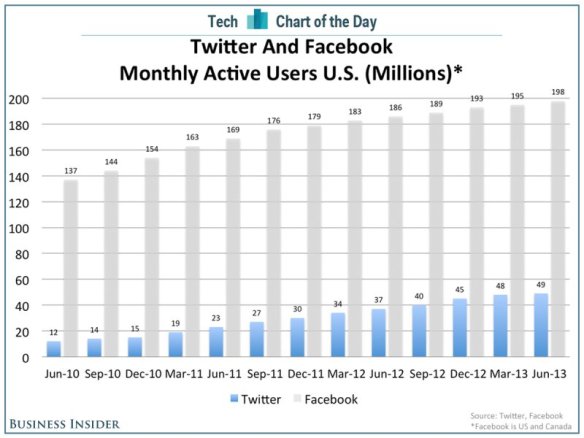
Twitter Has A Surprisingly Small Number Of US Users | Stephen’s Lighthouse

Read more: http://www.businessinsider.com/twitter-has-a-surprisingly-small-number-of-us-users-2013-10#ixzz2gypwp2LD

The Beginner’s Guide to the Hashtag | Mashable


If you’re a social media novice, hashtags — those short links preceded by the pound sign (#) — may seem confusing and unnecessary. But they are integral to the way we communicate online, and it’s important to know how to use them. Plus, they can be a lot of fun.

via The Beginner’s Guide to the Hashtag | Mashable

More gadgets, more reading: Survey suggests e-reader and tablet owners read more books |gigaom


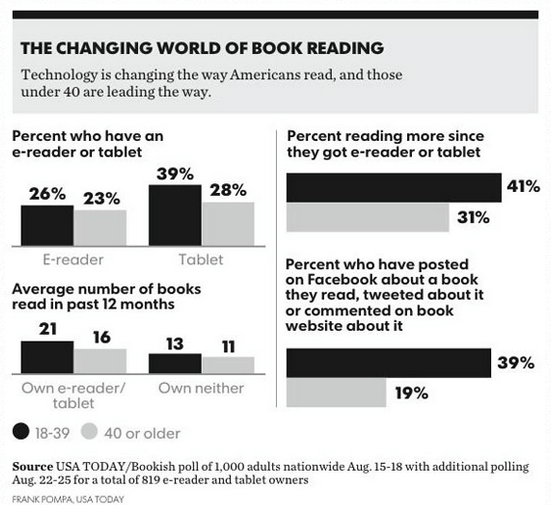
A new survey from USA Today and book discovery website Bookish finds that U.S. adults who own a tablet or e-reader read more books than the device-less. The survey also found differences in reading habits between adults under 40 and adults over 40.

Read: More gadgets, more reading: Survey suggests e-reader and tablet owners read more books | gigaom

See also: E-books are changing reading habits | USA Today

USA Today Survey


News: SCSL Social Media Library Launched, 10 Libraries Receive Grant, New Software Code Library, Favorite Gothic Romance Novels


South Carolina State Library Launches Social Media Library and Archive | The Digital Shift
The South Carolina State Library (SCSL) has launched the South Carolina State Agency Social Media Library, a new project that will archive all tweets, Facebook posts, and YouTube content generated by the official accounts of South Carolina’s state agencies while simplifying public access to this social media activity via a single online portal at scsocialmedialibrary.org. The portal and the archive were developed in collaboration with ArchiveSocial, a for-profit social media archiving company based in Durham, NC. It follows a similar effort launched by the State Archives of North Carolina less than a year ago.

Ten ‘enterprising libraries’ receive grant | The Bookseller
Ten library services around the country will receive a share of £450,000 designed to help promote business and entrepreneurship. The scheme has been established by Arts Council England (ACE), the British Library and the Department for Communities and Local Government.

Ex-Amazon Engineer Builds Library for World’s Software Code | WIRED
Kumar created a service called Runnable, a means of finding and using all the software “building blocks” that are freely available across the web.

My Favorite Gothic Romance Novels | HuffPost Books
Reviews 7 gothic novels.

Though lighter on the romance, I would add The Thirteenth Tale by Diane Setterfield, The Historian by Elizabeth Kostova and Sepulchre by Kate Mosse to the list. Did you know Louise May Alcott wrote gothic short stories? She did! Take a look at A Whisper in the Dark by the author. A collection of gothic novellas no longer under copyright.

A Map of Internet Freedom Around the World | Gizmodo


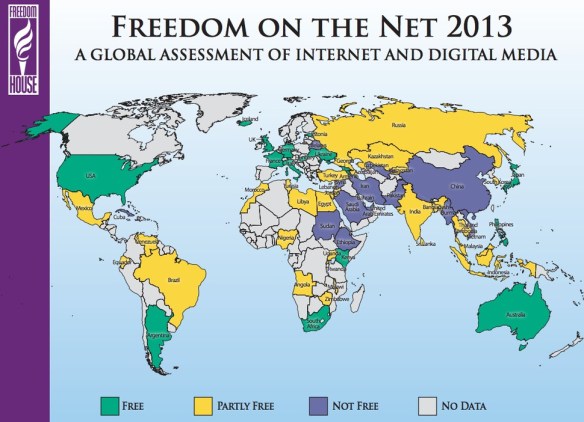
Here in the US, it’s easy to slip into the comfortable idea that the internet is unrestricted, a home for free speech and exploration, whether it’s meaningful and important, or dumb hashtags. It’s not that way everywhere though, and Freedom House has mapped out the current state of affairs across the globe.

Read and see more charts:  A Map of Internet Freedom Around the World | Gizmodo

Freedom On The Net 2013

GitHub For Beginners: Commit, Push And Go [PART 2 of 2] | ReadWrite


In Part 1 of this two-part GitHub tutorial, we examined the main uses for GitHub and began the process of signing up for a GitHub account and creating our own local repository for code. Now that these steps have been accomplished, let’s add the first part of your project now by making your first commit to GitHub.

Read: GitHub For Beginners: Commit, Push And Go [PART 2 of 2] | ReadWrite

Related: GitHub For Beginners: Don’t Get Scared, Get Started [PART 1 of 2] | ReadWrite

How to Find Creative Commons Video Assets | Mashable


Creating a YouTube video is a breeze now that nearly every computer has built-in video editing software. But integrating images, music or other media into a video can be tricky. If you use copyrighted songs or pictures, your video may be removed, and YouTube may even suspend your account.

Advice for finding CC images, video clips, music, texts and fonts and other assorted media.

Read: How to Find Creative Commons Video Assets | Mashable.

Engineers of Innovation | David Lankes | Vimeo


Innovation is a term with baggage. To some it is a nebulous concept thrown around to little effect. To others, it is a daunting task reserved for a few visionaries. In this presentation Lankes will talk about how innovation is the job of every librarian. Lankes will also talk about how innovation must be matched to a mission of learning and constant community improvement.

via Engineers of Innovation  | David Lankes | Vimeo

How Daydreaming Can Actually Make You Smarter | HuffPost


Psychology was my undergrad major. I have always been fascinated by theories of intelligence, cognitive development and memory. I’m one of those people who like to take personality and IQ tests. I believe in the value of reading to increase our emotional development and improve communication skills. Its great to see new research challenging our preconceived notions of intelligence.

Daydreaming gets a pretty bad rap. It’s often equated with laziness, and we tend to write off people with wandering minds as being absent-minded “space cadets” who can’t get their heads out of the clouds.

Though we all spend close to 50 percent of our waking lives in a state of mind-wandering, according to one estimate, some research casts daydreaming in a negative light. A 2010 Harvard study linked spacing out with unhappiness, concluding that “a wandering mind is an unhappy mind.” But could these unconscious thinking processes actually play a pivotal role in the achievement of personal goals?

In a radical new theory of human intelligence, one cognitive psychologist argues that having your head in the clouds might actually help people to better engage with the pursuits that are most personally meaningful to them. According to Scott Barry Kaufman, NYU psychology professor and author of Ungifted: Intelligence Redefined, we need a new definition of intelligence — one that factors in our deepest dreams and desires.

Read the full story: How Daydreaming Can Actually Make You Smarter | HuffPost

You may also like:  The Case for Preserving the Pleasure of Deep Reading | MindShift | The Modern MLIS