Beach Reads: A Library Pops Up In The South Of France | Co.Design


Staring down an expanse of vast and powerful ocean in late summer is guaranteed to make you question two things: your own sense of self-worth, and that of your e-reader. Nothing like the glare, the saltwater, the sunscreened fingers, the sand to recommend a hard-copy book. But the closest thing to literature on pages you can see is the bulk of September Vogue.

Now imagine, dear beach reader, that you’re lying underneath a soft, fabric-covered alcove on a breezy stretch of South of France coastline, the sound of Mediterranean waters lapping at the shore. Behind you is a library with up to 350 books–real-life, paperback books–at your curious disposal.

This is the precisely the dreamy vacation scenario that French industrial designer Matali Crasset fulfilled by creating a mobile library (yes, it actually exists) for the town of Istres. Located on the beach of Romaniquette, the freestanding steel literary haven is open to readers through September. “This project interested me for its relationship with real life,” Crasset tells Co.Design. “It is a dynamic object. I was able to develop a project that meets, in terms of usage scenarios, a logic and a demand that is very present, human, and alive.”

The Bibliotheque de Plage is stocked with titles ranging from classic Jane Austen to works chosen by the designer herself, those that provided inspiration through the course of the project’s execution. It was also essential to Crasset that the temporary beach library was a tribute to the importance of maintaining physical, personally curated collections of books. She collaborated with the town’s municipal library to establish “a comprehensive cultural policy of access to the books.” Her summer structure, she says, “brings books to the population to encourage the practice of not only reading, but of lending.”

Popup Beach Library

via 1 | Beach Reads: A Library Pops Up In The South Of France | Co.Design: business + innovation + design.

Collection of Links: Resources, Tools & Tech for New LIS/iSchool Students


The ToolsResources pages on The Modern MLIS

Archived MLIS and GTA Technology Topics, Tips & Tricks posts on The Modern MLIS

13 Devices College Students Actually Need | Stephen’s Lighthouse – August 2013

25 Apps You’ll Need to Survive College | Mashable – August 2013

10 Apps for Freshman Year of College | Mashable – August 2013

Your Very First Library Student Business Cards | Hack Library School – July 2013

11 Convenient Sites for Cheap Textbooks | Mashable – July 2013

23 Things for SLIS Students and Alumni: Essential Tools for Professional Success | SJSU.edu

Tech Tools for LIS Students {Starter Kit} | Hack Library School – September 2012

My Top 5 Apps for Back to School | Information Space – August 2012

10 open source projects that are leading innovation | TechRepublic


Technology depends upon Innovation. Without boundary-pushing ideas, technology (and those who depend upon it) would get nowhere. Innovation also drives businesses and society. Many people assume that most innovation is derived from closed source software and developers. That assumption is, in many instances, very wrong.

There are thousands upon thousands of open source projects that bring about innovation. Some do so on a small scale, while others are thinking massive and global.

The author lists 10 projects that are leading innovation in the world of technology.

  1. OpenNebula
  2. Ubuntu Unity
  3. OpenClinica
  4. OpenStack
  5. Kitware
  6. OpenDaylight
  7. ForgeRock
  8. Facebook Open Compute
  9. Hadoop
  10. Android

See the full story: 10 open source projects that are leading innovation | TechRepublic.

The Mistake Smart People Make: Being In Motion Vs. Taking Action | LifeHacker


There is a common mistake that often happens to smart people—in many cases, without you ever realizing it. The mistake has to do with the difference between being in motion and taking action. They sound similar, but they’re not the same.

via The Mistake Smart People Make: Being In Motion Vs. Taking Action | LifeHacker.

Surviving the All-Day Interview | Hack Library School


A sizable number of library students graduated in May or over the summer, and many of us were then faced with the prospect of finding that perfect job. Hack Library School has tackled other sides of this topic before, with Madeline’s post on the quick-turn after graduation, and Joanna’s post on eResumes, among others. I wanted to add my perspective after landing a number of all-day on-campus interviews for other jobs and collecting advice from many friends and colleagues I greatly respect. In true librarian fashion, I’ve synthesized their advice and built my own list.

via Surviving the All-Day Interview | Hack Library School.

NISO publishes update to Metrics Data Dictionary for Libraries and Information Providers | Stephen’s Lighthouse


NISO publishes update to Metrics Data Dictionary for Libraries and Information Providers | Stephen’s Lighthouse.

Stats and Graphs: What Should Potential Hires Learn in Library School? | Hiring Librarians


Stats and Graphs: What Should Potential Hires Learn in Library School? | Hiring Librarians.

Charts and results of survey responses. The survey is still open.

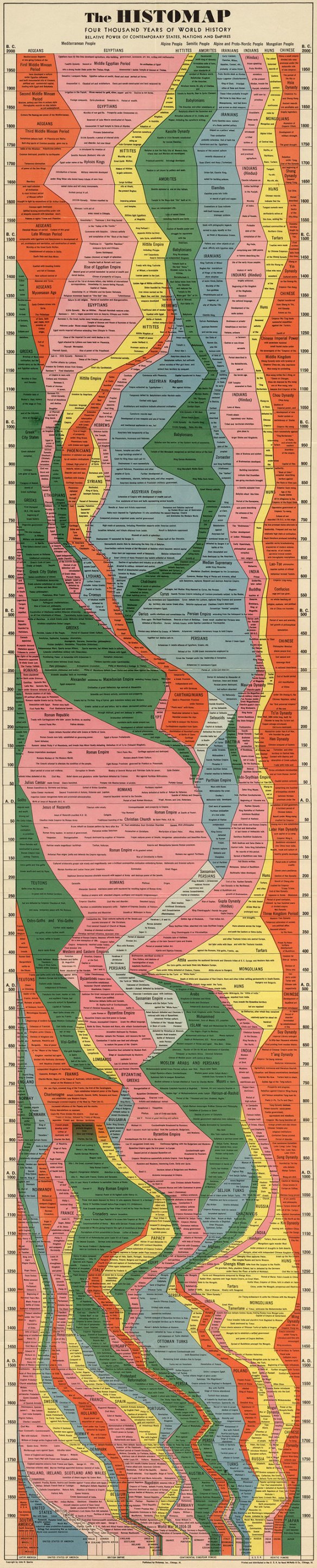
4,000 Years Of Human History Captured In One Retro Chart [Infographic] | Co.Design


If time is a river, the Histomap, created by John B. Sparks and first published by Rand McNally back in 1931, is a raging Mississippi. In that massive river of time, each of humanity’s great civilizations becomes a confluence that ebbs, wanes, and sometimes ebbs again, each a separate current in a river that inexorably rages down to the mouth of the present day.

Although certainly not modern, the Histomap is still a breathtaking example of good infographic design: A five-foot, roll-up chart that can fit an overview of human history on any wall. 

See the full story: Infographic: 4,000 Years Of Human History Captured In One Retro Chart | Co.Design: business + innovation + design.

The Histomap

How Is Information Technology Changing Healthcare? [INFOGRAPHIC] | Mashable


It’s not such a surprise these days when you visit your doctor’s office and your physician uses an iPad to take notes and store your medical records electronically. It makes sense, since managing modern-day medical information involves a great deal of effort and resources.

This tech shift has spurred the field of “health informatics,” which describes the intersection of healthcare, information technology and business. The infographic below — by the University of Illinois at Chicago’s (UIC) Online Masters of Health Informatics program — breaks down and describes health informatics and the mashup of technology and healthcare.

via How Is Information Technology Changing Healthcare? [INFOGRAPHIC] | Mashable

Healthcare & IT

Good Leaders Get Emotional | Doug Sundheim – Harvard Business Review


Good Leaders Get Emotional | Doug Sundheim – Harvard Business Review

[http://blogs.hbr.org/cs/2013/08/good_leaders_get_emotional.html]

Much of what comes out of people’s mouths in business these days is sugar-coated, couched, and polished. The messages are manufactured, trying to strike just the right tone. Genuine emotion stands in stark contrast. It’s a real person sharing a real feeling. When we hear it, we’re riveted — for one because it’s rare, but also because it’s real. Sometimes it’s uncomfortable and a little messy. But that’s what makes it powerful. No one is trying to hide anything.

We hide emotions in an attempt to stay in control, look strong, and keep things at arm’s length. But in reality, doing so diminishes our control and weakens our capacity to lead — because it hamstrings us. We end up not saying what we mean or meaning what we say. We beat around the bush. And that never connects, compels, or communicates powerfully.

Yes, being too emotional in business can create problems. It clouds objective analysis, screws up negotiations, and leads to rash decisions. But in nearly two decades of working with leaders, I’ve found that showing too much emotion is far less of a problem than the opposite — showing too little.

Emotions are critical to everything a leader must do: build trust, strengthen relationships, set a vision, focus energy, get people moving, make tradeoffs, make tough decisions, and learn from failure. Without genuine emotion these things always fall flat and stall. You need emotion on the front end to inform prioritization. You need it on the back end to motivate and inspire.

Over the last 17 years working with senior teams I’ve collected a lot of examples of leaders getting emotional — to good end. Here are a few:

“I’m angry that I had to spend 3 hours dealing with a problem that you created — a problem that you should have handled. Don’t put me in that position again.” Joan, a partner in a consulting firm hated conflict and rarely said things like this. She normally just rolled up her sleeves and took care of problems herself, even if she hadn’t created them. Then she got promoted to the head of the Southeast Region. There were too many problems to take care of by herself. Her outburst above and the ensuing conversation was a survival tactic, but it sent a clear message to the partner in charge of the Atlanta office. Don’t let this employee staffing issue happen again, and if it does, fix it yourself — before it lands on my plate. It was uncharacteristically aggressive for Joan, but exactly what the situation needed. That was two years ago and the problem hasn’t happened since.

“I think most of the ideas on this list are sh**ty…but that one’s great. Let’s do it.” Jamie, the CEO at a biotech company had a reputation for walking the fine line between galvanizing a team and offending them. He shot straight and went with his gut. While he had to clean up messes from time to time, it was never anything egregious. And his approach had a profoundly positive impact on the organization. Everyone knew where they stood with him. And everyone knew that he meant what he said. When he got excited about something, no matter what, he was going to make it happen. His energy and emotion accelerated innovation and execution across the company.

“I’m upset. I’m responsible. I apologize.” It was the type of mea culpa no one expected from Jeremy. The COO of a software firm, he had had a horrible relationship for years with Ron, a key product development VP. Finally, frustrated and tired, Ron quit. Within months it became clear that Jeremy had underestimated Ron’s impact on his team. It started to fall apart. With Ron gone, Jeremy was able to step back and see that he’d let a small issue create a huge problem. And that his stubbornness was at the root of it. He apologized to the executive team with a tear in his eye. I was there. It was shocking. That’s not the kind of guy Jeremy was. In an instant I understood how much he cared about the company and how ashamed he felt. Everyone saw it. Amazingly, he ended up apologizing to Ron and hiring him back.

Often, one of the reasons we don’t show emotion is because we’re not even aware we’re feeling it. We’re angry, frustrated, or upset and we suppress it. We’re excited, motivated, or inspired and we temper it. We do it without even realizing it. Emotional data seems less relevant in the business world where logical data reigns supreme. But it’s not only relevant, It’s usually the lynchpin to change and growth.

One further point. It’s important to note there’s a gender bias around showing emotion at work. I’ve seen that in the same places where men get labeled tough, passionate, or open, women get labeled bitchy, hysterical, or weak. I find this double standard particularly destructive and insidious because it leads to women’s emotions getting dismissed more readily than men’s, often at exactly the times where that emotion is most needed — times when no one else in the room is raising the most important points. We all need to stay aware of this double standard and not enable it.

My advice to all leaders is to pay attention to your emotions. At least a couple times a week, stop for 10 minutes and ask yourself, “What am I feeling right now?” Write it down if you can. Keeping a regular journal is a helpful way to understand how you’re feeling.

Then pick your spots to let loose a little. Let your emotions out. Let people in. Both are critical to effective leadership.