U.S. Navy Launches NeRD, a Security Enhanced E-Reader | The Digital Shift


The U.S. Navy General Library Program NGLP last month announced the release of its new Navy e-Reader Device NeRD, which comes preloaded with 300 titles including popular fiction, recent bestsellers, and content from the Chief of Naval Operations Professional Reading Program. The new e-ink readers were designed by preloaded digital content provider Findaway World perhaps best known in the library world for its Playaway and are the first devices to feature Findaway’s new “Lock” ereader security solution.

These preloaded devices do not have wifi connectivity or accessible data inputs or outputs, and are designed to be manipulation free. This design adheres to the Navy’s security protocols, which include restrictions on many types of personal electronic devices with rewritable media or recording capabilities on board ships. In an earlier interview during the request for information stage of the project in 2012, Nilya Carrato, program assistant for the NGLP told LJ that preloaded, manipulation-free devices would also help ensure that titles are not accidently deleted during long deployments, and that sailors would not use their personal credit cards to add content to the devices.

via U.S. Navy Launches NeRD, a Security Enhanced E-Reader | The Digital Shift.

Access My Info Tool Lets Telecom Subscribers Know If Theyve Been Spied On | HuffPo


Canadians concerned about their online privacy have a new way to find out whether their telecom provider is collecting information about them — and sharing it with third parties like government entities.

The new tool, developed by some of the countrys top privacy experts, makes it easier for Canadians to force their provider to disclose their practices.

“What were trying to do as researchers is identify what kind of data telecommunications companies in Canada collect, obtain, and process, and disclose to third parties,” said Dr. Christopher Parsons, a fellow at the Munk School of Global Affairs Citizen Lab.

“But we also wanted to make it easier for Canadians individually to engage in the same sort of action.”

Known as “Access My Info,” the web tool helps create a formal letter which, under Canadian privacy law, telecom companies are legally obliged to respond to within 30 days, the website offering the tool says.

Canadians requesting the information fill out a few basic details about themselves and their telecom provider, and can do so confidentially, the website says.

Read More: Access My Info Tool Lets Telecom Subscribers Know If Theyve Been Spied On | HuffPo

The Most Important Insights From Mary Meeker’s 2014 Internet Trends Report | TechCrunch


A must-read that’s chock full of critical knowledge. Kleiner Perkins partner Mary Meeker’s data dumps have become a highly anticipated event in the tech industry, as her research helps everyone else level up.

The only problem is that the 2014 Internet Trends report is 164 slides of dense data, so we’ve broken it down into a digestible summary of the most important facts, including a look at whether we’re in a bubble.

READ: The Most Important Insights From Mary Meeker’s 2014 Internet Trends Report | TechCrunch.

Link to the PDF of the presentation.

The US is opening up the Smithsonian’s digitized art collection | Engadget


The White House promised that it would open up government data last year, and it’s now expanding those plans in some intriguing directions. For one, it’s opening up the Smithsonian American Art Museum’s digitized collection; you’ll soon get to build apps and other tools using the institution’s artwork as a foundation. Even curators don’t have that much access right now, the administration says. via The US is opening up the Smithsonian’s digitized art collection | Engadget

From the White House Continued Progress and Plans for Open Government Data:

  • Smithsonian American Art Museum Collection: The Smithsonian American Art Museum’s entire digitized collection will be opened to software developers to make educational apps and tools. Today, even museum curators do not have easily accessible information about their art collections. This information will soon be available to everyone.

Woman Puts Deus Ex On Computer Chip In Her Hand | Kotaku


Zoe Quinn doesn’t just make heartfelt, experimental games like Depression Quest. She’s also pretty set on becoming a cyborg, judging from the cyberpunk as hell implants she’s gotten over the last couple of years.

READ MORE: Woman Puts Deus Ex On Computer Chip In Her Hand | Kotaku

Sony Crams 3,700 Blu-Rays’ Worth of Storage in a Single Cassette Tape | Gizmodo


Sony just unveiled tape that holds a whopping 148 GB per square inch, meaning a cassette could hold 185 TB of data. Prepare for the mixtape to end all mix tapes. Read more: Sony Crams 3,700 Blu-Rays’ Worth of Storage in a Single Cassette Tape  | Gizmodo

This Scientist Uses The New York Times Archive To Eerily, Accurately Predict The Future | Co.Exist


The New York Times might be a widely respected chronicler of past events, but can we use it to divine the future? Kira Radinsky, a 27-year-old Israeli computer prodigy dubbed the “web prophet” says yes.

Radinsky, who appeared this year on MIT’s prestigious list of top 35 inventors under the age of 35 (previous winners include the likes of Mark Zuckerberg, Larry Page, and Sergey Brin), and who started university at the age of 15 and received her Ph.D. in computer science at 26, has developed a unique system which she claims has already predicted the first cholera epidemic in Cuba in many decades, many of the riots that started the Arab Spring, and other important world events.

The complex computer algorithms she wrote collect immense volumes of electronic data–most notably several decades of New York Times archives but also anything from Twitter feeds to Wikipedia entries–and processes it to extract little-known cause and effect patterns that can be used to predict future events.

Red more: This Scientist Uses The New York Times Archive To Eerily, Accurately Predict The Future | Co.Exist

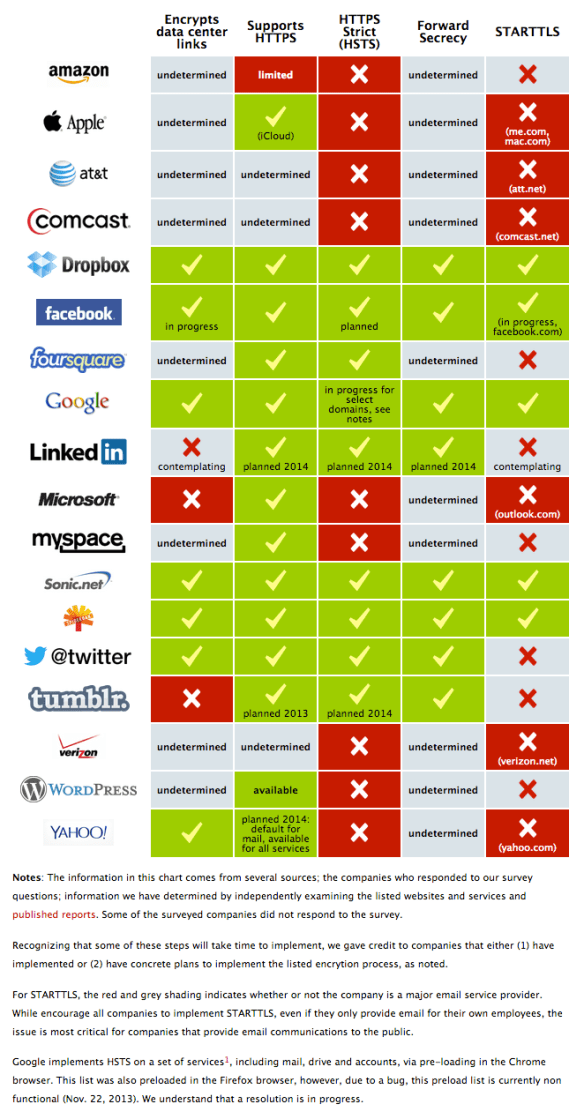
UPDATE: Encrypt the Web Report: Who’s Doing What | EFF


We’ve asked the companies in our Who Has Your Back Program what they are doing to bolster encryption in light of the NSA’s unlawful surveillance of your communications. We’re pleased to see that four companies—Dropbox, Google, SpiderOak and Sonic.net—are implementing five out of five of our best practices for encryption. In addition, we appreciate that Yahoo! just announced several measures it plans to take to increase encryption, including the very critical encryption of data center links, and that Twitter has confirmed that it has encryption of data center links in progress.

Read: UPDATE: Encrypt the Web Report: Who’s Doing What | Electronic Frontier Foundation

UPDATE: Encrypt the Web Report: Who's Doing What | Electronic Frontier Foundation


How to Opt Out of Data Tracking on Your Most-Used Sites | Mashable


Google’s latest updates to its terms of service have left many privacy advocates crying foul. One new feature called “shared endorsements” allows your name and photograph to be used in targeted advertisements on Google property sites.

Google’s support page for shared endorsements claims the feature will allow for more friend-based recommendation of music and restaurants, working much like Facebook’s Sponsored Stories.

Shared endorsements are not unique. Many sites, apps and browsers are using your information in ways you might not entirely comply with if you’d take the time to read their privacy policies. Often, opting out is only a click away, though it may be difficult to find out where exactly to click.

We’ve compiled this list of ways various Internet companies are tracking and using your data — plus, given you the tools to opt out, if you wish.

Reviews how to opt out for:

  • Targeted Advertisements
  • Search History
  • Disable Third-Party Cookie Tracking

Read: How to Opt Out of Data Tracking on Your Most-Used Sites | Mashable

Related: