News: Education & Technology, Librarianship


Education & Technology

Librarianship

Are Digital Libraries A ‘Winner-Takes-All’ Market? OverDrive Hopes So | Forbes
“Schools and libraries in all forms are transitioning their spends from providing physical items that are being stored on shelves and branches to digital items — the fastest portion of their growth,” said Steve Potash  in a recent interview. Potash is President and CEO of OverDrive, the Cleveland-based provider of technology for managing and distributing digital content for lending libraries.

Gross: Fifty Shades of Grey goes viral – literally | theguardian
Library copies of the bestselling sadomasochistic romance were found to carry traces of herpes and cocaine.

This Grad Student Hacked Semantic Search To Be Better Than Google | Co.Labs


Full Post

Google may be the dominant search engine, but it’s far from ideal. One major problem: How do you search for things you don’t know exist?

Using Google’s own experimental algorithms, a graduate student may have build a solution: a search engine that allows you to add and subtract search terms for far more intuitive results.

The new search engine, ThisPlusThat.Me, similarly looks for context clues among the terms. For instance: Entering the arithmetic search “Paris – France + Italy” gives the top result as “Rome,” but if I search the same thing in Google, I’ll get directions between Paris and Italy, restaurants in France and Italy, and a depressing Yahoo Answers of whether Italy is in Paris (or vice versa). “Rome,” on the other hand, is an association you, a human, would make (I wantThis, without That but including Those)–and the engine makes that decision based on each answer’s semantic value compared to your search.

Until now, search has been stuck in a paradigm of literal matching, unable to break into conceptual associations and guessing what you mean when you search. There’s a reason Amazon and Netflix have scored points for their item suggestions: They’re thinking how you think.

The engine, created by Astrophysics PhD candidate Christopher Moody, uses Google’s own open-source word2vec algorithm research to take the terms you searched for and ranks the query results by relevance, just like a normal search–except the rankings are based on “vector distances” that have a lot more human sense. So in the above example, other results could have been, say, Napoleon or wine–both have ties with the above search terms, but within the context of City – Country + Other Country, Rome is the vector that has the closest “distance.”

All the word2vec algorithm needs is an appropriate corpus of data to build its word relations on: Moody used Wikipedia’s corpus as a vocabulary and relational base–an obvious advantage in size, but it also had the added benefit of “canonicalizing” terms (is it Paris the city, or Paris from the Trojan War? In Wikipedia, the first is “Paris” and the second “Paris_(mythology).” But millions of search-and-replaces in Wiki’s 42 GB of text was intensive, so Moody used Hadoop’s Map functions to fan those search-and-replaces to several nodes.

A search query then spits out an 8 GB table of vectors with varying distances; Moody tried out a few data search systems before settling on Google’s Numexpr to find the term with the closest vector distance.

via This Grad Student Hacked Semantic Search To Be Better Than Google | Co.Labs | code + community.

Data Science: More Than Mining [Infographic] | Visual.ly

Image


Data Science: More Than Mining

Circle of Life: The Beautiful New Way to Visualize Biological Data | Wired Science


Krzywinski developed Circos, an open source visualization tool that arranges tabular data in circular form. It was a simple idea, but transformative: It’s since been used for thousands of visualizations, and its distinctive aesthetic is synonymous with the informational richness of our moment.

Read: Circle of Life: The Beautiful New Way to Visualize Biological Data | Wired Science

For more on Martin Krzywinski’s science art take a look at his website.

Circle of Life: The Beautiful New Way to Visualize Biological Data - Wired Science

Google Maps becoming more context-aware and ’emotional’ | CNET


Snip

SAN FRANCISCO — For Google, the map of the future is taking everything it knows about you and the world and plotting it in real-time as you move through your life.

“We can build a whole new map for every context and every person,” said Bernhard Seefeld, product management director for Google Maps, speaking at the GigaOm Roadmap 2013 conference. “It’s a specific map nobody has seen before, and it’s just there for that moment to visualize the data.”

Like the early days of map making that told stories of discovery and created more of an emotional connection with the unfolding world, Google wants to build what Seefeld called “emotional maps that reflect our real life connections and peek into the future and possibly travel there.”

Google’s context-aware maps will require refining and extending the underlying map data, and combining it with the kind of personal data from applications that powers Google Now, the company’s personal digital assistant technology.

Read more: Google Maps becoming more context-aware and ’emotional’ | Internet & Media – CNET News.

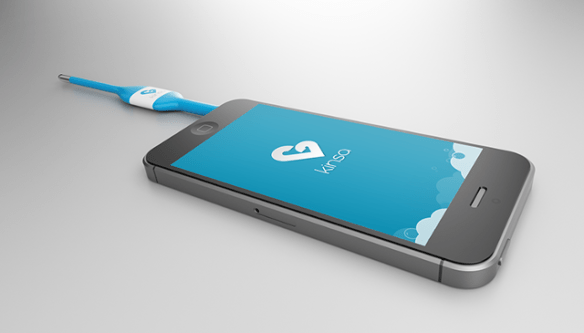
This Tech-Enabled Thermometer Tracks More Than Just A Fever | Co.Design


Kinsa wants to change how we glean information about our health, starting with the world’s most common medical device.

Quotable: “There’s a bigger picture: Like the Scanadu Scout, Kinsa is part of a larger tapestry of data companies, fitness wearables, and health gadgets that want to empower us to start owning our own data. Sensors give us on-demand insights into our health, whereas a doctor’s office means tests and a wait time for a phone call.”

Read: This Tech-Enabled Thermometer Tracks More Than Just A Fever | Co.Design | business + design.


This Tech-Enabled Thermometer Tracks More Than Just A Fever | Co.Design | business + design


Keep Your Precious Data Safe by Storing Passwords in Your Subconscious | Gizmodo


Do you ever fear that, one day, data-hungry bandits will tie you to a chair and make you surrender your Facebook password? It’s not an unreasonable fear, actually. Christopher Nolan made a gripping documentary about this very scenario. But, thanks to a new method developed by scientists from Stanford and Northwestern, you may never have to worry about remembering a password ever again.

The technique depends on so-called “procedural memories,” the things stored in your brain that you access unconsciously. For example, you ride a bike or play a guitar without thinking about it. These memories are actually stored deep in the part of your brain that handles motor control and habit-forming, as opposed to explicit memories which are stored in the frontal cortex, among other places. However, you can train yourself to access procedural memories when you need them.

Read More: Keep Your Precious Data Safe by Storing Passwords in Your Subconscious | Gizmodo.

How to Erase Yourself From the Internet | Gizmodo


If your growing weariness of being constantly tethered to the Internet has become overwhelming, it might be time to scrub yourself from the social media sphere altogether. Here’s how you can become a ghost on the Internet, by tracking down and eliminating your digital past.

Read: How to Erase Yourself From the Internet | Gizmodo.

Provides instructions for how to remove/deactivate accounts for Facebook, Twitter, LinkedIn, and Google+. Recommends other tools including Account Killer, Just Delete Me and Knowem.

A Future Internet Might Not Use Servers | Gizmodo


You’d think that given how pervasive the internet is, we’d be stuck with the fundamental architecture it uses: servers that many devices connect to for their information fix. But a team of Cambridge University scientists wants to shake things up—and remove servers altogether.

A project named Pursuit aims to make the internet faster, safer and more social by implementing a completely new architecture. The system does away with the need for computers to connect directly to servers, instead having individual computers being able to copy and re-publish content on receipt. That would allow other computers to access data—or, at least, fragments of data—from many locations at once.

Read: A Future Internet Might Not Use Servers | Gizmodo.

Adobe Data Breach Affects 38 Million — Not 3 Million, as Reported | Mashable


Full Post

In early October, Adobe announced that 2.9 million customers were hit in a major data breach. As it turns out, the breach went much further, affecting 38 million users, according to a report from Naked Security.

The attackers gained access to users’ customer IDs, names, encrypted passwords, encrypted debit and credit card numbers and other personal data.

“So far, our investigation has confirmed that the attackers obtained access to Adobe IDs and (what were at the time valid), encrypted passwords for approximately 38 million active users,” said Adobe spokesperson Heather Edell.

Adobe initially believed the hackers accessed source code from Adobe Reader, Acrobat and ColdFusion. New data shows that a portion of source code for its Photoshop software was stolen, too.

Adobe set up a help page for affected users, notified them and reset their passwords. The company advises users to change their passwords entirely not only for Adobe products, but also for other sites where they used the same password.

Adobe Data Breach Affects 38 Million — Not 3 Million, as Reported | Mashable.