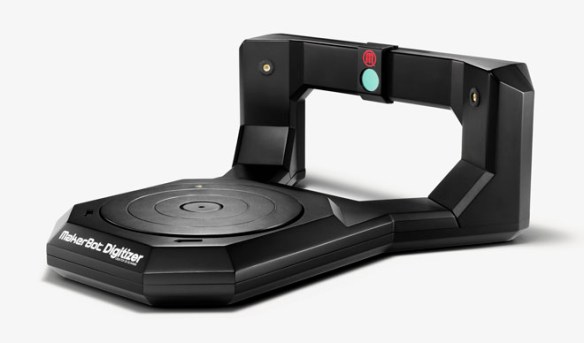
See the post: MakerBot Digitizer Will Clone All Your Stuff Using a Turntable and Lasers | Gadget Lab | Wired.com

In the future, e-books will act just like social networks. We’ll use them on our phones, share and comment right inside e-reader apps, and publishers will use our data to help them make better marketing decisions. If you think digital reading is exploding now, just wait.
The article examines a new reading app called Readmill, which makes “each and every book its own self-contained social network.” See the full story: E-Books Could Be The Future Of Social Media ⚙ Co.Labs ⚙ code + community.
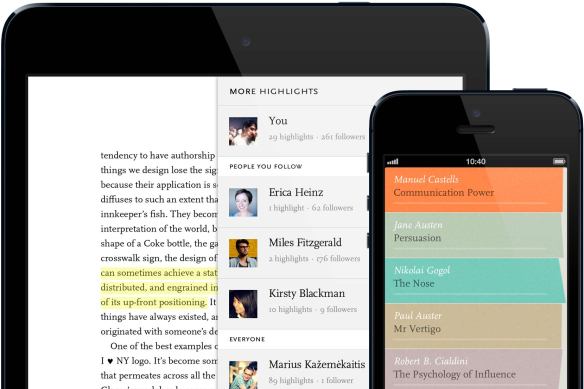
Image Attribution: Readmill
Even when it’s useful, data is often ugly. And without design experience, it’s difficult to make it visually appealing. Enter DataAppeal. For the past year, the data visualization company has showcased a web platform that makes it easy for anyone to upload location-based data files and turn them into beautiful, visually unique 3-D animated maps on a digital globe.

via How To Turn Your Data Into Beautiful 3-D Maps | Co.Exist | ideas + impact.
DataAppeal has a free basic account with limited features and some restrictions, which allows 15 dataset uploads per year.
Great to see an organization swoop in, so to speak, to preserve a defunct application, then go a step further and open the source code to developers. Hope to see this happen more often.
The Smithsonian’s Cooper-Hewitt design museum in New York just acquired the source code to an iPad app called Planetary from its now-defunct developer. Code is officially art now.
Planetary, as you can see in the video above, is basically a fancy music visualizer. The app’s source code was donated to the Cooper-Hewitt, which promptly open-sourced the code in hopes that people will use its visualization methods for other applications. Beyond the original lines of code, the museum has made a commitment to preserving the offshoots of the open-source project, and to nurturing their development. Planetary’s source has also been printed out in machine-readable OCR-A font on archival stock. Apparently, posterity demands a physical paper record that’s a little less fleeting than a digital archive.
See the full story: The Smithsonian Just Added a Chunk of Code to Its Permanent Collection | Gizmodo.
The photos look like they could have been taken at a bar, a bat mitzvah, or one of those swanky media parties with sponsored vodka. But they weren’t. These photobooth shots were snapped at the New York Public Library as part of a new social media initiative to engage more with the library’s selfie-loving patrons, and the live photostream is making our hearts melt.
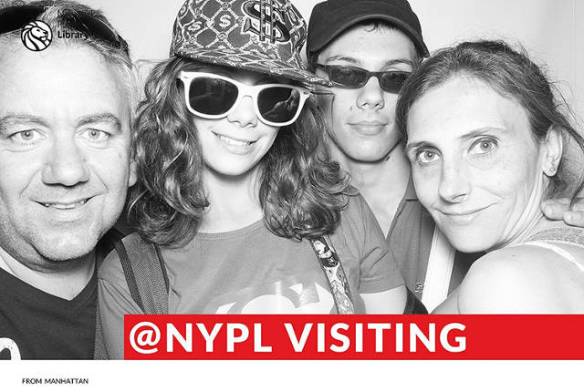
See the full story: How Selfies Are Re-Energizing The New York Public Library | Co.Exist | ideas + impact.
Perusing the Web, one quickly finds that learning platforms lean toward more academic subjects and mastery — online classes and courses — but what about more practical learning content and instruction? Sure, YouTube is rife with “how-to” videos, but separating the signal from the noise can take a lot of time.
It’s this problem (or opportunity) that led Justin Kitch to launch Curious back in May…Kitch saw an opportunity to capitalize on the rise of video-based education and offer curious minds, hobbyists and lifelong learners a place to peruse and find how-to content on any subject.
Like a combination of Skillshare and Udemy, Curious essentially aims to be a marketplace of how-to videos, allowing those experts and those who want to teach with those eager to learn from them…in a way that’s more targeted, navigable and interactive than YouTube.
Curious for iPad and Curious on the web.
via Curious Brings Its “Learn Anything” Marketplace And Video Lesson Library To The iPad | TechCrunch.
The latest magazine circulation figures show promising digital results for the industry – but is it enough to offset the fall in print?
Digital edition circulation statistics of predominantly UK magazine readership.
See the full story: Digital magazines: how popular are they? | News | theguardian.com.
The J. Paul Getty Museum is home to troves of fascinating historical artifacts. And last week, the museum [announced] a project to give the public unfettered access to it. The Open Content Program makes 4,600 high-resolution images available for free and for any use whatsoever.
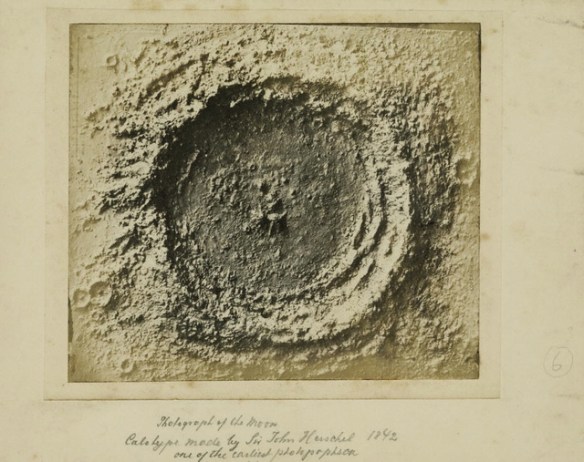
Unknown (photographer) , Moon Crater, late 1850s, Salted paper print from a Collodion negative.
See the full story: 11 Amazing Historical Snapshots From One of the World’s Best Archives | Gizmodo.
See also: Open Content, An Idea Whose Time Has Come | James Cuno | The Getty Iris
Copyright Takedowns on Twitter Are Up 76 Percent | Gizmodo
Twitter just released its latest transparency report detailing government requests for information requests, content removal requests and copyright takedowns. Not just one or two but all three categories are up in the first half of this year.
The UK wants to filter porn. Here’s how it might hurt the Internet. | Washington Post
Prime Minister David Cameron announced a plan to filter online pornography by default for households in the United Kingdom, saying the initiative is about protecting children and “their innocence.”
U.K. to compel customers to opt-in for internet porn | CBC
British internet providers will begin blocking access to online pornography unless customers specifically opt-in to surf sexually explicit material.
Tim Berners-Lee warns against governments controlling the Web | CNET
“When you make something universal…it can be used for good things or nasty things…we just have to make sure it’s not undercut by any large companies or governments trying to use it and get total control.”
What Internet Freedom Means to Me (and You) | Information Space
For the fourth of July, I thought it would be fitting (and fun) to get people’s ideas on Internet freedom.
Internet porn ‘opt in’ is censorship, say Canadians | Your Community | CBC
All internet pornography should be preemptively blocked in Canada, says Conservative MP Joy Smith of Winnipeg, which would force those who want to access adult content to “opt in” with their internet service provider….Many of those within our comments and on social media say that making citizens opt in to access adult content through their ISP would be a form of censorship.
A Map of the Countries That Censor the Internet | Gizmodo
The classification of censorship depends on political censorship like human rights and government opposition, social censorship, conflict/security censorship and various Internet tool censorship.
The Most Convoluted DMCA Takedown Request of All Time | Gizmodo
Anti-Gay group Straight Pride UK is abusing the DMCA takedown process to censor work by a journalist. No surprise there—the DMCA is twisted for all kinds of dumb purposes. The inexplicable part? The hate group filed a takedown on… its own press release. How dare you say that we said the words that we wrote in a press release.
This presentation was given at the School Library Association of New Zealand Aotearoa (SLANZA) conference in 2013. It focusses on what gamification is and how to use game elements to bring fun into the library.
 infophile