
http://www.bbc.co.uk/programmes/p02tx270/player
Instead of grabbing the remote or poking at your smartphone, the BBC thinks the future of TV navigation could lie in mind control. For its latest experiment, the broadcaster is testing a brainwave reading headset developed by This Place that lets you launch iPlayer and choose programmes with your thoughts. READ MORE: BBC experiment lets you control iPlayer with your mind | Engadget
Tag Archives: disabilities
#AugmentedReality #AR Goggles Aim to Help Legally Blind See | MIT Technology Review #tech #gadgets #disabilities @TechReview
Startup VA-ST thinks its depth-sensing glasses can help people with little sight get around more easily. READ MORE: Augmented-Reality Goggles Aim to Help Legally Blind See | MIT Technology Review
Google’s Guide To Designing With #Empathy | Co.Design #design #accessibility #tech #UX
According to the World Health Organization, more than 1 billion people worldwide have a disability. To Astrid Weber and Jen Devins, Google’s resident accessibility experts, that stat should be stamped on the back of every designer’s hand, because it means that one out of every seven people on the planet is potentially left behind by thoughtless design decisions. At this year’s Google I/O conference in San Francisco, I sat down with the two UX experts and asked them what designers could do to make their apps more accessible. The key, they told me, was using your imagination and having a little more empathy. Here are six ways designers can reach that extra billion.
READ MORE: Google’s Guide To Designing With Empathy | Co.Design | business + design.
This Massive, Open Source Map Makes the World More Wheelchair Friendly | Gizmodo #maps #accessibility #disabilities
The world is tough place to navigate in a wheelchair. But finding ramps and elevators can be easier thanks to this handy map app that anyone can edit.
It’s called Wheelmap, and it tells you the accessibility status of public places all over the world. It’s free and grades locations in a traffic light-style, red-yellow-green scale of wheelchair accessibility. Developed by German nonprofit SOZIALHELDEN e.V., it’s now celebrating five years since launch. Since 2010, users have added nearly half a million entries across the globe.
“Accessible” means you can enter the place without steps, and that all rooms inside a building can be entered without steps, as well. “Limited accessibility” refers to entrances with a max of one step no higher than seven centimeters, and that the “most important rooms” can be entered without steps.
Wheelmap launched back in 2010, and since then, has become available in 22 languages. It’s available for both iOS and Android users.
READ MORE: This Massive, Open Source Map Makes the World More Wheelchair Friendly | Gizmodo
Even Tiny Updates to Tech Can Be Obstacles for the Disabled | WIRED #tech #disabilities #access
I completed a web design for usability course during my MLIS program. For one of the sessions, guest lecturers with disabilities demonstrated how they accessed the Internet and provided insight into the challenges they experience with this activity. An eye-opening learning experience which I’m grateful to have had, which has provided me with greater understanding of the issues the disabled confront accessing the web and how designers can improve web content, layout and features to aid access. I highly recommend reviewing W3C Schools Accessibility Guidelines for more information on removing barriers to web information and communication. The article below discusses another challenge for the disabled when using tech: iterative updates.
WHEN THE AMERICANS with Disabilities Act was passed 25 years ago, it was intended to usher in a new age of accessibility. It promised recourse from discrimination in employment, transportation and communication—in other words, greater access to the physical world. Since then, the world has evolved in radical ways—physical boundaries have come down as our lives have transitioned by varying degrees to online spaces. It is almost impossible to imagine our daily routines without the use of personal technology. For people with disabilities like myself, technology has opened new doors in ways the historic legislation never could have conceived.
As a person with autism and apraxia—a condition that leads me to have great difficulty with planning and organizing everything from moving my mouth when I speak to the steps needed to wash my hands—I rely upon personal technology for many things. A device that translates my typed words into a voice is my link to the world. And the rise of social media and online classrooms has expanded my networks and ability to participate in activities once closed to me.
But often these are positive outcomes of technology made for the masses rather than benefits baked into the design. And as technology is iterated, I can already see ways in which it has and will continue to create new barriers unless its creators consider a more universal approach.
READ MORE: Even Tiny Updates to Tech Can Be Obstacles for the Disabled | WIRED
A Pen For People With Parkinson’s | Co.Design
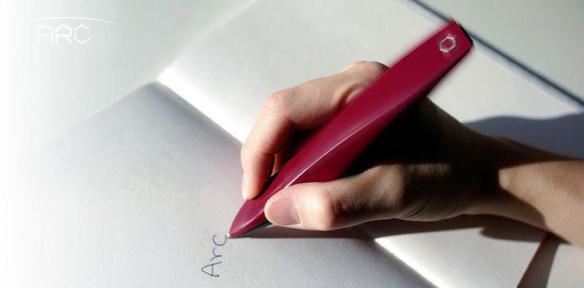
Lucy Jung never thought much about designing for sick people. Then she was diagnosed with a brain tumor. She recovered, and the experience has driven her toward what she now thinks of her calling: to use design to help improve the quality of life of hospital patients and those with chronic conditions.
It drove the 27-year-old designer to create the Arc, a pen for people with Parkinson’s disease. Along with three fellow students (Hwan Soo Jeon, Tian-jia Hsieh, and Danny Waklin) from the UK’s Royal College of Art and the Imperial College London who took part in the Innovation Design and Engineering joint masters course, Jung designed the pen to not only make it easier for people with Parkinson’s to write legibly, but to actually loosen up the muscles of their hands after they’ve put the pen down.
READ MORE: A Pen For People With Parkinson’s | Co.Design | business + design.
High-Tech Glove Could Help the Deaf-Blind Send Text Messages | Mashable
In German-speaking countries, deaf-blind people use a “tactile alphabet” called Lorm to communicate with one another, which involves a series of motions on the hand.
The problem with Lorm, though, is that few people understand it. This means that people who are both deaf and blind are often limited to communicating with others who understand Lorm.
But a new technology aims to help them communicate more easily with people who don’t understand Lorm. Researchers in Berlin are developing the Mobile Lorm Glove, with which deaf-blind people can transmit Lorm to text on a computer or mobile device.
READ MORE: High-tech glove could help the deaf-blind send text messages | Mashable
Disabled Boy Learns to Play Piano With His Eyes Using Virtual-Reality Headset | The Guardian
Eye Play the Piano is the work of Japanese VR headset manufacturer Fove, working with the University of Tsukuba. The project is pitched as a “universal piano” which children can play using eye movements while wearing the headset.
Through the use of Fove’s eye-tracking technology, the headmount recognises the user’s eye movement. The user blinks on one of the many panels within the interface to trigger the preferred note, which is then conveyed to the piano,” explains the Eye Play the Piano website.
READ MORE: Disabled boy learns to play piano with his eyes using virtual-reality headset | Technology | The Guardian.
E-Book Legal Restrictions Are Screwing Over Blind People | WIRED
Snip
…For the nearly 8 million people in the US with some degree of vision impairment, the advent of ebooks and e-readers has been both a blessing and a burden. A blessing, because a digital library—everything from academic textbooks, to venerated classics, to romance novels—is never further away than your fingertips. A burden, because the explosion of ebooks has served as a reminder of how inaccessible technology really can be…
READ MORE: E-Book Legal Restrictions Are Screwing Over Blind People | WIRED
This Font Could Help Dyslexics Read Better | CNET + A Typeface For Dyslexics? Don’t Buy Into The Hype | FastCompany
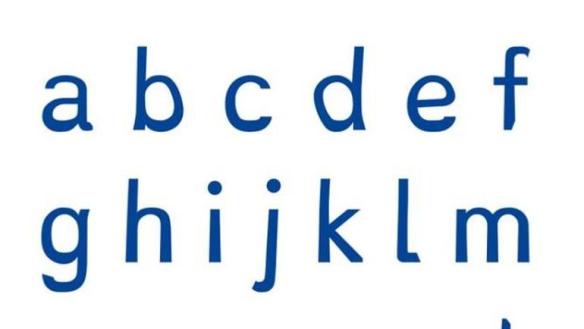
This Font Could Help Dyslexics Read Better | CNET
Inspired by his own experiences with dyslexia, Dutch designer Christian Boer developed a font to make reading easier.
and a rebuttal…
A Typeface For Dyslexics? Don’t Buy Into The Hype | FastCompany
Lucida creator Chuck Bigelow argues that dyslexie and other similar fonts are statistically no better than Arial.
 infophile