“The challenge in this whole virtual continuum is assessing whether any of these trends are worth our time and intellectual energies.”
via The Immersive Information Professional – Next Steps | The Search Principle

“The challenge in this whole virtual continuum is assessing whether any of these trends are worth our time and intellectual energies.”
via The Immersive Information Professional – Next Steps | The Search Principle
Ouya Console Starts Shipping to Kickstarter Backers With 104 Games | Mashable
Related:
Ouya: A Game-Changing Game System | American Libraries Magazine
“Libraries should keep an eye on the Ouya. Not only as a relatively inexpensive way to bring console games to the library, but also as an example of independent publishing squaring off against the established giants.”
You may also like:
Update (August 30, 2015): Coding resources available on the Internet are listed here.
I began learning to code more than a decade ago during my undergraduate days at university sitting in a darkened room in front of a SunSystem computer running Unix. I programmed in C++ and Java for endless hours. I never complained about my biology and math labs and tutorials again after taking a computer science class! I did not realize at the time how useful I would find this skill in future years. During my Masters, which I completed in 2012, I learned to program in HTML/XHTML and CSS from the ground up, although I had prior knowledge from building my own websites. Now my next goals are to learn to code PHP and APIs. I not only want to learn these languages to bolster my resume but to learn more about the fundamentals of Internet and mobile architecture. How they are connected. I think learning to code is a great way to learn how to solve problems.
I find it surprising how popular coding is becoming, especially in libraries. Although now with the morphing of hackerspaces and makerspaces in libraries maybe its not so surprising. Librarians are known for being pioneers in education, learning and collaborative efforts after all. We can now even learn a programming language by attending a conference session – the 2013 ALA Conference in June will be presenting a LITA Pre-conference Introductory Python Workshop. 2012 was known as Code Year. With this push for awareness and education of coding there are now numerous resources one can use to learn abut coding and how to code. Here are a few of them:
Literacy
Learning to Code
APIs/Apps
“As a librarian I use a lot of information, software, and resources which are made available to me through creative commons licensing, open access repositories, and the open source community. If you’re like me and looking for ways to give back, here are a few ideas for ways you can contribute to these amazing communities.”
via 7 Ways Librarians Can Participate in Open Access/Open Source/Education Communities – iLibrarian.
Resources for Digital Learning – The Digital Shift.
Includes resources on:
“To be a functioning member of today’s digital society, one must not only be able to use social networking and online publishing tools, but must also be able to think critically about all forms of media. Social media allows the instant amplification of both fact and fiction, and without a strong foundation in media literacy, it can be difficult to determine which sources to trust.”
via Is Teaching Media Literacy Important? | Mashable.
BYOD in educational institutions has been growing in popularity for years. Recently, I have seen more resources for BYOD policies in business. Below are some useful links for both.
Educational Organizations
EDUCAUSE BYOD Portal
SFU BYOD Wiki
Business
A BYOD project management primer | TechRepublic
Three BYOD policies for keeping workers (and IT) happy | TechRepublic
BYOD Security White Papers and Resources for Businesses | Webopedia
Four worst mistakes you can make with a BYOD policy | TechRepublic
10 essential elements of BYOD training | TechRepublic
How to Make Sure Your BYOD Plan Is All Good [Infographic] | Biztech
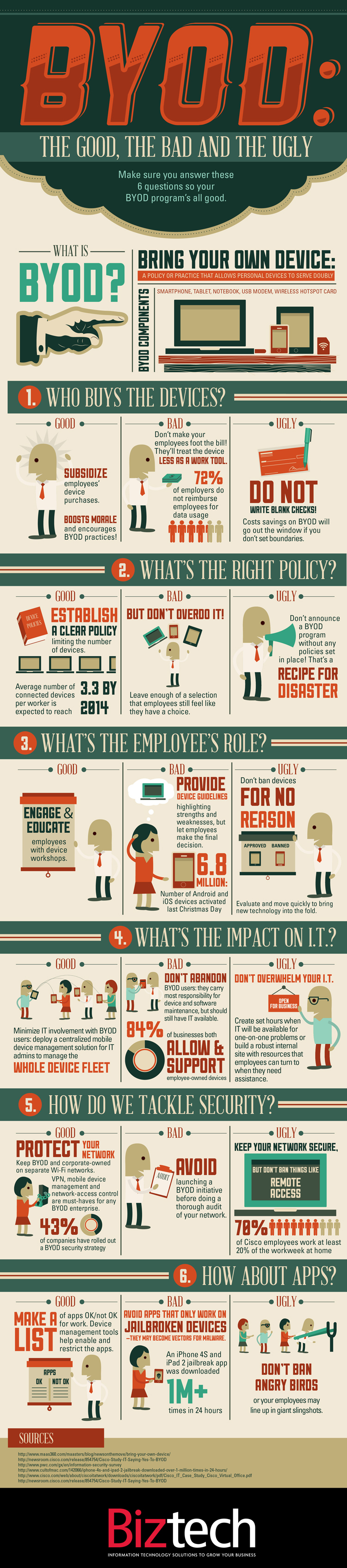
BYOD
“Everyone’s going MOOC-crazy these days. From frequent media coverage of online courses and platforms like Coursera, edX, Udacity, and Udemy to discussions about the complexities and business models of online education, the excitement around MOOCs (Massive Open Online Courses) has finally “bubbled” over.”
via Beyond the Buzz, Where Are MOOCs Really Going? | Wired Opinion | Wired.com.
You may also like:
The MOOC Revolution: A Sketchy Deal for Higher Education – DISSENT Magazine
Move Over Harvard And MIT, Stanford Has The Real “Revolution In Education”
“When I began a student assistant position in reference and instruction this semester, the time to brave the classroom arrived without my previously anticipated sense of preparation and confidence. I was excited and terrified. A part of me believed that I could be quite good, while the other part waited for the fraud police to stop me before I could present my novice self to a class of undergraduates.”
via Overcoming Instruction Stage Fright « Hack Library School.
 infophile