A Pen For People With Parkinson’s | Co.Design


A Pen For People With Parkinson's | Co.Design | business + design

Lucy Jung never thought much about designing for sick people. Then she was diagnosed with a brain tumor. She recovered, and the experience has driven her toward what she now thinks of her calling: to use design to help improve the quality of life of hospital patients and those with chronic conditions.

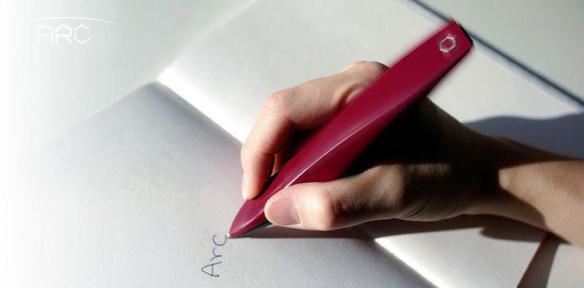
It drove the 27-year-old designer to create the Arc, a pen for people with Parkinson’s disease. Along with three fellow students (Hwan Soo Jeon, Tian-jia Hsieh, and Danny Waklin) from the UK’s Royal College of Art and the Imperial College London who took part in the Innovation Design and Engineering joint masters course, Jung designed the pen to not only make it easier for people with Parkinson’s to write legibly, but to actually loosen up the muscles of their hands after they’ve put the pen down.

READ MORE: A Pen For People With Parkinson’s | Co.Design | business + design.

How Technology Is Warping Your Memory | HuffPo


Take a moment to think about the last time you memorized someone’s phone number. Was it way back when, perhaps circa 2001? And when was the last time you were at a dinner party or having a conversation with friends, when you whipped out your smartphone to Google the answer to someones question? Probably last week.

Technology changes the way we live our daily lives, the way we learn, and the way we use our faculties of attention — and a growing body of research has suggested that it may have profound effects on our memories (particularly the short-term, or working, memory), altering and in some cases impairing its function.

The implications of a poor working memory on our brain functioning and overall intelligence levels are difficult to over-estimate…READ MORE: How Technology Is Warping Your Memory | HuffPo

Reading On A Screen Before Bed Might Be Killing You | HuffPo


You’ve heard that using screens before bedtime can mess with your sleep, but new research suggests the problem is even more serious.

Reading from an iPad before bed not only makes it harder to fall asleep, but also impacts how sleepy and alert you are the next day, according to new research from Brigham and Womens Hospital in Boston, Massachusetts. The study, published in the journal Proceedings of the National Academy of Sciences on Monday, said the findings could impact anyone who uses an eReader, laptop, smartphone, or certain TVs before bed.

The new research supports conclusions from older studies, which have also found that screen time before sleep can be detrimental.

READ MORE: Reading On A Screen Before Bed Might Be Killing You | HuffPo

5 Best Yoga Poses for Reading | BOOK RIOT


My two most favourite activities! I definitely think butterfly pose should have been included on this list though.

The holiday season is a great time to carve out some stress-free time with a book. If you want to take that relaxation a step further, or work on some tighter muscles, some yoga poses are actually perfectly suited for reading time.The majority of these poses work better when you give your body some time to ease and settle into them. I usually give myself a two page time limit before switching to the other side, but you can do more or less depending on your body. Benefits of each yoga pose are listed below, along with links to more in-depth articles about how to practice them correctly.

READ MORE 5 Best Yoga Poses for Reading | BOOK RIOT.

9 Fashionable Wearables for the Sartorially Savvy | Mashable


The fashion world wants to get functional. Smart, wearable technology has always had a bit of an image problem. Google Glass, Fitbit and other popular tech companies have found it difficult to add a sartorial touch to smart gear. Jamming an ugly smartwatch onto a chic outfit has always been the curse of those who sit at the crossroad between taste and technology. But the designer world is here to help. Thanks to a number of collaborations with fashion mavens such as Diane von Furstenberg and Tory Burch, stylish wristbands, smartwatches and even Google Glass are getting gorgeous upgrades. Here are nine gadgets that are actually smart and chic.

READ MORE: 9 Fashionable Wearables for the Sartorially Savvy | Mashable

Awesomely Gross Medical Illustrations From the 19th Century | WIRED


In the 19th century, doctors couldn’t use photographs to teach their students to distinguish between benign or cancerous growths. Or how teeth looked in patients affected by hereditary syphilis. Or the stages of cholera.

So the physicians, surgeons, and anatomists of the 1800s built close relationships with artists, craftsmen, and publishers to produce beautiful (yet horrifically off-putting at times) illustrations. In The Sick Rose: Disease and the Art of Medical Illustration, Richard Barnett collects up the best examples of these images. They—and the accompanying chapters of text, organized by disease—are endlessly fascinating.


Excerpted from The Sick Rose: Disease and the Art of Medical Illustration, by Richard Barnett, published this month by Distributed Art Publishers.

VIA: Awesomely Gross Medical Illustrations From the 19th Century | Science | WIRED.

Going to the Library Can Make You as Happy as a Pay Raise, Study Claims | Bustle


Apparently, libraries provide patrons with a happiness that money can’t buy. Or at least nothing less than almost two grand in cash. According to a recent study commissioned by the U.K.’s Department for Culture, Media, and Sport, the act of going to the library induces joy equivalent to that brought on by a £1,359 ($1,878) pay raise.

The study was conducted in an attempt to measure which activities have the most positive impact on an individual’s wellbeing. Visiting a library scored among the top joy-generating activities, alongside dancing and swimming, giving us yet another reason to hang-out at our local library.

Read more: Going to the Library Can Make You as Happy as a Pay Raise, Study Claims | Bustle.

How Being Humble, Kind, and Calm Will Make Your Life Easier | LifeHacker


You’ve heard it all your life: Being humble, kind, and calm is the “right thing to do.” But if that isn’t enough to convince you, consider this: humility, kindness, and calmness can actually help you get ahead in life. Read more: How Being Humble, Kind, and Calm Will Make Your Life Easier | LifeHacker

Finally, a Digital Library of Bizarre Human Bones From the Middle Ages | Gizmodo


skull from Chichester

A spinal column with fused vertebrae. The bones of a woman with advanced syphilis. Skeletons deformed by rickets and leprosy. A fascinating online library of deformed bones from the Middle Ages goes live today—and while I didn’t even realize such a thing existed, now I can’t imagine living without it. God bless technology.

The Digit[ised] Diseases website is run by the Royal College of Surgeons in London. It brings together 3D scans of over 1,600 bone specimens taken from patients with debilitating and disfiguring conditions like rickets and leprosy, and makes them free for the public to browse. Bored on a Monday morning? Gawk at this deformed spinal column or marvel at this alien-like skull with an enlarged cranium. In the scientists’ own words, “it does not resemble any known hominid species.” Cool!

Read:  Finally, a Digital Library of Bizarre Human Bones From the Middle Ages | Gizmodo

How Braille Was Invented | Gizmodo


Braille Alphabte

Braille was invented by a nineteenth century man named Louis Braille, who was completely blind.

Braille’s story starts when he was three years old. He was playing in his father’s shop in Coupvray, France, and somehow managed to injure his eye. Though he was offered the best medical attention available at the time, it wasn’t enough—an infection soon developed and spread to his other eye, rendering him blind in both eyes. While a tragedy for him, had this accident not happened, we wouldn’t have braille today.

There was a system of reading in place for the blind at the time, which consisted of tracing a finger along raised letters. However, this system meant that reading was painfully slow and it was difficult to discerning by touch the relatively complex letters of the alphabet. As a result, many people struggled to master the embossed letter system.

Read the rest of the story: How Braille Was Invented | Gizmodo