This Gorgeous Game Teaches You the History of Typography | Gizmodo


Do you like type? Did you go see the movie Helvetica and break out in tears of joyful satisfaction at the end credits? Do you have a graphic designer cousin who taught you what sans serif meant, and did you think it was fascinating? You’re going love Type:Rider.

This new game for iOS and Android takes the history of typography and transforms it into a beautifully mesmerizing game.

Then there’s the typography. For each asterisk you collect, you unlock a piece of the history of typography from cave paintings to Comic Sans. Each level represents a different period in human history starting with “Origins” followed by “Gothic” which jumps in around Gutenberg’s time.

Read: This Gorgeous Game Teaches You the History of Typography | Gizmodo.

Type:Rider – TRAILER – EN from Cosmografik on Vimeo.

You may also like:
50 Scariest Books, Alexandria Library Destroyed by Budget Cuts Not Fire?, Be a Better Reader, Famous Book Cover Art


Let’s celebrate October with The 50 Scariest Books of All Time | Flavorwire.

This story suggests The Great Library at Alexandria was destroyed by budget cuts, not fire @ ion.com.

Want to learn How to Be A Better Reader | HuffPost Books? This story give 14 tips.

Take a look at The Art of Famous Book Covers | Publisher’s Weekly.


British Film Institute to launch streaming video service on October 9th | Engadget


The British Film Institute promised that it would put 10,000 movies online as part of the Film Forever initiative, and it’s now making good on its word — if slowly. The Institute will launch the first phase of its BFI Player streaming service on October 9th with a library of more than 1,000 videos, including movies, behind-the-scenes clips and archival footage. About 60 percent of the content will be free, with the rest available as pay-per-view. As for those remaining 9,000 videos? The BFI expects those to appear in the months ahead, and it’s launching BFI Player’s second phase in early 2014.

via British Film Institute to launch streaming video service on October 9th | Engadget.

Gaming and Play in the Library: A Brief History | Information Space


The international academic journal Library Quarterly recently published my article tracing the history of gaming in libraries back to the 1850s. You can see the entire article in the publications area of my game lab, Because Play Matters. I wanted to offer a few highlights here about how public libraries have used games over the years.

Read the full story: Gaming and Play in the Library: A Brief History | Information Space.

21 Muppets Find a Much-Deserved Home at the Smithsonian | Gizmodo


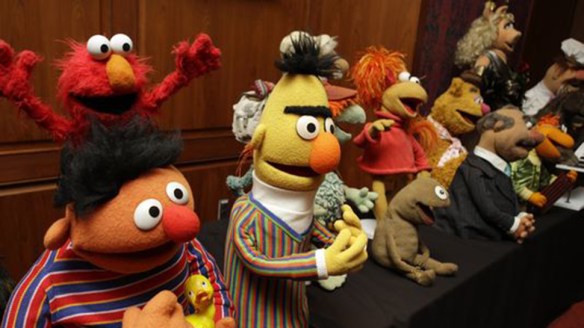
Thanks to a donation from the Henson Foundation, on Tuesday, Miss Piggy, Kermit the Frog, and 19 other Muppets and well-loved characters gained their rightful place in history, entering into the collection of the Smithsonian Museum.

The Muppets

Read: 21 Muppets Find a Much-Deserved Home at the Smithsonian | Gizmodo.

Internet Archaeologists Reconstruct Lost Web Pages | Mashable


The Internet is disappearing. And with it goes an important part of our recorded history. That was the conclusion of a study Technology Review looked at last year, which measured the rate at which links shared over social media platforms, such as Twitter, were disappearing.

The conclusion was that this data is being lost at the rate of 11% within a year and 27% within two years.

Today, the researchers behind this work reveal that all is not lost. Hany SalahEldeen and Michael Nelson at Old Dominion University in Norfolk, Va., have found a way to reconstruct deleted material, and they say it works reasonably well.

Read the full story: Internet Archaeologists Reconstruct Lost Web Pages | Mashable.

Researchers build[ing] ‘Google Earth’ project for the ancient world | theguardian.com


A tool developed by researchers at Southampton University has indexed historic maps, photos and historic documents to provide a simple location search tool for the UK.

The Pelagios 3 project takes data from ancient Latin and Greek sources, which formed the basis of two previous Pelagios projects, and builds on it with documents and maps from Arabic sources, medieval European and Chinese maps, and seafaring charts from the 13th century, cross-linking them into one searchable database. 

Read the full story: Researchers build ‘Google Earth’ project for the ancient world | Technology | theguardian.com.

A Visual History Of The Last 20 Years Of Open Source Code | ReadWrite


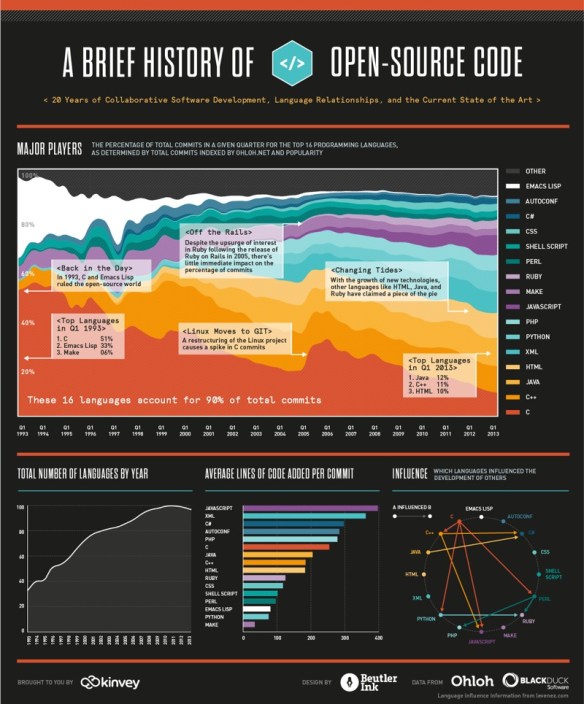
We were able to visualize the percentage of total commits in a given quarter for the top 16 programming languages from 1993 until today. We hope you’ll find this image—a provocative pattern of dips and spikes—to be as interesting as we do. It truly shows how dynamic the world of programming is. We’ve also included a few graphs on other interesting data points: total number of languages by year, average lines of code per commit, and tracking which languages influenced the development of others.

Visual History Of The Last 20 Years Of Open Source Code

via A Visual History Of The Last 20 Years Of Open Source Code | ReadWrite.

An Online Project Collects The Stories Behind Favorite Heirlooms | Co.Design


Genie lamps, ancient tomes, swords in stones: Classic tales reveal that certain objects possess magical powers, absorbed through generations of inheritance. With today’s relentless pressure to just buy more and more, it’s easy to forget the power of our own belongings. We’re all hoarders on some level. But most of us have at least one heirloom with a rich history, an item that seems more alive than the rest.

British photographer Joakim Blockstrom wants to hear these particular stories and to document your favorite heirlooms. Blockstrom founded The Heirloom Project, an online bank of images of passed-down objects along with their histories. The intent is to start a discussion about the meaning of inheritance and its relationship to our identities and what we value.

An Online Project Collects The Stories Behind Favorite Heirlooms | Co.Design | business + design

See the full post: An Online Project Collects The Stories Behind Favorite Heirlooms | Co.Design | business + design.

An Oral History Of Apple Design: 1992–2013 | Co.Design


Most efforts to explain design at Apple end up reducing a complex 37-year history to bromides about simplicity, quality, and perfection–as if those were ambitions unique to Apple alone. So Fast Company set out to remedy that deficiency through an oral history of Apple’s design, a decoding of the signature as told by the people who helped create it. A longer version of the story that includes material not published elsewhere is available in the Byliner original ebook, Design Crazy.

Read the full article: An Oral History Of Apple Design: 1992–2013 | Co.Design | business + design.