Libraries Play A Central Role in Connected Learning | The Digital Shift


The Internet offers today’s youth unprecedented opportunities to connect with peers and seek knowledge in almost any area of interest—and libraries are uniquely positioned to play a central role in this learning, according to Mimi Ito, professor and cultural anthropologist at the University of California, Irvine, and principal investigator for Connected Learning, a new education model funded by the MacArthur Foundation’s Digital Media and Learning Initiative.

Read: Libraries Play A Central Role in Connected Learning | The Digital Shift

Alessandro Acquisti: Why privacy matters | TED.com


The line between public and private has blurred in the past decade, both online and in real life, and Alessandro Acquisti is here to explain what this means and why it matters. In this thought-provoking, slightly chilling talk, he shares details of recent and ongoing research — including a project that shows how easy it is to match a photograph of a stranger with their sensitive personal information.What motivates you to share your personal information online? Alessandro Acquisti studies the behavioral economics of privacy and information security in social networks.

via Alessandro Acquisti: Why privacy matters | Video on TED.com.

The 15 Countries Where The Most Young People Are Online | Co.Exist


Full Article

What did children do before computers? If the future goes the way of babies with iPads, it’s a question we might be asking ourselves soon. But if you’re between 15 and 24 years old and live in the United States, there’s already a good chance you grew up playing around with MS Paint. According to a new report out from the UN’s International Telecommunication Union (ITU), growing up with the Internet qualifies you as a “digital native,” and some countries have a far higher proportion of them than others.

The results, however, might surprise you.
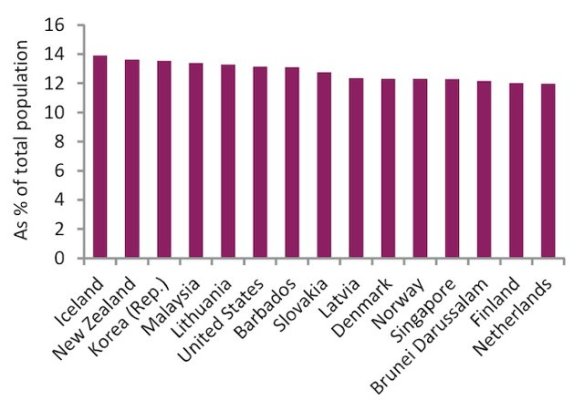
The 15 Countries Where The Most Young People Are Online | Co.Exist | ideas + impactSource: ITU

Out of a global population of 7 billion, 363 million of us have grown up “surrounded by and using tools and toys of the digital age.” China and India boast the largest number of these people, but digital natives only make up a relative minority of their respective populations. When it comes to countries with the highest percentages of digital natives, the United States actually comes in sixth place, below Lithuania and Malaysia.

Iceland, however, ranks number one in digital native penetration, with 14% of the Icelandic population having grown up on computers. That makes sense, given that Iceland has the highest percentage of young people in Europe (and a small population). New Zealand makes number two on the list for the same reason. South Korea, meanwhile, ranks third largely because of high Internet use among all youth and its government’s aggressive investment in educational technology: By 2015, all Korean schools will provide cloud-based learning services to students.

Malaysia comes in fourth place on the list, and for striking reasons. Unlike Iceland or New Zealand, Malaysia doesn’t have a particularly high concentration of 15-to-24 year-olds. But like South Korea, the young people who do live in Malaysia have spent more time with the Internet: By 2012, 74.4% of youths had at least five years of Internet experience under their belts. Much of that, explains the report, can be attributed to the fact that the Malaysia has brought so many of its schools online, and by 2000 had already stocked 31% of its primary schools and 54% of its secondary schools with computer facilities.
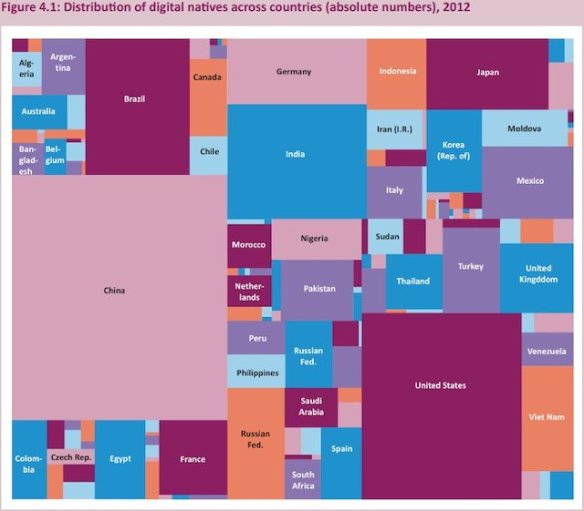
The 15 Countries Where The Most Young People Are Online | Co.Exist | ideas + impactAbsolute numbers of digital natives by country. Source: ITU

Starting in January of this year, Malaysian 21-to-30-year-olds have been able to score $65 rebates on certain smartphones, courtesy of government subsidies. The country’s National Broadband Initiative has set about dramatically lowering costs of accessing the Internet, including launching the 1 Million Netbooks program, which distributes netbooks to low-income families.

The report notes that proportions of digital natives largely stick to levels of economic development. In high-income, developed countries, digital natives with five years of Internet experience or more make up 86% of young Internet users, while in the developing world, digital natives only count as 47% of young Internet users. The global average comes to slightly more: Digital natives make up 56% of all young Internet users–more than 362 million people worldwide.

via The 15 Countries Where The Most Young People Are Online | Co.Exist | ideas + impact.

Technology Adoption by Lower Income Populations | Pew Research Center


Aaron Smith, Senior Researcher at the Pew Research Center’s Internet Project, discusses the Project’s latest research about internet usage, broadband adoption, and the impact of mobile connectivity among lower-income populations.

Recent Pew Research Links


25 percent of men watch online porn, and other ‘facts’ about Americans’ online video habits | The Washington Post
Do you spend a lot of time watching videos on YouTube? You’re not alone. The Pew Internet & American Life project released new survey data on how Americans engage with video online Thursday. And the percentage of online adults who watch or download videos has grown from 69 percent of adult Internet users in 2009 to 78 percent today.

Online Video 2013 | Pew Internet
Over the past four years, the percent of American adult internet users who upload or post videos online has doubled from 14% in 2009 to 31% today. That includes 18% of adult internet users who post videos they have created or recorded themselves—many of whom hope their creations go viral. The share of online adults who watch or download videos has also grown from 69% of internet users in 2009 to 78% today, and mobile phones have become a key part of the video viewing and creating experience.

Who’s Not Online and Why | Pew Internet
As of May 2013, 15% of American adults ages 18 and older do not use the internet or email. Asked why they do not use the internet:

  • 34% of non-internet users think the internet is just not relevant to them, saying they are not interested, do not want to use it, or have no need for it.
  • 32% of non-internet users cite reasons tied to their sense that the internet is not very easy to use. These non-users say it is difficult or frustrating to go online, they are physically unable, or they are worried about other issues such as spam, spyware, and hackers. This figure is considerably higher than in earlier surveys.
  • 19% of non-internet users cite the expense of owning a computer or paying for an internet connection.
  • 7% of non-users cited a physical lack of availability or access to the internet.

Cell Phone Activities 2013 | Pew Internet
Fully 91% of American adults own a cell phone and many use the devices for much more than phone calls. In our most recent nationally representative survey, we checked in on some of the most popular activities people perform on their cell phones and found:

  • 81% of cell phone owners send or receive text messages
  • 60% of cell phone owners access the internet
  • 52% send or receive email
  • 50% download apps
  • 49% get directions, recommendations, or other location-based information
  • 48% listen to music
  • 21% participate in a video call or video chat
  • 8% “check in” or share their location

What the World Would Look Like If Countries Were As Big As Their Online Populations | The Atlantic


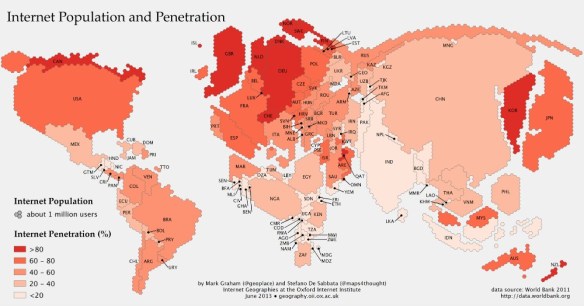
The map, created as part of the Information Geographies project at the Oxford Internet Institute, has two layers of information: the absolute size of the online population by country (rendered in geographical space) and the percent of the overall population that represents (rendered by color). Thus, Canada, with a relatively small number of people takes up little space, but is colored dark red, because more than 80 percent of people are online. China, by contrast, is huge, with more than half a billion people online, but relatively lightly shaded, since more than half the population is not online. Lightly colored countries that have large populations, such as China, India, and Indonesia, are where the Internet will grow the most in the years ahead. (The data come from the World Bank’s 2011 report, which defines Internet users as “people with access to the worldwide network.”)

Internet Population and Penetration

Read: What the World Would Look Like If Countries Were As Big As Their Online Populations | Rebecca J. Rosen | The Atlantic.

11 Weird Internet Sites, Encyclopedic Site for Game Consoles, 17 Design Inspiration Sites, Newbie YouTube Guide, Pinterest Ads


Gizmodo spotlights 11 of the Weirdest Sites on the Internet, submitted by followers.

This Encyclopedic Site Contains 41 Years of Video Game Console Design | Kotaku. The Wikipedia contributor behind the site, Evan Amos, wants to establish a free, online museum based on his collection.

Developers suggest 17 Sites for Web Design Inspiration | Mashable.

New to YouTube? Take a look at The Beginner’s Guide to YouTube | Mashable.

Here’s What a Pinterest Ad Looks Like | AllThingsD

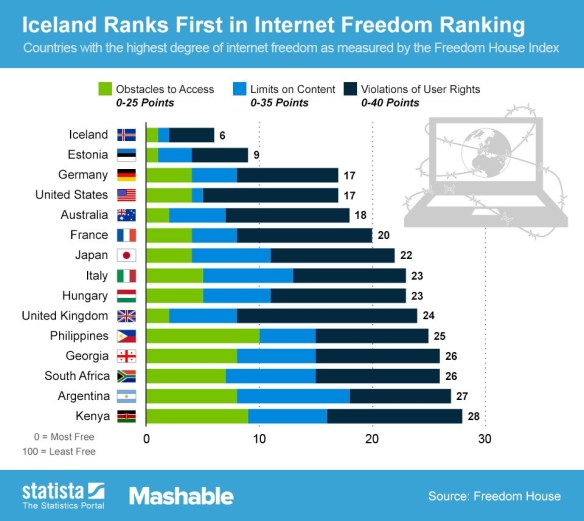
The 10 Countries With the Most Internet Freedom | Mashable


Statista’s chart, below, shows the 10 countries with the highest degrees of Internet freedom, as measured by the Freedom House Index.

Internet Freedom

Read: The 10 Countries With the Most Internet Freedom | Mashable.

Socratic World Textbook, Berners-Lee Google Coalition for Cheap DW Internet, SCRIBD Founder Envisions E-Reading Wearables


Socratic Is Creating a Textbook for the World, One Teacher Video at a Time | AllThingsD
Socratic today announced that it has raised $1.5 million from Spark Capital, Betaworks, John Maloney, Terrapin Bale, Chris Dixon and David Tisch. The company (formerly known as Vespr) aggregates and organizes video lessons (first, high school and college content; today, just chemistry and physics) so teachers and students can use them as resources.

Sir Tim Berners-Lee and Google lead coalition for cheaper internet [to the developing world] | The Bookseller
Cross-industry coalition aims to provide cheaper access in developing world, but analysts say service lacks support from ISPs.

Scribd Founder Envisions Google Glass-like Wearables For E-reading
“If we’re going to build hardware, the thing we want to do is build reading goggles, so you can do hands-free reading,” Adler says. “It’s a little bit of a crazy idea, and I think it’s a long way away for us, but there is already a number of e-readers out there, and I don’t think people need yet another device.”

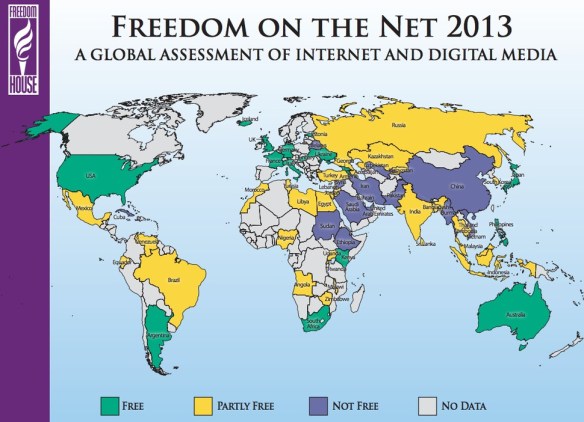
A Map of Internet Freedom Around the World | Gizmodo


Here in the US, it’s easy to slip into the comfortable idea that the internet is unrestricted, a home for free speech and exploration, whether it’s meaningful and important, or dumb hashtags. It’s not that way everywhere though, and Freedom House has mapped out the current state of affairs across the globe.

Read and see more charts:  A Map of Internet Freedom Around the World | Gizmodo

Freedom On The Net 2013