Generate a 3D Hologram With Your Smartphone | Mashable #makerspaces #holograms #tech


Regardless whether the hologram created is actually in 3D, this project would make a fantastic makerspace activity!

LONDON – If you happen to have an old CD case and a few basic tools lying around, this one will make a pretty cool party trick. British YouTuber and independent tech reviewer Mrwhosetheboss has uploaded an instructional video on how to turn any old smartphone into a 3D hologram projector – using nothing more complicated than a sharp knife, a ruler, a pen and paper, an old CD case and four squares of sticky tape. READ MORE: Here’s how you can generate a 3D hologram with your smartphone | Mashable

Research Summary: #Competencies for Professionals in Learning Labs and #Makerspaces | Kyungwon Koh | Academia.edu #libraries


[T]he authors conducted a research project in order to identify the competencies required for professionals to perform innovative services in library or museum Learning Labs and Makerspaces. READ ARTICLE: Research Summary: Competencies for Professionals in Learning Labs and Makerspaces | Kyungwon Koh | Academia.edu.

Direct Link to PDF

Can These Tiny #Robots Teach Fourth Graders How To Code? | Fast Company #coding #kids #tech #makerspaces


I’m in a laboratory at Drexel University watching a remote-controlled robot do a spastic breakdance across the floor. The fist-sized, brightly colored bot looks simple enough: It has two wheels, two antennae, and what appears to be a friendly face. But it has a mission much bigger and more ambitious than its tiny form factor: This thing wants to teach kids how to become programmers.

This freewheeling toy android comes from a young startup called LocoRobo. Its moves are set using a mobile app that allows the user to program simple actions: go forward, accelerate, spin around, stop. And while plenty of kids would be content to play with a smartphone-controlled toy robot, LocoRobo wants to let them dig much deeper into the code and sensors that make it work. READ MORE: Can These Tiny Robots Teach Fourth Graders How To Code? | Fast Company | Business + Innovation.

Vortex Is A Toy Robot That Teaches #Kids How To Code | TechCrunch #robots #kids #coding #makerspaces


DFRobot, a company that has been building robots for the education market since 2008, this week introduced its first attempt at making a robot accessible to all children, with the debut of Vortex – an interactive, programmable robot aimed at kids 6 and up. The Vortex robot pairs with iOS and Android smartphones or tablets over Bluetooth, and lets kids control its movement by tapping the screen in the Vortex app to initiate commands. It also comes four free, pre-programmed games – “bumping fight,” “virtual golf,” “driving,” and “robot soccer,” which can later be customized by the child to create their own play experience. READ MORE: Vortex Is A Toy Robot That Teaches Kids How To Code | TechCrunch.

At last, the Raspberry Pi Mini PC Has An Official Case | Engadget #RaspberryPi #tech


There’s no question that the Raspberry Pi is successful among the homebrew computing crowd. However, it’s not what you’d call consumer-friendly — the bare circuit board you normally get is clearly intended for tinkerers who plan to put the mini PC inside their own projects. Mercifully, you won’t have to devise a shell for it (or run it exposed) for much longer. READ MORE: At last, the Raspberry Pi mini PC has an official case | Engadget

Makers Are Getting Their Own Social Network [Beta] | Engadget #makerspace makerspace.com


Maker Media founder Dale Dougherty speaks with such an infectious exuberance about creating and building that after speaking to him you want to go home and resurrect that project that’s been sitting in your garage or bedroom. From a magazine, to a series of faires and camps for children, Doughterty’s Maker Media reach – and enthusiasm – spans the globe and beginning today, it’s launching a beta of its new MakerSpace social network.

MakerSpace beta invitations are available [on request]. Like the Google model of beta invites, anyone that gets an invitation, can invite a few friends. If you don’t get into the beta, the full site will launch out of beta later this year. But, if you’re lucky enough to get onboard, you can create a profile, find and bookmark projects you find interesting, and post your own projects. Maker is calling it a place to “show and tell.” READ MORE: Makers are getting their own social network | Engadget

I just signed up! Looking forward to finding some ideas for the CoderDojo program I volunteer with. Also available from Makerspace.com is a free makerspace playbook with all you need to know about getting a makerspace up and running in their school or community.

3 Google Cardboard Articles | WIRED, Engadget, TechCrunch #GoogleCardboard #virtualreality @googlecardboard #makerspaces


Google Cardboard is VR’s Gateway Drug | WIRED
There’s no reason not to try Cardboard now. It’s cheap, it’s easy, it works with your phone. It’s still a million miles away from the best VR demos out there; Oculus, HTC’s Vive, and Project Morpheus all blow Cardboard out of the water—which they should, because they’re not made of cardboard. But Cardboard more than accomplishes what it’s supposed to: It transports you.

Google’s Cardboard Design Lab teaches VR with (what else) VR | Engadget
Google debuted its larger and more robust Cardboard VR headset at I/O yesterday, now it needs some apps that actually run on it. However, designing a program in a virtual 3D environment is quite different than designing one to run on a 2D touchscreen. That’s why Google has also released the Cardboard Design Lab, an app that teaches you the basics of VR design from within a VR environment. The program runs through 10 fundamental design aspects — from “Using a Reticle” and “Keeping the User Grounded” to “Guiding with Light” and “Gaze Cues” — all from within the confines of the Cardboard headset. It won’t transform you into an VR hacking wizard overnight (as it’s not designed to) but CDL will give neophyte coders a solid overview of what they’re getting themselves into. And while the lessons learned here can just as easily be applied to designing for the Rift as Cardboard, the app is currently only available on Android.

Google’s Cardboard VR Now Works (Very Well) With iPhone | TechCrunch
Google’s Cardboard VR app first appeared last year at I/O 2014, but the initial version was somewhat limited in terms of device support. A new version released this year works with devices with screen sizes ranging up to 6 inches, but the more exciting news for many might be that it now also works with iPhone.

The new Cardboard for iOS app is available in the U.S. store now, and includes the same demo apps, as well as the same QR-code based pairing process to make sure it’s optimized for whichever generation of headset you have. Cardboard for iOS is a free download, and works with iPhone 5 and up.

Check Out This Coding Toy—For Grownups | ReadWrite @TeamKano #coding #diy #makerspaces #tech


I think its a very smart marketing move for Kano to launch products that are gender and age neutral. I volunteer with my public library’s CoderDojo program, which is for 9 to 17 year olds. One of the participant’s parents has actually stayed to learn as well. Its heartwarming to see parent and child learning new concepts together. Learning to code, makerspaces, hackfests, arduino…these activities are fun and instructive for all ages and can be a family activity too.
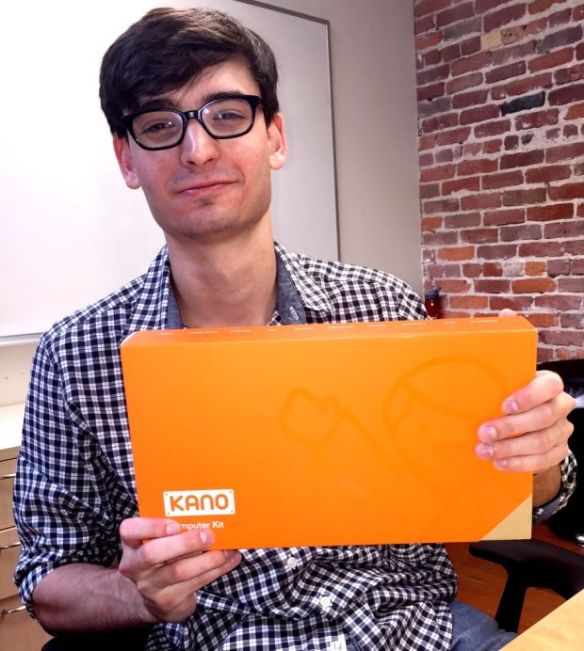
Check Out This Coding Toy—For Grownups - ReadWrite

Kickstarted into existence in 2013, with a campaign that blasted through its $100,000 goal with $1.5 million in pledges, Kano now makes Raspberry Pi–based computer kits commercially available to children ages 6 to 14. Inspired by those young users, who founder Alex Klein says have created and shared as many as 5 million lines of code, he wants to spread that enthusiasm to a larger audience.

Engineering kits have been popular among kids and a natural fit in the educational space. Likewise, Kano set out following in the footsteps of companies like Little Bits, Adafruit, and Goldie Blox. But Klein now wants to extend Kano’s reach, taking it into grown-up territory. Simply put, he wants to appeal to everyone’s inner “inventor and tinkerer,” he said.

Klein wants to push into the adult maker market by putting out products that are both gender- and age-neutral. The core design, he hopes, speaks to fundamental human impulses: “Everyone has shared urges to look inside,” he said. “Everyone wants to take control. Everyone wants to make and play.”

Kano’s next stage of evolution will involve some fundamental shifts. The company is expanding its line-up with new add-on kits, and plans to open up Kano Blocks—its game-making arena—and online platform Kano World to community development.

All Kano products run on Kano OS, the open source operating system that sits on top of Raspberry Pi. It boasts high computational powers that let it run fast, boot quickly and offer clear graphical rendering. For developers, this means that they will have ample resources to jump on board and quickly create their own projects. Kano World allows for the Kano community to share their creations and add on to existing projects.

READ MORE: Check Out This Coding Toy—For Grownups | ReadWrite

C.H.I.P. — The super tiny computer that only costs $9 [@Kickstarter] | Mashable #makerspaces @nextthingco


If you thought the $35 Raspberry Pi 2 was a small and cheap computer, think again. Next Thing Co.’s open-source C.H.I.P. is an even smaller barebones microcomputer that only costs $9.

Like the Raspberry Pi, C.H.I.P. can be used in a variety of ways. Connect the necessary parts — a keyboard, mouse, and a display — to it and it becomes a personal computer. Otherwise, you can hack it into a retro games emulator, or robot, or whatever you can dream up. Next Thing Co. encourages users to learn how to code and make things with C.H.I.P.

Next Thing Co. is currently crowdfunding C.H.I.P. through a Kickstarter campaign. At the time of this writing, the project has successfully reached its $50,000 funding goal with 29 days to go. The first C.H.I.P computers are expected to start shipping in December.

READ MORE: C.H.I.P. — the super tiny computer that only costs $9 | Mashable

Raspberry Pi 2 runs free Windows 10, costs $35 | CNET


Microcomputing fans take note — there’s a new Raspberry Pi in town. The all-new board brings a host of new hardware, including a Broadcom 900MHz quad-core ARM Cortex-A7 processor and 1GB of RAM. Those upgrades, the Raspberry Pi Foundation says, make the Pi 2 Model B a much more powerful computer — not just a good computer for its $35 price.

The Raspberry Pi is an extremely simple computer that can be yours for very little money. It looks and feels very basic, but can be built into any number of geeky projects, and is designed to get youngsters interested in coding…

…Raspberry Pi is on a collision course with Microsoft’s upcoming Windows 10 operating system. “For the last six months,” the Raspberry Pi Foundation writes on its blog, “we’ve been working closely with Microsoft to bring the forthcoming Windows 10 to Raspberry Pi 2. Microsoft will have much more to share over the coming months. The Raspberry Pi 2-compatible version of Windows 10 will be available free of charge to makers.”

READ MORE: Raspberry Pi 2 runs free Windows 10, costs $35 | CNET.