A Brief History Of Deep Linking | TechCrunch #tech


Deep linking has become one of the hottest topics in mobile over the past year as dozens of startups have launched around using, improving and discovering deep links. All of the big platform companies also have projects to own “the deep linking standard” or the search index for mobile. So, what are deep links and where did they come from?

READ MORE: A Brief History Of Deep Linking | TechCrunch.

Google wants you to download your web search history | Engadget #search


Wondering what you were searching for online a few years ago? You now have a (relatively) easy way to find out. Google has quietly trotted out an option to download your entire search history. So long as you searched using your Google account, you’ll have a permanent record.

via Google wants you to download your web search history | Engadget

How to Conduct a [U.S.] Patent Search to Make Sure Your Brilliant Invention Doesn’t Already Exist (Infographic) | Entrepreneur #patents


Check out the infographic below for a crash course in how to conduct a [U.S.] patent search, and to figure out if you should even seek a patent at all. Good luck! We’re crossing our fingers for you. MORE: How to Conduct a Patent Search to Make Sure Your Brilliant Invention Doesn’t Already Exist (Infographic) | Entrepreneur

Ex-Apple Designer Rethinks The Bible For A Mobile World | Co.Design


Ex-Apple Designer Rethinks The Bible For A Mobile World | Co.Design | business + design

Kory Westerhold and his cofounder, Yahoo Design Director Aaron Martin, give co.Design an exclusive look at their beautiful new bible app. READ MORE: Ex-Apple Designer Rethinks The Bible For A Mobile World | Co.Design | business + design.

Watch Thousands of Free Movies at Documentary Heaven | Lifehacker


Documentaries aren’t just informative; they’re also fun to watch. And if you’re a fan, Documentary Heaven has thousands of titles to choose from. The website doesn’t host any movies itself, but it curates and embeds free titles from sites like YouTube and Vimeo. You’ll find both the popular and the obscure…Topics range from politics to economics to biographies, and some topics are a bit more specific: gangs, conspiracies, evolution. You can browse these topics from their list, or use the search tool to find something specific.

via Watch Thousands of Free Movies at Documentary Heaven | Lifehacker

This Clever Image Search Could Change The Way You Find Pictures Online | Gizmodo


This Clever Image Search Could Change The Way You Find Pictures Online

Compared to searching for text, searching for images is super hard. But a new way to index and navigate through averaged images—those blurry composites that pull together millions of images into one—could radically change the way that we search for photos or products online.

READ MORE: This Clever Image Search Could Change The Way You Find Pictures Online | Gizmodo

SlideRule Searches for the Best Online Courses in Any Category | LifeHacker


Online classes are a great way to learn new skills. SlideRule makes your search easier by letting you browse and search through over 17,000 online courses. READ: SlideRule Searches for the Best Online Courses in Any Category | LifeHacker

And The Winner Of TechCrunch Disrupt NY 2014 Is… Vurb | TechCrunch


And The Winner Of TechCrunch Disrupt NY 2014 Is… Vurb | TechCrunch

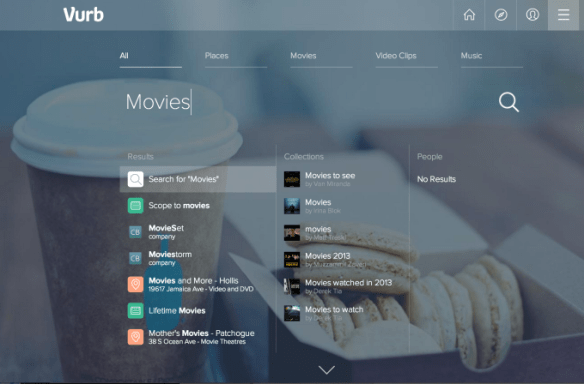
Vurb is a web and mobile contextual search engine. When you type a query in Vurb, you get everything you need without having to leave the search engine. The company is rolling out search for Places, Movies, and Media. It will soon launch search for add People, Startups, and others. For example, if you search for a film, you get a trailer, showtimes, reviews, a link to watch the movie on Netflix, the IMDb score and more.

Read More: And The Winner Of TechCrunch Disrupt NY 2014 Is… Vurb | TechCrunch.

See also: Vurb’s Contextual Search Engine Blows Away Those Stupid Lists Of Links | TechCrunch


Make Google behave: techniques for better results | Karen Blakeman


This Grad Student Hacked Semantic Search To Be Better Than Google | Co.Labs


Full Post

Google may be the dominant search engine, but it’s far from ideal. One major problem: How do you search for things you don’t know exist?

Using Google’s own experimental algorithms, a graduate student may have build a solution: a search engine that allows you to add and subtract search terms for far more intuitive results.

The new search engine, ThisPlusThat.Me, similarly looks for context clues among the terms. For instance: Entering the arithmetic search “Paris – France + Italy” gives the top result as “Rome,” but if I search the same thing in Google, I’ll get directions between Paris and Italy, restaurants in France and Italy, and a depressing Yahoo Answers of whether Italy is in Paris (or vice versa). “Rome,” on the other hand, is an association you, a human, would make (I wantThis, without That but including Those)–and the engine makes that decision based on each answer’s semantic value compared to your search.

Until now, search has been stuck in a paradigm of literal matching, unable to break into conceptual associations and guessing what you mean when you search. There’s a reason Amazon and Netflix have scored points for their item suggestions: They’re thinking how you think.

The engine, created by Astrophysics PhD candidate Christopher Moody, uses Google’s own open-source word2vec algorithm research to take the terms you searched for and ranks the query results by relevance, just like a normal search–except the rankings are based on “vector distances” that have a lot more human sense. So in the above example, other results could have been, say, Napoleon or wine–both have ties with the above search terms, but within the context of City – Country + Other Country, Rome is the vector that has the closest “distance.”

All the word2vec algorithm needs is an appropriate corpus of data to build its word relations on: Moody used Wikipedia’s corpus as a vocabulary and relational base–an obvious advantage in size, but it also had the added benefit of “canonicalizing” terms (is it Paris the city, or Paris from the Trojan War? In Wikipedia, the first is “Paris” and the second “Paris_(mythology).” But millions of search-and-replaces in Wiki’s 42 GB of text was intensive, so Moody used Hadoop’s Map functions to fan those search-and-replaces to several nodes.

A search query then spits out an 8 GB table of vectors with varying distances; Moody tried out a few data search systems before settling on Google’s Numexpr to find the term with the closest vector distance.

via This Grad Student Hacked Semantic Search To Be Better Than Google | Co.Labs | code + community.