Discoverables: Web Service for Skill Discovery | Spark+Mettle


Discoverables. A website that helps young people identify, develop and showcase their key strengths and soft skills to potential employers or investors, progressive organisations and freelancers, instead of posting job descriptions, can discover raw talent through us.

Read More: Discoverables | Spark+Mettle

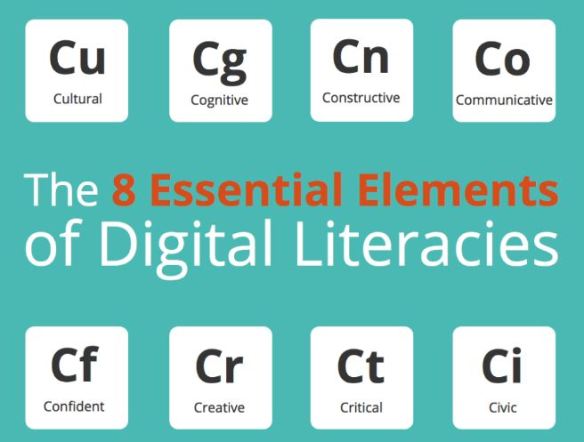
20 Things Educators Need To Know About Digital Literacy Skills | InformED


Teaching digital literacy is about more than just integrating technology into lesson plans; it’s about using technology to understand and enhance modern communication, to locate oneself in digital space, to manage knowledge and experience in the Age of Information.

These are vague descriptions, as are most of the descriptions you’ll find of digital literacy in blog posts and journal articles online. What teachers need, more than a fancy synopsis of how digital publication affects the meaning of a text, is a practical and applicable guide to helping students think productively about the digital world.

[These are] the top do’s and don’ts we’ve come across–in research and in our own experience–when it comes to making students digitally literate. The post reviews 5 Teaching Practices That Destroy Digital Literacy (e.g. criticizing digitalk) and 15 Habits to Cultivate in Your Students (e.g. get used to multiple literacies).

READ: 20 Things Educators Need To Know About Digital Literacy Skills | InformED

SlideRule Searches for the Best Online Courses in Any Category | LifeHacker


Online classes are a great way to learn new skills. SlideRule makes your search easier by letting you browse and search through over 17,000 online courses. READ: SlideRule Searches for the Best Online Courses in Any Category | LifeHacker

Tradecraft Launches A School For Teaching Non-Technical Skills To Tech Workers | TechCrunch


For many companies in Silicon Valley, it’s fairly easy to find, train, and evaluate technical talent — for the most part, it’s easy to determine and quantify how well a person codes. But evaluating and training non-technical personnel is something many struggle with. To help change this, a new school called Tradecraft has emerged to help teach those seeking UX, growth, and sales positions the skills they need to succeed in the tech world.

Tradecraft was founded by Russ Klusas and Misha Chellam, who believe it (or something like it) is necessary to teach necessary skills to non-technical tech workers.

Read: Tradecraft Launches A School For Teaching Non-Technical Skills To Tech Workers | TechCrunch.

Networked Worlds & Networked Enterprises | Pew Research Center


Networked Worlds & Networked Enterprises
Lee Rainie, Director of the Pew Research Center’s Internet Project, shows how the large, loosely knit social circles of networked individuals expand opportunities for learning, problem solving, decision making, and personal interaction.

The new social operating system of “networked individualism” requires us to develop networking skills and strategies, work on maintaining ties, and balance multiple overlapping networks. The “triple revolution” that has brought on this transformation: the rise of social networking, the capacity of the Internet to empower individuals, and the always-on connectivity of mobile devices.

Drawing on extensive evidence, Rainie examines how the move to networked individualism has driven changes in organizational structure, job performance criteria, and the way people interact in workplaces. He presents a glimpse of the new networked enterprise and way of working.


You Don’t Have Enough Tech | Roy Tennant | The Digital Shift


Full Article

You Don’t Have Enough Tech | Roy Tennant | The Digital Shift | November 5, 2013

I recently spoke at the Information Today “Library Leaders Digital Strategy Summit”, a mini-conference held in conjunction with the Internet Librarian Conference in Monterey, California. I was signed up to be on a library technology panel, and to focus on what library managers needed to know about technology. In the execution it was less formal, since the panelists were parceled out among the tables where the participants were sitting while Rebecca Jones and Mike Ridley plied us with questions.

In typical style, I didn’t like the first question, so I answered the question I wish I had been asked. I did this because whenever I address an audience I try to think about the most important thing they should hear and I focus on that. That’s what I told them, and then I said:

“I decided that the single most important thing I can tell you about technology in libraries is this: You don’t have enough techYou don’t have enough technical staff and the staff you have don’t have enough technical knowledge.”

Heads nodded all over the room. Apparently, as I often do, I had stated the obvious. But it opened up a rich vein of discussion that stretched into the buffet lunch that we brought back to our tables. While chatting with one library leader, we agreed that the best way to hire new staff wasn’t by specific experience, but personality characteristics. I even wrote a Library Journal column about it way back in 1998 (see the archived version).

The other part of this is that the day is long past when we should be hiring staff without any sort of technical capabilities. I mean, done. Fully baked. To help illustrate this, I related the fact that I had decided to go to library school to get my masters in the early 1980s. Even then, I knew that computers were going to be important to librarianship. I mean, srsly. However, since I couldn’t stomach the idea of spending years in a basement somewhere (where most computer science students were relegated back in the day), I majored in Geography and minored in Computer Science. I then went to library school to get my Masters, where I had already far surpassed the computer science requirements at the time.

This means that even 30 years ago the handwriting was on the wall. Tech was our future. It still is, only more so. If you are a children’s librarian your charges shouldn’t know more about how to use an iPad than you do. If you fancy yourself a public service librarian you had better know how to troubleshoot public computers and printers.  If you are an archivist you are (or should be) at Ground Zero of your institution’s digitization plans. There are, in other words, no professional positions in a modern library that lack a technical component.

Also, the more technical abilities you bring to your position — any position — the more valuable you will be to your organization. So you decide: how valuable do you want to be?

Meanwhile, as the sun rose higher in the Monterey sky and we looked out from our perch at the top of the Monterey Marriott overlooking the bay, we perhaps could be forgiven for thinking we could see farther than we really could. Today’s world was at least 30 years in the making. We had a warning. We knew this was coming. We have no one to blame but ourselves. You don’t have enough tech.

Your Next Investment: People, Not Projects | Mashable


Many investors say they invest in people, not ideas. Everyone has great ideas, but not everyone has the right mix of intelligence, resourcefulness and determination to execute the idea.

Enter Pave, an impact-investing site that need not be compared to Kickstarter or Indiegogo. Pave is a platform where individuals can back young people’s careers (the average funding goal is $27,000). The idea isn’t new — patrons and angel investors have been around for a while — but the technological tactics are new, and the platform helps to level the playing for people with big ideas and passion to match. The site launched in December 2012 and has 4,500 prospects and 1,700 backers to date.

Pave prides itself on people, not projects, and the setup enables investors to back someonebased on aligned interests, such as business, education and environment. It’s not a traditional loan, and it’s not a donation — the point isn’t for the prospect to pay the investor back quickly. The financial backing is a way for established individuals to help young, ambitious people build sustainable careers and projects over the next 10 years — and the prospects can spend money how they see fit. Backers earn financial returns for supporting successful prospects, and they often evolve into mentors for the prospect, though that’s not written into the funding agreement.

Read more: Your Next Investment: People, Not Projects | Mashable

Mozilla Promotes ‘Web Competency’ with New Standards | The Digital Shift


 The Mozilla Foundation has launched a new  Web Literacy Standard intended to serve as a roadmap for competent Web use and comprising “the skills and competencies people need to read, write, and participate effectively on the Web,” according to Mozilla’s site.

Launched during the nonprofit organization’s October 25–27 Mozilla Festival, the Standard features recommendations for proficiency in three main categories: Exploring (navigating for the Web), Building (creating for the Web), and Collecting (participation on the Web).  The release of the Standard follows months of development and community feedback since the project was inaugurated in February 2013.

Read: Mozilla Promotes ‘Web Competency’ with New Standards | The Digital Shift.

Skilled for Life – Key findings from the survey of adult skills | OECD Education


Mapping Creative Spaces Around The World | Co.Exist


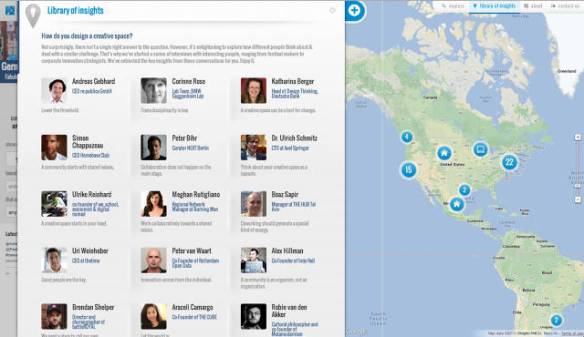
If you’re looking for a creative space–a place to work that truly fosters collaboration, a place to learn new skills, a community of like-minded artists and entrepreneurs–you probably look on Yelp or do a Google search. That won’t yield much. These spaces are scattered across Yelp categories, and a Google search for “creative spaces” shows just a smattering of local spots. That’s what Berlin-based consulting studio ignore gravity discovered while researching creative spaces around the world.

So the studio pulled together data on hundreds of creative spaces and presented them in the Creative Space Explorer, a tool that lets users pinpoint creative spaces on a global map–and add their own. ” We define ‘creative space’ as an enviro that consciously is set up to trigger collaboration in a creative way,'” explains Max Krüger, one of the creators of Creative Space Explorer.

See the full article: Mapping Creative Spaces Around The World | Co.Exist | ideas + impact.

Mapping Creative Spaces Around The World | Co.Exist | ideas + impact