16 Conference Networking Tips for Educators and Librarians | OEDB.org


Summer is conference season for many in the library and educational fields, and there’s no better time to make new contacts and network than at a conference. Not all of us are natural networkers however, myself included!, so I’ve gathered some tips and tricks for conference goers that you may find useful. What I’ve found most helpful personally is preparing before the event so that I have a plan and some groundwork already in place. And I can’t stress enough how handy social media is with regard to event networking so be sure to take advantage of social tools such as Twitter, blogs, LinkedIn, Facebook, etc. to make yourself more visible and also for interacting with others at the conference.

READ: 16 Conference Networking Tips for Educators and Librarians | OEDB.org

Social Media for Recruitment – Infographic | Staff.com


Social Media for Recruitment – Infographic | Staff.com Blog
Social Media for Recruitment - Infographic
Staff.com – Connecting Great Companies with Global Talent

6 Steps To Building A Killer LinkedIn Profile Infographic | Fast Company


There are undeniable benefits to networking with professionals on linkedin, but you’re not the only person who thinks so. Here’s how to compete with the other 277+ million people looking for opportunities.

Read about all six steps here: 6 Steps To Building A Killer LinkedIn Profile Infographic | Fast Company | Business + Innovation.

Full infographic from LinkHumans below.

6 Steps To Building A Killer LinkedIn Profile Infographic | Fast Company | Business + Innovation


This Scientist Uses The New York Times Archive To Eerily, Accurately Predict The Future | Co.Exist


The New York Times might be a widely respected chronicler of past events, but can we use it to divine the future? Kira Radinsky, a 27-year-old Israeli computer prodigy dubbed the “web prophet” says yes.

Radinsky, who appeared this year on MIT’s prestigious list of top 35 inventors under the age of 35 (previous winners include the likes of Mark Zuckerberg, Larry Page, and Sergey Brin), and who started university at the age of 15 and received her Ph.D. in computer science at 26, has developed a unique system which she claims has already predicted the first cholera epidemic in Cuba in many decades, many of the riots that started the Arab Spring, and other important world events.

The complex computer algorithms she wrote collect immense volumes of electronic data–most notably several decades of New York Times archives but also anything from Twitter feeds to Wikipedia entries–and processes it to extract little-known cause and effect patterns that can be used to predict future events.

Red more: This Scientist Uses The New York Times Archive To Eerily, Accurately Predict The Future | Co.Exist

Infographic: Social Media For Social Good | Marketing Technology Blog

Image


Social Media for Social Good

Storytelling in 2014 | Gary Vaynerchuk


10 Surprising Social Media Statistics That Will Make You Rethink Your Social Strategy | Fast Company


If you’re managing social media for your business, it might be useful to know about some of the most surprising social media statistics this year. Here are 10 that might make you rethink the way you’re approaching social media.

Read: 10 Surprising Social Media Statistics That Will Make You Rethink Your Social Strategy | Fast Company | Business + Innovation.

Bosses May Use Social Media to Discriminate | WSJ.com


Many companies regularly look up job applicants online as part of the hiring process. A new study suggests they may also use what they find to discriminate.

The study, a Carnegie Mellon University experiment involving dummy résumés and social-media profiles, found that between 10% and a third of U.S. firms searched social networks for job applicants’ information early in the hiring process. In those cases, candidates whose public Facebook profiles indicated they were Muslim were less likely to be called for interviews than Christian applicants. The difference was particularly pronounced in parts of the country where more people identify themselves as conservative. In those places, Christian applicants got callbacks 17% of the time, compared with about 2% for Muslims.

The same experiment, conducted from February to July of this year, found that online disclosures about job candidates’ sexuality had no detectable impact on employers’ early interest.

The research is the latest example of how people’s digital trails can have far-reaching and unintended effects, particularly in the job market.

Read the rest of the story: Bosses May Use Social Media to Discriminate | WSJ.com.

3 Ways to Use Social Media for Fundraising | See3 Communications


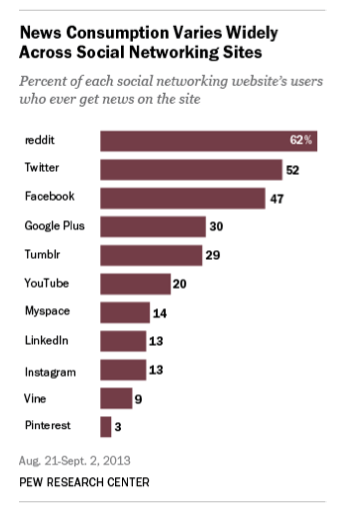
Pew Social Media Study: 30% Of The U.S. Gets News Via Facebook; Reddit Has The Most News-Hungry Regular Users | TechCrunch


The Pew Research Center is today releasing comparative numbers looking at how U.S. adults use social networking sites to read news (a follow-on from earlier research focusing on two specific sites, Facebook and Twitter).

This is significant for a couple of reasons. Social media sites have become a key component of how many news organizations today are looking to reach consumers as old-media forms like printed editions continue to decline. In turn, social media sites are turning news a way of attracting more eyeballs to improve their own ad-based businesses. That is to say, news and social media are dancing partners that are still working out how to move in the same direction without stepping on each other’s feet, and this survey is one indicator of how well the public is receiving that.

Read more and see all the charts: Pew Social Media Study: 30% Of The U.S. Gets News Via Facebook; Reddit Has The Most News-Hungry Regular Users | TechCrunch.

Pew: News Consumption