Short on social skills? Debrett’s to teach young jobseekers manners (at £1,000 a go) | theguardian.com


Snip: They are not ignoring new technology, and will offer guidance on “netiquette”: when to put a smiley face or kisses on an email (never in the workplace) and why you should never text the boss unless they have texted you first. Debrett’s developed its programme on “social intelligence” for under-30s after a survey of business leaders threw up some serious issues around young people entering the modern workplace.

Read the full story: Short on social skills? Debrett’s to teach young jobseekers manners (at £1,000 a go) | theguardian.com.

Tech Titans And Online Education Orgs Team Up With The Open Education Alliance | TechCrunch


Google, AT&T and a host of online education organizations are forming an alliance to develop standards for career readiness. Spearheaded by Massively Open Online Course (MOOC) provider, Udacity, the Open Education Alliance will explore standards for how to prepare and evaluate graduates. The still-forming group of technology companies will help online education providers develop courses, tests, and certifications meant to supplement the use of a college degree in the hiring process.

See the full story: Tech Titans And Online Education Orgs Team Up With The Open Education Alliance | TechCrunch.

Great Web Tools | edtechteacher.org


In order to help educators integrate technology effectively, we have compiled a list of technology tools focused on learning goals consistent with the CRCD [collect-relate-create-donate] framework. Unlike other lists that promote “cool tools,” yet leave teachers wondering about purposeful educational integration, our list is driven by specific learning goals that promote critical-thinking, creativity, collaboration, and community-mindedness. We hope you will find our list useful.

What are your Learning Goals?

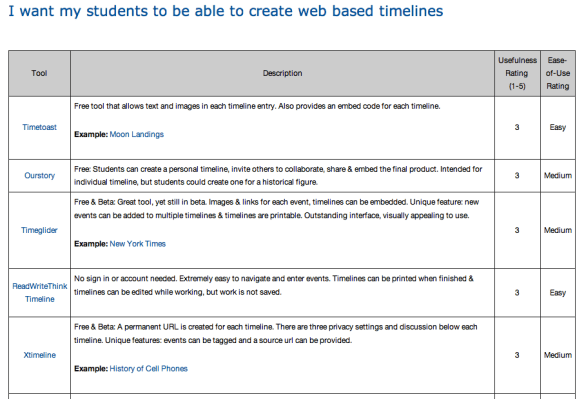
  1. I want my students to be able to create web based timelines.
  2. I want my students to create web based mind maps / graphic organizers.
  3. I want my students to publish their writing online for others to read.
  4. I want real-time, online discussion with my students.
  5. I want my students to search and evaluate web sites.
  6. I want to create guided research activities for my students.
  7. I want to connect my students to other students around the world.
  8. I want my students to create online portfolios.
  9. I want my students to create books, magazines, posters, or newsletters online.
  10. I want my students to record or edit audio.
  11. I want to use an interactive whiteboard effectively with my students.
  12. I want my students to create and edit maps.
  13. I want my students to draw or create comics on the Internet.
  14. I want to create tests, quizzes, and games online.
  15. I want my students to organize, bookmark and edit their research online.
  16. I want to find or create rubrics for multimedia projects.
  17. I want to connect to other teachers to share ideas and resources.

A comprehensive resource recommending a variety of tech according to each learning goal, as listed above. This is also a great resource for anyone looking for unique tech tools related to the activities listed.
techtools

via Great Web Tools | edtechteacher.org.

University of Texas at Austin Online Class Aims to Earn Millions | WSJ.com


Two University of Texas at Austin professors this week launched their introductory psychology class from a makeshift studio, with a goal of eventually enrolling 10,000 students at $550 a pop and bringing home millions for the school.

The professors have dubbed the class a SMOC—Synchronous Massive Online Class—and their effort falls somewhere between a MOOC, or Massive Open Online Course, a late-night television show and a real-time research experiment. The professors lecture into a camera and students watch on their computers or mobile devices, in real time.

The class, which made its debut [August 29, 2013], is emblematic of just how quickly the once-static business model of higher education is shifting as technology gives students more options and forces schools and professors to compete for their attention.

See the full story: University of Texas at Austin Online Class Aims to Earn Millions | WSJ.com.

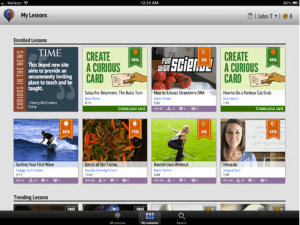
Curious Brings Its “Learn Anything” Marketplace And Video Lesson Library To The iPad | TechCrunch


Perusing the Web, one quickly finds that learning platforms lean toward more academic subjects and mastery — online classes and courses — but what about more practical learning content and instruction? Sure, YouTube is rife with “how-to” videos, but separating the signal from the noise can take a lot of time.

It’s this problem (or opportunity) that led Justin Kitch to launch Curious back in May…Kitch saw an opportunity to capitalize on the rise of video-based education and offer curious minds, hobbyists and lifelong learners a place to peruse and find how-to content on any subject.

Like a combination of Skillshare and Udemy, Curious essentially aims to be a marketplace of how-to videos, allowing those experts and those who want to teach with those eager to learn from them…in a way that’s more targeted, navigable and interactive than YouTube.

Curious for iPad and Curious on the web.

Curious

via Curious Brings Its “Learn Anything” Marketplace And Video Lesson Library To The iPad | TechCrunch.

‘Teachers on Pinterest’ Offers Education-Based Inspiration | PCMag.com


[T]his week announced a new effortto support “a community of creative, inspiring and hard-working people who make a difference to millions of kids everyday” — teachers.

A number of elementary school educators have already joined the fray, partnering on the launch of Teachers on Pinterest, where teachers can find everything from lesson plans for different grades to classroom decorating ideas.

Pinterest is also working with the online educators’ resource Edutopia to continue building the website’s education-focused community.

See the full story: ‘Teachers on Pinterest’ Offers Education-Based Inspiration | News & Opinion | PCMag.com.

Pinterest

A Computer To Teach You Not To Act Like A Computer | Co.Exist


Technology enthusiasts who spend their days playing with computers and robots often have the amount of social graces of the machines they’re programming. So it’s either a brilliant or incredibly off-base intervention that an MIT graduate student has designed computer software to attempt to teach the socially-maladjusted how to be more sociable, via a Siri-like virtual conversation coach.

The program, called My Automated Conversation Coach (MACH), “uses a computer-generated onscreen face, along with facial, speech, and behavior analysis and synthesis software, to simulate face-to-face conversations,” according to a press release. “It then provides users with feedback on their interactions,” for example, how good was their eye contact, which words did they emphasize, how did their voice rise and fall.

via A Computer To Teach You Not To Act Like A Computer | Co.Exist: World changing ideas and innovation.

Joyce Valenza’s Picks from the Top 25 Websites for Teaching and Learning | The Digital Shift


Teacher librarian Joyce Valenza reflects on the 2013 Best Websites for Teaching & Learning, the highly anticipated list chosen annually by the American Association of School Librarians (AASL).

See the complete post: Joyce Valenza’s Picks from the Top 25 Websites for Teaching and Learning | The Digital Shift.