Duke’s Legacy: Video Game Source Disc Preservation at the Library of Congress | The Signal: Digital Preservation


Duke’s Legacy: Video Game Source Disc Preservation at the Library of Congress | The Signal: Digital Preservation

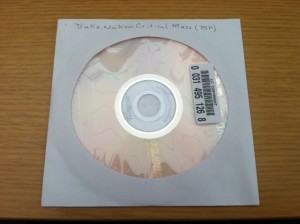
Several months ago, while performing an inventory of recently acquired video games, I happened upon a DVD-R labeled Duke Nukem: Critical Mass PSP. My first assumption was that the disc, like so many others we have received, was a DVD-R of gameplay. However, a line of text on the Copyright database record for the item intrigued me. It reads: Authorship: Entire video game; computer code; artwork; and music. I placed the disc into my computer’s DVD drive to discover that the DVD-R did not contain video, but instead a file directory, including every asset used to make up the game in a wide variety of proprietary formats. Upon further research, I discovered that the Playstation Portable version of Duke Nukem: Critical Mass was never actually released commercially and was in fact a very different beast than the Nintendo DS version of the game which did see release. I realized then that in my computer was the source disc used to author the UMD for an unreleased PlayStation Portable game. I could feel the lump in my throat. I felt as though I had solved the wizard’s riddle and unlocked the secret door.
READ MORE: Duke’s Legacy: Video Game Source Disc Preservation at the Library of Congress | The Signal: Digital Preservation.

MIT Develops a Phone Screen That Corrects Poor Vision | WIRED


Researchers from MIT and the University of California, Berkeley have created a prototype for a new display technology that can automatically correct for vision defects. Think of it as glasses for your iPad. Or your phone, or your car dashboard or any number of screen-based devices you have in your life. The point being, someday in the not too distant future you won’t need to wear glasses anymore to do certain tasks.

READ MORE: MIT Develops a Phone Screen That Corrects Poor Vision | Design | WIRED.

20 Things Educators Need To Know About Digital Literacy Skills | InformED


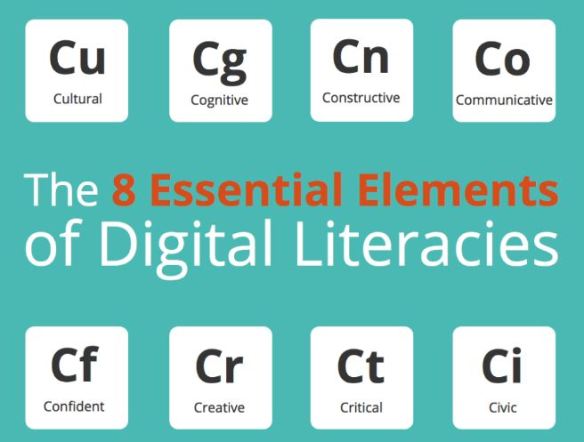
Teaching digital literacy is about more than just integrating technology into lesson plans; it’s about using technology to understand and enhance modern communication, to locate oneself in digital space, to manage knowledge and experience in the Age of Information.

These are vague descriptions, as are most of the descriptions you’ll find of digital literacy in blog posts and journal articles online. What teachers need, more than a fancy synopsis of how digital publication affects the meaning of a text, is a practical and applicable guide to helping students think productively about the digital world.

[These are] the top do’s and don’ts we’ve come across–in research and in our own experience–when it comes to making students digitally literate. The post reviews 5 Teaching Practices That Destroy Digital Literacy (e.g. criticizing digitalk) and 15 Habits to Cultivate in Your Students (e.g. get used to multiple literacies).

READ: 20 Things Educators Need To Know About Digital Literacy Skills | InformED

Top 30 Applications of Google Glass in Education [Interactive Infographic] | OpenColleges


The future is now. With Google Glass, teachers and students alike can display information in a smartphone-like hands-free format, while interacting with the Internet via natural language voice commands. With limitless possibilities at its fingertips, the education community can build closer working relationships with students, and allow children to get more involved with their learning experience. Open Colleges takes a look at how Google Glass might be used in education.

Click the link to EXPLORE all the possibilities illustrated within this interactive infographic: Top 30 Applications of Google Glass in Education  | OpenColleges


How Google Glass might be used in Education – An infographic by the team at Open Colleges

Absolutely fabulist: The computer program that writes fables | CNET


Forget a thousand monkeys at a thousand typewriters, researchers have created a computer program that writes fables by itself.

It might be a long way from “A Tale of Two Cities”, but researchers at Australia’s University of New South Wales have developed a computer program that is capable of writing its own fables.

The Moral Storytelling System, known as MOSS, has been developed by Margaret Sarlej, a PhD candidate at the School of Computer Science and Engineering at UNSW, led by Australian Research Fellow and artificial intelligence expert Dr Malcolm Ryan.

While humans are capable of creating simple or complex stories without a second thought, Sarlej said this is a skill that computers can’t easily emulate.

READ MORE: Absolutely fabulist: The computer program that writes fables | CNET.

A Short History of Photographic Camera [Infographic] | Visual.ly


A Short History of Photographic Camera | Visual.ly

A Short History of Photographic Camera | Visual.ly

24 Of Designs Most Important Principles, Animated | Co.Design


Although not anyone can be a designer, everyone who wants to can learn the elements of visual design: contrast, transparency, hierarchy, randomness, and so on. In fact, it doesnt even take all that long. Just watch this 50-second video. Animated by Toronto-based art director and motion designer Matt Greenwood, this video walks you through 24 of the most important visual design principles, ranging from rhythm to texture to color. It wont teach you everything you need to know to be a designer, but its a good start.

via 24 Of Designs Most Important Principles, Animated | Co.Design | business + design

Tech sector struggling with gender diversity says key is to involve girls | Toronto Star


Tech companies have long been criticized for their lack of female employees, especially in management and engineering roles. In the last few years, however, the industry has taken note of the gender disparity and it is slowly changing.

READ: Tech sector struggling with gender diversity says key is to involve girls | Toronto Star

Comixology DRM-Free Comics | $1 for Access to 15,000 Marvel Comics | Gizmodo


You Can Finally Download DRM-Free Comic Book Backups From Comixology | Gizmodo
The biggest digital comic book distributor in all of digital comics land, Comixology, just took a relatively unprecedented move for a platform its size. Customers will now be able to download DRM-free backups—meaning when you buy a book, you’ll finally get to own it, too.

You Can Access 15,000 Marvel Comics Right Now For a Buck | Gizmodo
As we all prepare our brains and Twitter feeds for the unstoppable flood of comics and entertainment news that will pour out of San Diego Comic-Con, Marvel announced some news in the quiet before the storm. Now, for 99 cents, readers can gain access to Marvel Unlimited, the publisher’s treasure trove of 15,000 issues from current series (well, at least six months old) and classic golden- and silver-age titles. You can also store up to 12 issues offline so you can read without a reliable Wi-Fi connection. As long as you have a Mac, PC, iOS, or Android device, you’re in business.


Bibliotheca Bible Project Blows Up On Kickstarter With Chapterless Bible | HuffPo


Graphic artist and book designer Adam Lewis Greene has envisioned a Bible without chapters and his idea has found incredible success on the crowd-funding site Kickstarter. He hopes his design will emphasize the role of the Bible as a great literary text by taking away conventions which have been added to increase its usability as a tool for study.

The website describes Bibliotheca as “The entire biblical library in four elegant volumes, designed purely for reading. The text is reverently treated in classic typographic style, free of all added conventions such as chapter numbers, verse numbers, section headers, cross references and notes.”

READ: Bibliotheca Bible Project Blows Up On Kickstarter With Chapterless Bible | HuffPo