Bill Gates Unveiled Windows 30 Years Ago | Gizmodo


No matter what you think of Windows 8, it’s certain that Windows is both iconic and significant in the evolution of personal computing. It’s a series of operating systems, of course, but it’s also been a concept, a way of thinking, an influencer, and a touchstone for 30 years since Bill Gates introduced it on November 10, 1983.

The “Interface Manager” that would become Windows went into development in 1981 and finally had its public release as Windows 1.0 in November 1985. This first stab wasn’t actually a full OS, but more of a “graphical shell” that extended MS-DOS to have a user interface, as it is known today.

But Windows 1.0 had many defining OS features, like a calendar, clock, Microsoft Paint, a text editor, terminal, and clipboard. Windows allowed users to view multiple program windows at once, yup, though they couldn’t overlap at all. The early days of tiles! And 1.0 enabled data transfer between programs. Plus, it came with drivers for things like keyboards and the Microsoft Mouse, which had debuted earlier in 1983.

30 years seems simultaneously like an incredibly long time and a quick blur when you consider how Windows has evolved and spread to dominate between 80% and 90% OS marketshare. Windows 8 made it clear that Microsoft views interactive touch integration as crucial to a PC operating system going forward into the fourth Windows decade. Too bad hyper Ballmer ads won’t be the face of the next era.

Bill Gates Unveiled Windows 30 Years Ago Today | Gizmodo.

Have Your Mac Read A Book To You In Mavericks And iBooks [OS X Tips] | Cult of Mac


Full Post

Have Your Mac Read A Book To You In Mavericks And iBooks [OS X Tips] | Cult of Mac

For those of you who might want to listen to a book via iBooks, one option is to load an iBook on your iPhone or iPad and turn on VoiceOver.

That can change the way your iOS device works, though, so it can be tricky to the uninitiated.

Now that iBooks is on Mavericks, however, you have another option: get your Mac to read your iBook to you.

If you’ve upgraded to Mavericks (and you should, it’s free and optimized for older machines), you have a copy of iBooks on your Mac. Launch it with a double click to the iBooks icon in the Dock or the Applications folder, and then double click one of your iBooks to open it.

Click your mouse in front of where you’d like your MAc to start reading to you, and then head up to the Edit menu. Select the Speech option in the menu, and then choose “Start Speaking.” Your Mac will read to you in the voice that’s chosen in the System Preferences Dictation & Speech preference pane.

Your Mac will keep reading the book until you choose Stop Speaking in the same Edit > Speech menu, though it won’t turn pages when it gets to a new page. If you want to follow along while it reads (a great option for folks with print or other reading disabilities), you’ll need to click the arrow keys or swipe along your trackpad as you go.

If you just want to have your Mac read a selection of text to you, simply click and drag to highlight that section, and then choose Start Speaking from the Edit menu, or right-click and choose Start Speaking from the More option in the contextual menu.

via Have Your Mac Read A Book To You In Mavericks And iBooks [OS X Tips] | Cult of Mac.

Study: What You Would Be Doing If You Spent Less Time Online | The Atlantic


Most of us have heard our parents or grandparents complain that the digital age has corrupted the youth and taken them away from doing “better things.” Whether or not this is an accurate assessment, no one had ever really figured out how much our computer time cuts into other activities—at least not until now. New research from Scott Wallsten, an economist at the Technology Policy Institute in Washington, D.C., attempts to show exactly what Americans are missing out on because they’re glued to their computer screens.

Wallsten limits his study to “online leisure,” or time spent online doing things like combing social networks, browsing for non-work purposes, instant messaging, etc. (Online games—even though they can take up a lot of leisure time—are excluded because of the way the data Wallsten used are collected by the US Census Bureau. Despite the data’s shortcomings, Wallsten finds that online leisure time still crowds out other activities.)

See the charts and read more: Study: What You Would Be Doing If You Spent Less Time Online – Simone Foxman | The Atlantic.

Upstagram Is A Flying Raspberry Pi That Publishes Live Pictures On Instagram | TechCrunch


What do Instagram, the Raspberry Pi and the movie “Up” have in common? When you mash all these things together, you get Upstagram, a neat hack that the Hackerloop team just unveiled.

First, the team made a replica of the house in “Up” using paper and foam. It was just big enough to fit a Raspberry Pi and its camera, a battery and a 3G hotspot. The Raspberry Pi, an open source and very cheap mini-computer to tweak, experiment and try new things with, is a hacker’s dream.

Then, the team used about 90 helium balloons to make the house fly above Paris’ landscape. While Instagram is only available on iOS and Android, they reverse-engineered the posting process to transform the Raspberry Pi into an Instagram-taking machine.

Read more: Upstagram Is A Flying Raspberry Pi That Publishes Live Pictures On Instagram | TechCrunch.

Life with Raspberry Pi: Sparking a School Coding Revolution | The Digital Shift


Our classroom glows with activity. One kid drafts a how-to article in which he explains the steps involved in wiring a cardboard Minecraft controller. Another writes a branching-path, choose-your-own-adventure story in Twine, a free, downloadable interactive fiction app. A student who’s claimed throughout his middle-school career that he isn’t a writer leans close to his laptop screen, finding and fixing coding errors. He composes, compiles, and debugs more than 100 lines of code to light up a three-by-three-light LED display plugged into his laptop.

A pair of especially curious students sits huddled around our newest computer, an exposed-faced circuit board smaller than a paperback book. It’s called a Raspberry Pi. They’re watching how the code they write in one window changes the course of a game in another. They may not know it yet, but these kids are playing with an open-source computing platform that just might change the way we teach young people how to interact with computers.

Read: Life with Raspberry Pi: Sparking a School Coding Revolution | The Digital Shift.

A Future Internet Might Not Use Servers | Gizmodo


You’d think that given how pervasive the internet is, we’d be stuck with the fundamental architecture it uses: servers that many devices connect to for their information fix. But a team of Cambridge University scientists wants to shake things up—and remove servers altogether.

A project named Pursuit aims to make the internet faster, safer and more social by implementing a completely new architecture. The system does away with the need for computers to connect directly to servers, instead having individual computers being able to copy and re-publish content on receipt. That would allow other computers to access data—or, at least, fragments of data—from many locations at once.

Read: A Future Internet Might Not Use Servers | Gizmodo.

Screw Teaching Your Kids–Get This Robot Instead | Co.Labs


Gupta set out to find a way to teach very young children the basics of coding–sequences of instructions, subroutines, events, conditional statements–in a playful way. Today Play-i launched a crowdfunding campaign to raise $250,000 to manufacture two kid-friendly robots called Bo and Yana, which teach high-level programming concepts to children as as young as five.

Read more: Screw Teaching Your Kids–Get This Robot Instead ⚙ Co.Labs ⚙ code + community.

Apple releases OS X Mavericks for free | CNET News


Mac users can have Apple’s latest Mac operating system, OS X Mavericks, for free, the company announced Tuesday at an event in San Francisco.

“Today we’re going to revolutionize pricing,” Craig Federighi, Apple’s chief of iOS and OS X, said. The software is available today.

Apple introduced the system in June at its developers’ conference. The company touted its extended battery life, tabs, and tags, while demonstrating new features in Safari, Maps, and iBooks.

Federighi reiterated the new features at Tuesday’s event. A 13-inch MacBook Air with Mavericks gets up to an hour more of Web browsing and up to 1.5 hours more iTunes movie playback, he said.

He also explained how the system adjusts its memory based on the task. This allows for optimal quality when you’re running a graphics-heavy program — and speed when you’re not. He also highlighted the iBook app, in which photos and videos can pop out of a textbook, and an iCloud keychain, which syncs payment information for online purchases.

CNET’s Jason Parker said in June that the OS is faster and easier to use, and apps have a cleaner look.

via Apple releases OS X Mavericks for free | CNET News.

The 15 Countries Where The Most Young People Are Online | Co.Exist


Full Article

What did children do before computers? If the future goes the way of babies with iPads, it’s a question we might be asking ourselves soon. But if you’re between 15 and 24 years old and live in the United States, there’s already a good chance you grew up playing around with MS Paint. According to a new report out from the UN’s International Telecommunication Union (ITU), growing up with the Internet qualifies you as a “digital native,” and some countries have a far higher proportion of them than others.

The results, however, might surprise you.
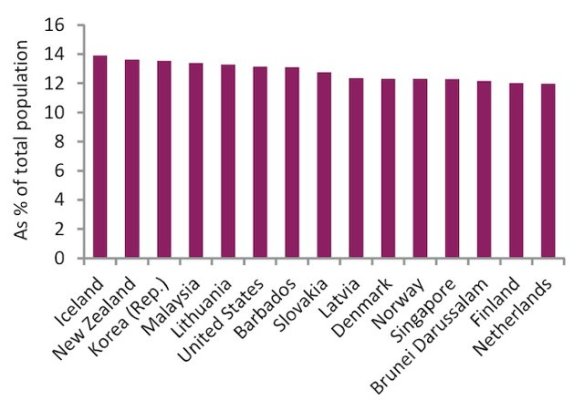
The 15 Countries Where The Most Young People Are Online | Co.Exist | ideas + impactSource: ITU

Out of a global population of 7 billion, 363 million of us have grown up “surrounded by and using tools and toys of the digital age.” China and India boast the largest number of these people, but digital natives only make up a relative minority of their respective populations. When it comes to countries with the highest percentages of digital natives, the United States actually comes in sixth place, below Lithuania and Malaysia.

Iceland, however, ranks number one in digital native penetration, with 14% of the Icelandic population having grown up on computers. That makes sense, given that Iceland has the highest percentage of young people in Europe (and a small population). New Zealand makes number two on the list for the same reason. South Korea, meanwhile, ranks third largely because of high Internet use among all youth and its government’s aggressive investment in educational technology: By 2015, all Korean schools will provide cloud-based learning services to students.

Malaysia comes in fourth place on the list, and for striking reasons. Unlike Iceland or New Zealand, Malaysia doesn’t have a particularly high concentration of 15-to-24 year-olds. But like South Korea, the young people who do live in Malaysia have spent more time with the Internet: By 2012, 74.4% of youths had at least five years of Internet experience under their belts. Much of that, explains the report, can be attributed to the fact that the Malaysia has brought so many of its schools online, and by 2000 had already stocked 31% of its primary schools and 54% of its secondary schools with computer facilities.
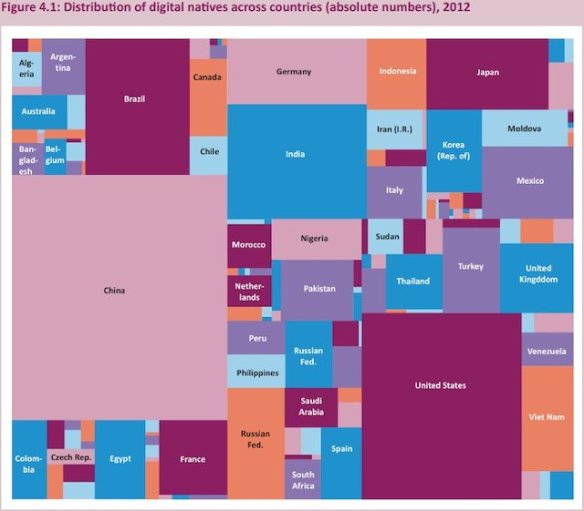
The 15 Countries Where The Most Young People Are Online | Co.Exist | ideas + impactAbsolute numbers of digital natives by country. Source: ITU

Starting in January of this year, Malaysian 21-to-30-year-olds have been able to score $65 rebates on certain smartphones, courtesy of government subsidies. The country’s National Broadband Initiative has set about dramatically lowering costs of accessing the Internet, including launching the 1 Million Netbooks program, which distributes netbooks to low-income families.

The report notes that proportions of digital natives largely stick to levels of economic development. In high-income, developed countries, digital natives with five years of Internet experience or more make up 86% of young Internet users, while in the developing world, digital natives only count as 47% of young Internet users. The global average comes to slightly more: Digital natives make up 56% of all young Internet users–more than 362 million people worldwide.

via The 15 Countries Where The Most Young People Are Online | Co.Exist | ideas + impact.

OverDrive announces new APIs for Library Circulation | OverDrive


Last year we introduced the initial set of OverDrive APIs that enable approved vendors to deeply integrate OverDrive-hosted catalogs and nearly 1 million digital titles with their apps and platforms. These included the ability to access catalog metadata, see availability of a title and search the library’s collection.

Today, we are excited to announce that the all-new Circulation APIs are available on the OverDrive Developer Portal. The Circulation APIs will allow approved partners to request checkouts, downloads, holds, and returns from within their own discovery interface. This means users will now be able to browse and search their library’s digital collection, see what’s available and check out a title or place a hold all without ever leaving the library OPAC.

Read: OverDrive announces new APIs for Library Circulation | OverDrive.